• Research
  • Strategic Europe
  • About
  • Experts
Carnegie Europe logoCarnegie lettermark logo
EUUkraine
  • Donate
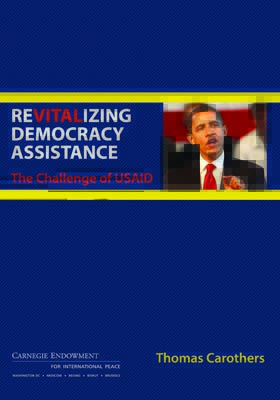
Revitalizing Democracy Assistance: The Challenge of USAID
Report

Revitalizing Democracy Assistance: The Challenge of USAID

USAID—the largest source of U.S. democracy assistance—requires deep-reaching reforms if the Obama administration hopes to adequately address challenges to democracy around the world.

Link Copied
By Thomas Carothers
Published on Oct 27, 2009

Additional Links

Full TextSummary

Democracy is largely stagnant in the world and a growing number of governments exhibit hostility toward international democracy aid. Faced with this daunting context, President Obama and his foreign policy team have so far moved only cautiously to formulate an approach to democracy promotion. Tackling longstanding problems with the basic structures of U.S. democracy aid would boost this effort. As the largest source of such assistance, USAID is an obvious starting point for deep-reaching reforms.

Key Conclusions

  • With the Obama administration having launched major reviews of development policy, a critical juncture exists for substantial reforms of USAID and other key actors in U.S. democracy assistance, a domain that now consists of $2.5 billion a year of aid programs in more than 80 countries.
     
  • Although USAID has a long record of positive contributions to numerous democratic transitions, its accumulated institutional woes lead to democracy aid efforts that fall short due to lack of flexibility, stifled innovation, and lack of institutional commitment.
     
  • Fixing USAID’s shortcomings will require determined, focused leadership at USAID, with active support from Congress and the Obama administration. As Congress and the administration take up the larger overhaul of U.S. development policy generally, they should not neglect the domain of democracy and governance support. 


Recommendations

  • Fight bureaucratization: The crushing bureaucratization of USAID’s democracy and governance work must be reversed through a comprehensive series of reforms that simplify the procurement process, eliminate duplicative layers of oversight, reduce reporting requirements, and improve the evaluation process.
     
  • Bolster local ownership: USAID should build more flexible funding arrangements with its implementing partners that encourage genuine partnerships with local groups and increase direct funding to local organizations. 
     
  • Strengthen the place of democracy and governance work within USAID: Ensure that democracy and governance is fully supported as an institutional priority and is well-integrated into other areas of foreign assistance, through clear leadership commitment at the top and numerous steps at other levels, such as strengthening the Office of Democracy and Governance and following through on new training commitments. 


“A successful revitalization of USAID’s democracy and governance work would be a telling signal that the Obama administration is forging significant institutional changes that will help the United States meet the serious challenges that democracy’s uncertain global fortunes now pose.”

About the Author

Thomas Carothers

Harvey V. Fineberg Chair for Democracy Studies; Director, Democracy, Conflict, and Governance Program

Thomas Carothers, director of the Carnegie Endowment for International Peace’s Democracy, Conflict, and Governance Program, is a leading expert on comparative democratization and international support for democracy.

    Recent Work

  • Commentary
    When Do Mass Protests Topple Autocrats?
      • McKenzie Carrier

      Thomas Carothers, McKenzie Carrier

  • Article
    The Trump Administration’s Tangled Talk About Democracy Abroad
      • McKenzie Carrier

      Thomas Carothers, McKenzie Carrier

Thomas Carothers
Harvey V. Fineberg Chair for Democracy Studies; Director, Democracy, Conflict, and Governance Program
Thomas Carothers
North AmericaUnited StatesPolitical ReformDemocracyForeign Policy

Carnegie does not take institutional positions on public policy issues; the views represented herein are those of the author(s) and do not necessarily reflect the views of Carnegie, its staff, or its trustees.

More Work from Carnegie Europe

  • Commentary
    Strategic Europe
    Taking the Pulse: Is it NATO’s Job to Support Trump’s War of Choice?

    Donald Trump has demanded that European allies send ships to the Strait of Hormuz while his war of choice in Iran rages on. He has constantly berated NATO while the alliance’s secretary-general has emphatically supported him.

      • Rym Momtaz

      Rym Momtaz, ed.

  • Commentary
    Strategic Europe
    Time to Merge the Commission and EEAS

    The EU is structurally incapable of reacting to today’s foreign policy crises. The union must fold the EEAS into the European Commission and create a security council better prepared to take action on the global stage.

      Stefan Lehne

  • Commentary
    Strategic Europe
    Russia’s Imperial Retreat Is Europe’s Strategic Opportunity

    The war in Ukraine is costing Russia its leverage overseas. Across the South Caucasus and Middle East, this presents an opportunity for Europe to pick up the pieces and claim its own sphere of influence.

      William Dixon, Maksym Beznosiuk

  • Commentary
    Is the Radical-Right Threat Existential or Overstated?

    Amid increased polarization and the influence of disinformation, radical-right parties are once again gaining traction across Europe. With landmark elections on the horizon in several countries, are the EU’s geostrategic vision and fundamental values under existential threat?

      Catherine Fieschi, Cas Mudde

  • Commentary
    Strategic Europe
    Europe and the Arab Gulf Must Come Together

    The war in Iran proves the United States is now a destabilizing actor for Europe and the Arab Gulf. From protect their economies and energy supplies to safeguarding their territorial integrity, both regions have much to gain from forming a new kind of partnership together.

      • Rym Momtaz

      Rym Momtaz

Get more news and analysis from
Carnegie Europe
Carnegie Europe logo, white
Rue du Congrès, 151000 Brussels, Belgium
  • Research
  • Strategic Europe
  • About
  • Experts
  • Projects
  • Events
  • Contact
  • Careers
  • Privacy
  • For Media
  • Gender Equality Plan
Get more news and analysis from
Carnegie Europe
© 2026 Carnegie Endowment for International Peace. All rights reserved.