• Research
  • Strategic Europe
  • About
  • Experts
Carnegie Europe logoCarnegie lettermark logo
EUUkraine
  • Donate
Fixing a Failed Strategy in Afghanistan
Report

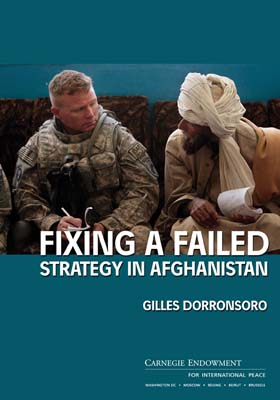
Fixing a Failed Strategy in Afghanistan

To correct a failing strategy in Afghanistan, the United States and its allies need to focus on protecting Afghan cities and reallocating more resources to the North.

Link Copied
By Gilles Dorronsoro
Published on Nov 16, 2009

Additional Links

SynopsisFull Text

As the debate on future U.S. strategy draws to a close, the war in Afghanistan is spreading to the North (an area that had previously been relatively quiet), the balance of power in Afghanistan has shifted in the Taliban’s favor, and the Afghan government continues to lose legitimacy in the eyes of the population and international community. In order to correct a failing strategy, the United States and its allies need to protect cities and reallocate more resources to the North. 

Gilles Dorronsoro explains that more troops alone will not fix a flawed approach and details what a new, successful U.S. strategy should look like: 

  • Secure key cities and roads: If a state can be rebuilt in Afghanistan it will start in the cities, so less energy should be focused on the Pashtun countryside. This approach will decrease Coalition casualties and increase local participation.
     
  • Redistribute Coalition troops: Troops are heavily deployed in the South and East where the prospects for success are low. They should be refocused on the North, where the Taliban can be stopped.
     
  • Redistribute development aid: Development dollars are currently being directed most heavily to areas where Coalition control is weakest. These scarce resources should instead be focused on the more peaceful districts of Afghanistan.
     
  • Build an Afghan partner: Increase the size and capabilities of the Afghan National Army, but understand that this will not happen overnight. An Afghan army of 150,000 by 2015 is a realistic and achievable goal.


“The Coalition badly needs a success in the next few months to counter the widely held perception that defeat is the likely outcome,” concludes Dorronsoro. “The current strategy could very well fail and result in yet another demand for reinforcements next year. A vigorous debate―more about strategy than resources―is needed.”

About the Author

Gilles Dorronsoro

Former Nonresident Scholar, South Asia Program

Dorronsoro’s research focuses on security and political development in Afghanistan. He was a professor of political science at the Sorbonne in Paris and the Institute of Political Studies of Rennes.

    Recent Work

  • Paper
    Waiting for the Taliban in Afghanistan

      Gilles Dorronsoro

  • Paper
    Afghanistan: The Impossible Transition

      Gilles Dorronsoro

Gilles Dorronsoro
Former Nonresident Scholar, South Asia Program
Gilles Dorronsoro
South AsiaAfghanistanSecurityMilitaryForeign Policy

Carnegie does not take institutional positions on public policy issues; the views represented herein are those of the author(s) and do not necessarily reflect the views of Carnegie, its staff, or its trustees.

More Work from Carnegie Europe

  • Commentary
    Strategic Europe
    Russia’s Imperial Retreat Is Europe’s Strategic Opportunity

    The war in Ukraine is costing Russia its leverage overseas. Across the South Caucasus and Middle East, this presents an opportunity for Europe to pick up the pieces and claim its own sphere of influence.

      William Dixon, Maksym Beznosiuk

  • Commentary
    Strategic Europe
    Europe and the Arab Gulf Must Come Together

    The war in Iran proves the United States is now a destabilizing actor for Europe and the Arab Gulf. From protect their economies and energy supplies to safeguarding their territorial integrity, both regions have much to gain from forming a new kind of partnership together.

      • Rym Momtaz

      Rym Momtaz

  • Commentary
    Strategic Europe
    Taking the Pulse: Is France’s New Nuclear Doctrine Ambitious Enough?

    French President Emmanuel Macron has unveiled his country’s new nuclear doctrine. Are the changes he has made enough to reassure France’s European partners in the current geopolitical context?

      • Rym Momtaz

      Rym Momtaz, ed.

  • Commentary
    The Iran War’s Dangerous Fallout for Europe

    The drone strike on the British air base in Akrotiri brings Europe’s proximity to the conflict in Iran into sharp relief. In the fog of war, old tensions in the Eastern Mediterranean risk being reignited, and regional stakeholders must avoid escalation.

      Marc Pierini

  • Trump United Nations multilateralism institutions 2236462680
    Article
    Resetting Cyber Relations with the United States

    For years, the United States anchored global cyber diplomacy. As Washington rethinks its leadership role, the launch of the UN’s Cyber Global Mechanism may test how allies adjust their engagement.

      • Christopher Painter

      Patryk Pawlak, Chris Painter

Get more news and analysis from
Carnegie Europe
Carnegie Europe logo, white
Rue du Congrès, 151000 Brussels, Belgium
  • Research
  • Strategic Europe
  • About
  • Experts
  • Projects
  • Events
  • Contact
  • Careers
  • Privacy
  • For Media
  • Gender Equality Plan
Get more news and analysis from
Carnegie Europe
© 2026 Carnegie Endowment for International Peace. All rights reserved.