

Paper
Alejandro Foxley, Fernando Sossdorf
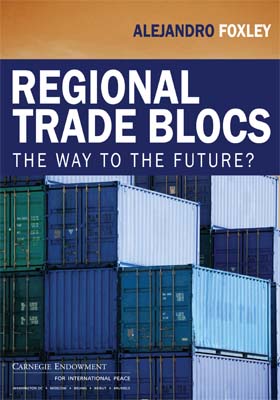
With global trade talks stalled and lower demand from major economies that were hit hard by the global economic crisis, three regions—Eastern Europe, Latin America, and East Asia—are managing to increase trade within their borders and building a broader free trade system.
With global trade talks stalled and lower demand from major economies that were hit hard by the global economic crisis, regional trade agreements are emerging as a way for middle-income countries to increase trade, spur growth, and lower unemployment rates. In a report, Alejandro Foxley analyzes how three regions—Eastern Europe, Latin America, and East Asia—are increasing trade within their borders and building a broader free trade system.
Using the findings from three vastly different experiences, Foxley says that regional trade agreements work best when participating countries have few political differences, coordinate their monetary and fiscal policies, and embrace globalization. And bottom-up approaches in which companies develop regional supply chains are more effective in improving regional integration than top-down approaches imposed by governments.
“Pursuing stronger regional trade agreements can help form the building blocks for global free trade deals,” Foxley writes. “Increasing trade will not only help middle-income economies develop but also drive growth around the world as the financial crisis recedes.”
Former Senior Associate, International Economics Program
Foxley was previously minister of foreign affairs, senator, and minister of finance of the Republic of Chile. While minister of finance he concurrently served as a governor of the Inter-American Development Bank and the World Bank.
Recent Work
Alejandro Foxley, Fernando Sossdorf
Alejandro Foxley
Carnegie does not take institutional positions on public policy issues; the views represented herein are those of the author(s) and do not necessarily reflect the views of Carnegie, its staff, or its trustees.

With its public finances in shambles, the far right polling at 35 percent ahead of the 2027 presidential election, and a growing protest movement, is France’s crisis a threat to the EU’s geopolitical awakening?

Rym Momtaz, ed.

Ahead of a tough winter for Ukraine, Donald Trump’s swing back toward Russia bodes ill. But instead of panicking, Kyiv’s European allies are focusing on action.
Rym Momtaz

Funding Ukraine remains a priority for European leaders. As Russia’s war of aggression heads into another winter, two feasible options to mobilize support for Kyiv should be fast-tracked.


Vladyslav Rashkovan, Gregory P. Wilson

While the EU and European governments are embracing the much-lauded middle-power moment, this entails three difficult conundrums.

Richard Youngs

Europe is facing rising populism internally as well as external pressures from Russia, China, Turkey, and the United States.

Dimitar Bechev