

Paper
Douglas H. Paal
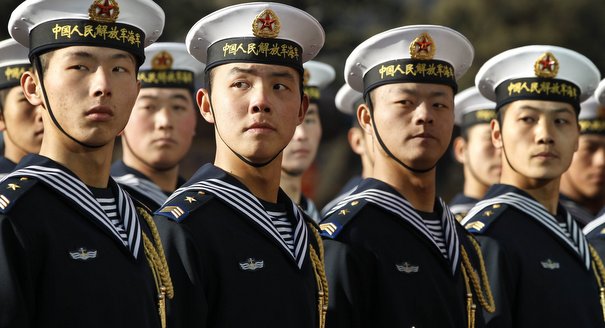
Source: Getty
While China’s new aircraft carrier does not pose a major threat to U.S. forces or allies in the Western Pacific, the United States needs to take steps to communicate this message of reassurance to countries in the region.
In 1966, Hollywood produced a Cold War comedy about a Russian submarine becoming stranded on the shoals of a small New England town. It was a good movie and it nicely captured the misplaced hysteria of the era about Soviet military intentions. It was called The Russians Are Coming! The Russians Are Coming! and I recommend you get it from Netflix.
Now get ready for the Chinese version: not a new movie, but a revived hysteria. China is about to put into operation its first aircraft carrier, rumored to be called Shi Lang, after a seventeenth century admiral who conquered Taiwan. Previously known as the Varyag when it was under construction for the Soviet and later the Ukrainian navies, China acquired the uncompleted carrier in 1998 at auction for $20 million.
Lacking electronics and a propulsion system, the ship was reportedly purchased to serve as a floating casino in Macao, but after a nearly incredible saga of transport from Ukraine and around Africa, it ended up in Dalian in China’s northeast, where it was dry-docked and painted People’s Liberation Army Navy (PLAN) gray. Subsequent activity presumably has involved installing the missing electronics and propulsion systems.
Officially, China was cagey about its intentions for the aircraft carrier. Chinese sources say that there was considerable debate internally over the risks and benefits of acquiring a single carrier or two. On the benefit side are the prestige and sense of having “arrived” as a power. More practically, a test run with a carrier will give the PLAN a more precise estimate of the costs, training, and operational adjustments needed to deploy such a capability effectively, before deciding on additions. For some, the carrier will reduce the difficulties of defending extended Chinese territorial claims in the South China Sea.
As for the risks, some Chinese argued that carriers are not economically or strategically wise in an era of enhanced conventional threats against carrier battle groups. Moreover, a carrier battle group will reinforce suspicions among China’s neighbors of its hostile intent.
It is now clear from gradually released official Chinese statements and news reports that the advocates of carriers won the debate, at least temporarily. Beijing has dribbled out hints that the carrier is coming, possibly out of concern for the reactions of its neighbors, including their own acquisitions for defense against a new perceived threat. It would be wise for Beijing to be cautious about over selling its development too, because of the formidable challenges learning to use carrier capabilities will pose to the PLAN.
Senior American naval officers and many of their colleagues in Asian navies regard the carrier as a manageable threat even if Beijing can learn how to deploy it. Some joke that they hope China will acquire five more battle groups and waste even more money that could go into other, more threatening systems. All say that they will watch China’s efforts at implementation this year closely.
In an interview with Bloomberg, Pacific Commander Admiral Robert Willard recently dismissed the impact of the carrier as largely “symbolic,” but he added that “based on the feedback that we received from our partners and allies in the Pacific, I think the change in perception by the region will be significant.”
For decades, regional states friendly to the United States and suspicious of China have seen American carriers as reassuringly symbolizing the U.S. ability to deter China from aggression against them. This was strongly reinforced in 1996, when former President Clinton dispatched two battle groups to waters near Taiwan in reaction to China’s missile “exercises” intended to intimidate Taipei.
If Beijing, as seems likely, ultimately chooses to use the carrier in operations in the South China Sea, where the United States is a self-professed guarantor of freedom of navigation but not a claimant, some other claimant states may feel the weight of China’s military more acutely than they have in centuries.
All this indicates that Washington and the Pacific Command need to deploy a strategy of regional reassurance as the Chinese carrier itself deploys. One element of this strategy would be to use hearings and public forums to make clear that China’s carrier is vulnerable to counter measures that the United States and its allies already possess. A second element will be public diplomacy that includes regular and high-profile deployments and exercises by American forces in the region.
The Obama administration’s revitalized Asia policy is a good platform. It will be augmented if the administration succeeds in extricating itself from Iraq and Afghanistan and effectively “rebalances” American attention to the Asia Pacific region—still very much a work in progress.
China can be expected to be as cautious as it has been up to now in revealing its new capability in the hope of reducing resistance and gaining acceptance of a new status for the PLAN. Port calls in the region with invitations to locals to visit the ship could eventually mark a new high in China’s currently truculent approach to transparency about the military.
But Beijing will also be tempted to steam its carrier close to Vietnam and perhaps other countries to send a tougher message to neighbors it thinks are too small to be uppity with China. In turn, these neighbors will have to choose between appeasement and deeper entanglement with the United States. And Washington may have to pick and choose those with whom it wishes to get more deeply entangled.
In sum, it makes sense not to overreact to China’s attempt at acquiring a capability already possessed by many countries and which may be in its waning days of war fighting utility anyway. At the same time, it will be necessary to address the perception gap between defense professionals and leaders and the publics in Asia while thinking ahead about some of the choices to come. Maybe there’s a movie to be made.

Distinguished Fellow, Asia Program
Paal previously served as vice chairman of JPMorgan Chase International and as unofficial U.S. representative to Taiwan as director of the American Institute in Taiwan.
Recent Work
Douglas H. Paal


Douglas H. Paal, Tong Zhao, Chen Qi, …
Carnegie does not take institutional positions on public policy issues; the views represented herein are those of the author(s) and do not necessarily reflect the views of Carnegie, its staff, or its trustees.

The hybrid warfare landscape is evolving rapidly, leaving policymakers without clear strategies. To better inform their work in addressing emerging challenges, governments must dig deeper into the underlying dynamics at play.


Raluca Csernatoni, Alicia Wanless

Mounting economic strain and battlefield losses will not necessarily make the Kremlin less dangerous. They could instead push Moscow toward a more aggressive hybrid campaign designed to test NATO’s Eastern flank, exploit allied hesitation, and fracture European resolve.

Maksym Beznosiuk

Over the past ten years, NATO has held almost as many summits as it did during the entirety of the Cold War. Are they still useful, or is it time to stop holding annual meetings?

Rym Momtaz, ed.

As the EU confronts profound challenges, several leaders have called for fundamental reform to the union’s model—but only modest, superficial changes have resulted. What if Europe really could be reimagined from zero today: What should such a redesigned European order look like?

Richard Youngs, ed.
As Russia's war on Ukraine drags on, NATO is expanding its footprint in the Black Sea. Turkey, Romania, and Bulgaria are upgrading their fleets and deepening trilateral cooperation.

Dimitar Bechev