

In The Media
Jessica Tuchman Mathews
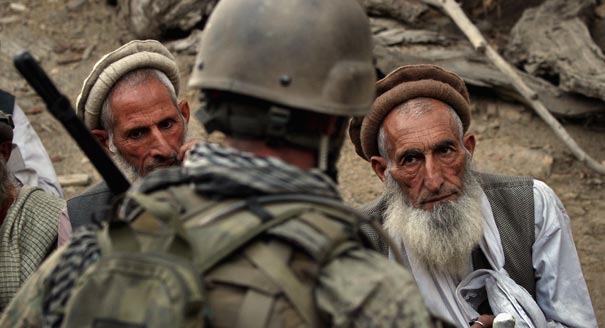
Source: Getty
In his speech, President Obama laid out a less ambitious approach to the war in Afghanistan that abandons the long-term goals of nation building in favor of improved intelligence, special forces, drone attacks, and a smaller footprint in country.
President Obama has emphatically underlined a shift in strategy in Afghanistan far more important than the drawdown numbers. Ironically, after a decade of war, half a trillion dollars, and innumerable strategies, it brings the United States back nearly full circle to the limited “no boots on the ground/special forces/air power” approach of the Bush presidency in 2002-03.
From a focus early in his administration on a broad counterinsurgency strategy aimed at improving the “military, governance, and economic capacity of Afghanistan and Pakistan,” President Obama has moved steadily back towards a counterterrorism strategy narrowly focused on killing al-Qaeda and other terrorist leaders and dismantling the groups’ fighting capability.
What’s absent from Obama’s speech tonight tells the story: nothing about working with the Karzai government; the importance of the civilian surge; combatting debilitating corruption; improving U.S. economic development efforts; or crafting a regional diplomatic strategy to ensure Afghanistan’s long-term stability, all of which have consumed American attention at one time or another. This less ambitious approach abandons the long-term goals of nation building in favor of improved intelligence, special forces, drone attacks, and a smaller footprint in country. Where Gen. Petraeus’ counterinsurgency strategy focuses on civilian welfare and counsels avoiding killing insurgents except “when they get in the way,” this strategy is all about killing them.
Because Afghanistan’s future under this new strategy depends on when its army and police will be able to take responsibility for the country’s security, the wisdom of U.S. policies in this regard demands attention. Progress has been made: numbers are way up, literacy is up, and capability is up, though still very limited. But Washington is building a force of more than 300,000 in the U.S. image. Current estimates are that it will cost $6 billion per year to maintain (up from $2 billion just a year ago)—twice what the Afghan government now spends in total. Security forces this large are never a recipe for success: they are much too big relative to everything else in a country whose GDP is a mere $20 billion.
The cost will have to be financed by foreigners indefinitely. That’s affordable for the West. But in addition to money, an army needs a soul. It has to be tied to a country and to a government it is willing to die for. Having tried everything from a close embrace to harsh, public criticism, the United States has now clearly washed its hands of the Karzai government. That is understandable. But there is little in history to suggest that an army trained, equipped, and paid for by foreigners will ever be a loyal or effective fighting force.
One has to wonder, then, whether this new strategy will join all the others that have failed.

Distinguished Fellow
Mathews is a distinguished fellow at the Carnegie Endowment for International Peace. She served as Carnegie’s president for 18 years.
Recent Work
Jessica Tuchman Mathews
Jessica Tuchman Mathews
Carnegie does not take institutional positions on public policy issues; the views represented herein are those of the author(s) and do not necessarily reflect the views of Carnegie, its staff, or its trustees.

With its public finances in shambles, the far right polling at 35 percent ahead of the 2027 presidential election, and a growing protest movement, is France’s crisis a threat to the EU’s geopolitical awakening?

Rym Momtaz, ed.

Ahead of a tough winter for Ukraine, Donald Trump’s swing back toward Russia bodes ill. But instead of panicking, Kyiv’s European allies are focusing on action.
Rym Momtaz

Funding Ukraine remains a priority for European leaders. As Russia’s war of aggression heads into another winter, two feasible options to mobilize support for Kyiv should be fast-tracked.


Vladyslav Rashkovan, Gregory P. Wilson

While the EU and European governments are embracing the much-lauded middle-power moment, this entails three difficult conundrums.

Richard Youngs

Europe is facing rising populism internally as well as external pressures from Russia, China, Turkey, and the United States.

Dimitar Bechev