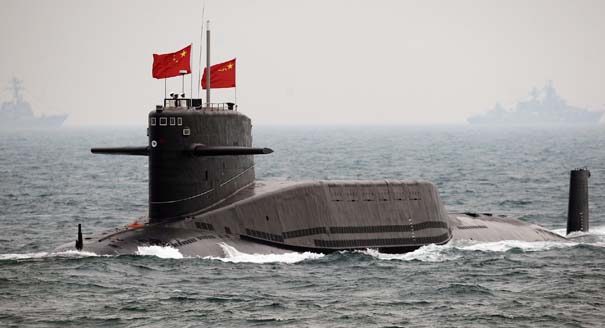
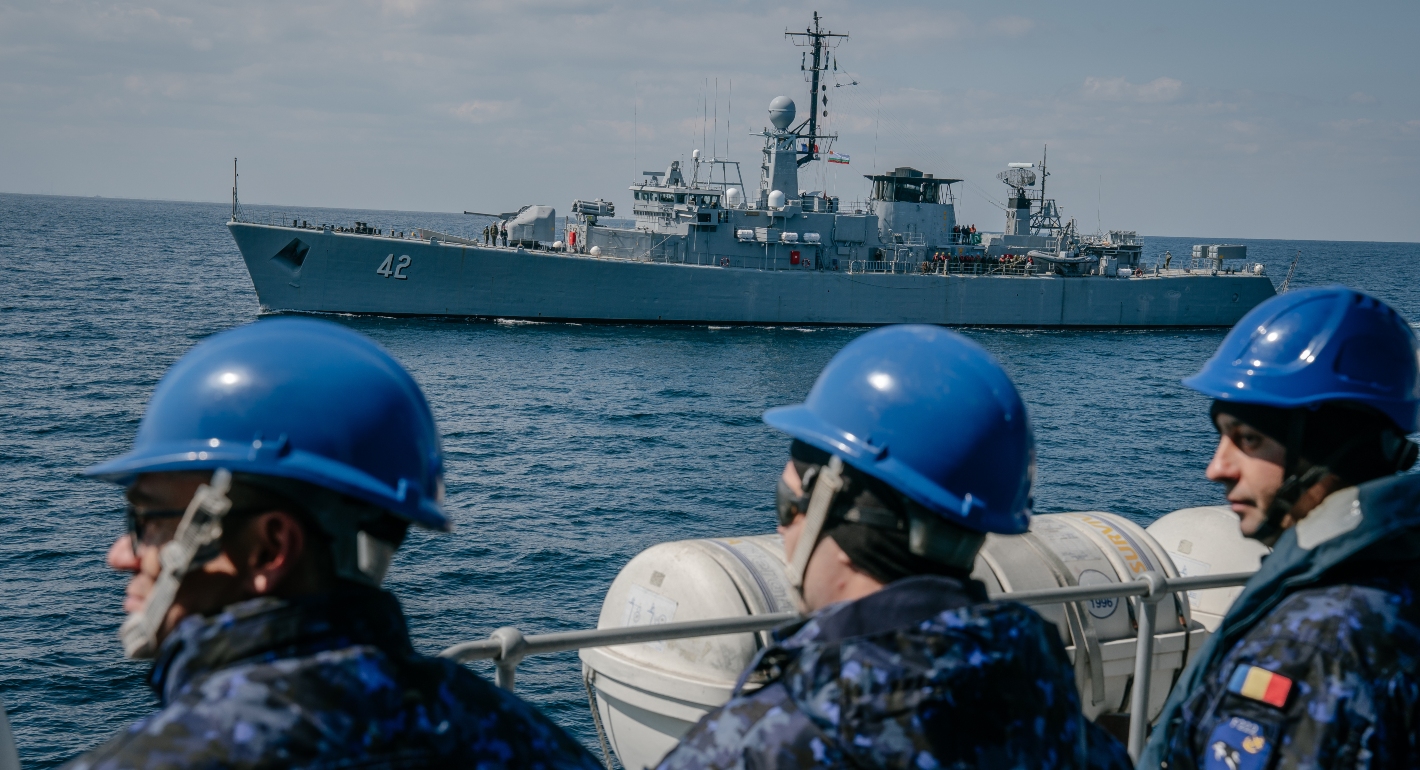
IMGXYZ7953IMGZYXWhen I was a student in the Naval Officer Candidate School, learning to drive ships, I was taught about the hazards of the South China Sea, where our instructors told us to stay away from those dangerous islands and shoals. Today, it is one of the most heavily trafficked waterways in the world. The islands and shoals are still there, but now more heavily contested amid territorial and maritime disputes. The watchword for America more than ever should be “caution, dangerous waters!”
This is a timely warning because next week the ASEAN Regional Forum (ARF) will hold its annual foreign ministers’ meeting in Bali. The previous meeting in Hanoi last July sent shockwaves through the region when Secretary of State Hillary Clinton declared U.S. support for “a collaborative diplomatic process by all claimants for resolving the various territorial disputes without coercion,” implying that Beijing departed from the Declaration of Conduct for the South China Sea (DOC) of 2002 and further suggesting that Beijing was muscling its outlandish territorial claims individually against the three other major claimant states in the area, in violation of the DOC. Clinton offered her “good offices” to provide a forum for dealing collectively with issues among the claimants.
China reacted badly at first to Clinton’s engagement on the South China Sea and in some of the finer details—such as not giving Beijing prior warning—her intervention might have been handled more diplomatically. But in the end it was timely and effective. She got Beijing’s attention and the support of most of the region for a common effort to resist China’s efforts to exploit the weaknesses of smaller counterparts through one-on-one confrontation.
Beijing has not yet given up on its one-on-one approach, but it is encountering more unified resistance and adjusting its tactics. The history of the territorial claims issues in the South China Sea is long and extremely complicated. They involve overlapping tensions about control of islets and shoals, rights to territorial waters and exclusive economic zones (EEZs), and access to their fishing and mineral resources. There are also disputes about the meaning of the United Nations Convention on the Law of the Sea (UNCLOS), which is itself supposed to provide rules for the settlement of disputes about the control and use of the area.
China is caught between two forces. One is the political need to stick to broad and individually questionable claims for the islands and their adjacent waters based on history, formerly represented by Beijing’s nine-dashed line surrounding the islands of the sea and implying sovereignty over virtually the entire South China Sea. The other is the attractiveness of relying on existing international law and making narrower UNCLOS-based claims that stand a better chance of being respected, a path toward which Beijing seems to be moving. In today’s newly strong China, buoyed by nationalism, careers will not be advanced by denying plainly and publicly the legitimacy of the nine-dashed line inherited from the last days of the Kuomintang government in 1947. Outsiders’ calls for the Chinese to clarify the situation can be viewed by some in China as offering a choice of suicide or war. But when China has had to meet UNCLOS deadlines to file partial claims, it has mostly played cautiously by the rules of UNCLOS, as it interprets them, or sought to avoid confronting them.
For their part, the other major disputants (Vietnam, the Philippines, and Malaysia) came to their legal claims fairly late in the game, mostly after soundings suggested in the 1970s that hydrocarbons may be present in commercially valuable quantities. But these are also complicated by colonial legacies and concessions, and patterns of customary use by fishermen and sailors over the centuries. Even a non-claimant, Singapore, was drawn into the diplomatic tussle when China sent a naval vessel through the South China Sea to Singapore last month and attempted to suggest the city state was legitimating China’s claims. Singapore’s foreign ministry spokesman was compelled to denounce the maneuver and call for China to clarify its oversized claims.
No one appears to have a compelling legal claim in all respects. Vietnam and the Philippines argue that the territorial claims over uninhabited or marginally inhabitable islets do not have standing comparable to their claim to divide the northern part of the South China Sea between them based on their continental shelves and EEZs. China makes bolder claims for the islets to strengthen its case. The South China Sea is thus a cat’s cradle of international law that, left unresolved, could invite preemptive use of force by the strong over the weak.
Washington’s interests in the South China Sea are usually characterized by officials as “freedom of navigation” and “peaceful settlement” of the disputes. Beijing says 70,000 vessels pass peacefully through the South China Sea every year, so freedom of navigation is not an issue. But Beijing also asserts (along with a handful of other nations, including Malaysia) that EEZs do not permit military reconnaissance without the authorization of the EEZ sovereign. Beijing attempted to sever a towed array dragged by the intelligence collection ship USNS Impeccable in 2009, and has made its unhappiness with frequent U.S. reconnaissance one of the “obstacles” to normal military-to-military relations with Washington. As a major naval power, the United States cannot be expected to ever accept in its entirety China’s expansive definition of its EEZ, let alone its self-imposed limitations on naval use of EEZs.
“Peaceful settlement” is an important mantra for Washington because the alternative—military action—would be devastating to the stability of the region. The relatively weak, developing economies of Southeast Asia have depended on the United States first to provide protection in the Cold War, and then to offer a balance to rising Chinese power. Up to now this has permitted them to avoid an all-out arms race in the region with its attendant costs and frictions. If the United States were to opt out of the South China Sea dispute, its regional influence and ability to protect its interests will decline, and regional stability could be lost—hence the Obama administration’s correct decision to speak up last year.
In preparation for next week’s ARF ministerial meeting, Beijing and Washington conducted “Asia-Pacific consultations” in Hawaii on June 25, a new form of meeting that had been agreed to at the latest Strategic and Economic Dialogue in May. Going into the session, the Chinese lead participant, Vice Foreign Minister Cui Tiankai, struck a tough posture against the United States trying to multilateralize what China considers strictly bilateral disputes. Following the meeting there were no public references to the South China Sea, but the U.S. spokesperson said they had “open, frank, and constructive discussions.”
China’s relatively quiet disposition since the consultations, taken together with its increasingly UNCLOS-observant approach to the issues, suggests the two sides may have found some unannounced and probably ambiguous understanding to avoid escalation for the time being. This would be in keeping with the reduced confrontational posture taken by Beijing since last December, following a year in which Chinese “assertiveness” in defending or advancing its far-flung interests in the South China, East China, and Yellow Seas sparked a regional backlash.
With upcoming exchanges of visits by the American and Chinese vice presidents to follow the state visit of President Hu Jintao last January, the two sides each have an interest in managing their tensions. This is further reinforced by the impending political year of elections in the United States and the 18th Party Congress in China.
The Obama administration’s resort to consultations and evident effort to restrain the rhetoric preceding the ARF ministerial are constructive in nature. These methods are all the more appropriate in the dangerous waters of the South China Sea.