

Commentary
As we close out another season of Strategic Europe, it is worth taking stock of the deep shifts underway.
Rym Momtaz
Source: Getty
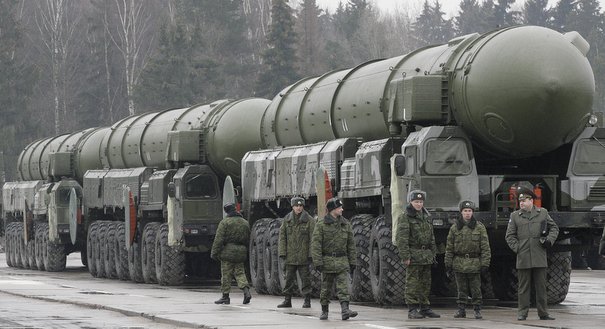
There is a fundamental disconnect between the West and Russia on the issue of missile defense, based on an outdated and incomplete understanding of the strategic environment and each other.
The facade of cooperation on missile defense between NATO and Russia is giving way to frustration on the latter’s side and what seems to be growing indifference on the former’s side. Russian president Dmitry Medvedev made a televised pre-Thanksgiving announcement of military and political steps that Moscow would take in response to the continued impasse on missile defense cooperation with NATO, including deploying its Iskander missiles and possibly in the future withdrawing from New START. The United States appears unmoved. It has reiterated that missile defense is going forward with or without Russian cooperation.
The U.S. ambassador to NATO, Ivo Daalder, has insisted that Russia is “quite hung up on our unwillingness” to guarantee that Russian strategic nuclear forces will not be targeted by NATO’s missile defense deployments “in legally binding writing.” Daalder and other administration officials affirm what many analysts have long known: Russia does not appear prominently on the list of likely threats facing the United States or NATO. However, rightly or wrongly, the same cannot be said of Washington or NATO’s appearance on Moscow’s list. Moscow is viewed by Washington more as an obstacle standing in the way of its plans than a partner with which it is seeking to strengthen European security.
Russia maintains that its biggest threat, as articulated in its 2010 Military Doctrine, is the expansion of NATO military infrastructure up to its western borders. Not only is this position based on unrealistic assessments of the threats facing Russia but unfortunately it is also the operational understanding of top Kremlin defense officials. During a recent interview with the state-owned television channel Russia 24, Dmitry Rogozin, the Russian ambassador to NATO—who is also the special representative for missile defense and considered in some circles to be the next minister of defense—reiterated that the construction of NATO infrastructure with “military potential” close to Russia’s western border was indeed a threat. He considers President Medvedev’s announcement on missile defense “timely,” concluding that the West only respects strength, therefore, to get somewhere in missile defense negotiations, Moscow had to up the ante. That is a far cry from Ambassador Daalder’s conclusion that Moscow “won’t be the driving force in what we [NATO] do.”
What the Kremlin does not seem to recognize or accept is that it is no longer a top priority for U.S. and NATO defense planners. Since the fall of the Soviet Union, the primary concern of the Atlantic Alliance has been to ensure stability in Europe, and over the last ten years, it has been to adjust to new challenges originating from territories outside NATO’s traditional area of operations. Unlike Russia, which continues to focus on perceived threats from the West, NATO is looking to preempt future threats by deploying active defenses, and it is adjusting its plans not based on dated Cold War logic but on assessments of future contingencies. As Secretary of State Hillary Clinton recently put it at a NATO meeting in Brussels, “It is not about Russia, it is frankly about Iran and other state or non-state actors who are seeking to develop threatening missile technology.” Daalder even noted to reporters that if for some reason the Iranian threat abates, “maybe the [missile defense] system will be adapted to that lesser threat.”
President Medvedev’s comments could be an attempt to force NATO to reevaluate the potential for Russia to present a threat, but that would run counter to larger Russian foreign policy goals. If Moscow would like to artificially resuscitate the Cold War model, it should recall how expensive past arms races were. If anything, upping the rhetoric will only empower hard-liners in the United States, further complicating already difficult missile defense negotiation, and cooperation writ large. Indeed, there is a group of U.S. Senators who opposed ratification of the New Start Treaty, who recently sponsored an amendment in their chamber’s version of the 2012 Defense Authorization Bill limiting the Obama administration’s options for pursuing defense cooperation with Russia, and are now holding up the nomination of Michael McFaul as the next U.S. ambassador in Moscow. This could possibly be evidence of an obstructionist caucus coalescing around the Obama administration’s Russia agenda.
While the Russian president’s recent television appearance was likely a preelection maneuver in order to appear strong before parliamentary vote, it also revealed three key strategic misunderstandings. The Kremlin has failed to fully comprehend its current strategic environment, how to effectively negotiate with the United States, and how to adjust its foreign policy to achieve long-term objectives. In fact, in the same television interview, Rogozin assessed current efforts by Western diplomats to “reassure us” of their benign intentions as inadequate. He added that Gorbachev’s people—the doves—were no longer at or near the negotiating table.
Moreover, while posturing may benefit the immediate political environment for the Putin-Medvedev tandem, it puts at risk larger foreign policy objectives that are critical for Russia’s economic development, namely modernization.
Most obviously, Russia’s plan to point dual-use missiles toward states from which it is attempting to attract foreign direct investment is unwise. But it is also unclear what purpose Moscow would have for seeking to maintain a relationship based on mutually assured destruction with states it seeks to partner with for modernization; it is no secret that Russia is basing its innovation hub, Skolkovo, on Silicon Valley. Additionally, the longtime Kremlin goal of integrating itself into European security architectures is not likely to benefit from targeting NATO missile defense assets in European states.
There is a fundamental disconnect between the United States/NATO and Russia based on an outdated and incomplete understanding of the strategic environment and of each other. Moscow has a defense policy that is unresponsive to its current threat environment and apparently unaware of larger foreign policy goals. In doing so, Russia is overplaying its hand and will be forced into a corner when NATO and the United States double down. In order to prevent this issue from scuttling U.S./NATO-Russia relations, a face-saving solution for Russia needs to be found. To Moscow’s credit, it has proposed multiple approaches to cooperation which have been one after another rebuffed by NATO. It is now possibly time for NATO to step up to the plate and give Moscow a way out.
Andrew Riedy is a visiting researcher at the Carnegie Moscow Center.
Andrew Riedy
Carnegie does not take institutional positions on public policy issues; the views represented herein are those of the author(s) and do not necessarily reflect the views of Carnegie, its staff, or its trustees.

As we close out another season of Strategic Europe, it is worth taking stock of the deep shifts underway.

Rym Momtaz

The hybrid warfare landscape is evolving rapidly, leaving policymakers without clear strategies. To better inform their work in addressing emerging challenges, governments must dig deeper into the underlying dynamics at play.


Raluca Csernatoni, Alicia Wanless
The EU had to compromise to adopt a twenty-first sanctions package against Russia, exposing growing cracks in the union’s resolve. Is this latest, weaker round worth it to keep pressure on Moscow?
Rym Momtaz, ed.

Trump is distracted and Ukraine wants Europe to step up. The continent’s leaders must find their voice and assert it in talks with Russia.

Alissa de Carbonnel

Mounting economic strain and battlefield losses will not necessarily make the Kremlin less dangerous. They could instead push Moscow toward a more aggressive hybrid campaign designed to test NATO’s Eastern flank, exploit allied hesitation, and fracture European resolve.

Maksym Beznosiuk