

Paper
Douglas H. Paal
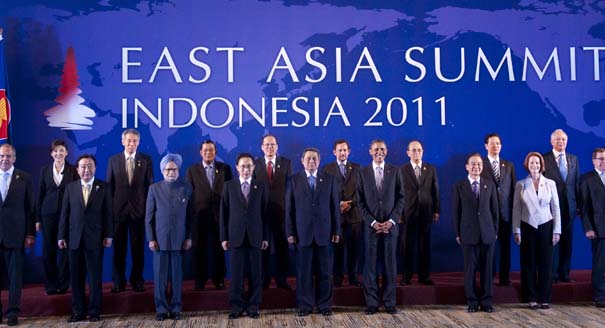
Source: Getty
During his ten days in the Asia-Pacific, President Obama managed to convey successfully his administration’s determination to “rebalance” American attention, influence, and investment toward Asia, and away from the wars in Iraq and Afghanistan.
President Barack Obama took ten days—a remarkably long time for any president to be abroad—to travel through the Asia-Pacific region in November, and he came back a winner. Despite seemingly endless, potentially deadening, leadership gatherings in beautiful places, Obama’s words and events managed to be substantial and to convey successfully his administration’s determination to “rebalance” American attention, influence, and investment toward Asia, and away from the wars in Iraq and Afghanistan.
The trip began in Hawaii, with Obama hosting the annual leadership meeting of the Asia-Pacific Economic Cooperation (APEC) forum, a 21-nation annual gathering focused on trade and economic issues. From there, he proceeded on a twice postponed state visit to Australia, where he pronounced his administration’s new commitment to the region and to a floor on American defense commitments there, despite impending budget cuts. The president and Prime Minister Julia Gillard further announced the stationing of a small but growing number of Marines and other service personnel at a training facility in Darwin, Northwest Australia.
Finally, he traveled to Bali, Indonesia, for the first participation by an American president in the East Asia Summit (EAS), a five year old forum looking to lay the foundations for a regional architecture. While there he also hosted the third U.S-ASEAN (Association of Southeast Asian Nations) summit, with participation by Myanmar’s president for the first time.
In all, Obama met in groups with the leaders of 26 countries, held nine bilateral meetings, and kicked off a major effort to construct a Trans-Pacific Partnership (TPP) of “high quality” free trade agreements with eight and possibly more candidate economies. His public and private comments set a moderate tone of firmness about America’s interests and commitment to the Asia-Pacific region. He reiterated a message of restoring the American economy and creating jobs. Quite coincidentally, Obama also seized on the recent moves toward reform in Myanmar, to place a call to opposition leader and Nobel peace prize recipient Aung San Suu Kyi, gaining her support for a visit by Secretary of State Hillary Clinton to Myanmar last week, also viewed as an initial success.
If you were viewing all this activity purely through the filter of the media, however, you might also conclude that Obama had successfully tightened the noose of containment around China. News accounts repeatedly returned to the theme of checking China’s rise in power or its recent aggressive behavior, such as in the South China Sea.
From the outset, Obama himself struck a stern note about trade and currency in comments after meeting with China’s President Hu Jintao at the APEC gathering. Some commentators in China detected an anti-China flavor in the TPP’s emphasis on “high quality” trade agreements, and at least initial exclusion of China as a party to the talks. They did not note that China has, in fact, been signing its own deals of varying quality and scope without attempting to include the United States.
The new American access to a training facility in Australia was portrayed as adding to America’s string of bases in the region and placing the United States in a better position to contend with China over the South China Sea and to be out of range of Chinese conventional missiles. The fact that this will be a training ground and not a base, with an initial detachment of 250 troops envisioned to grow only to 2,500, was less remarked upon. Moreover, the remote distance of Australia from China and the unlikelihood of scenarios where the Marines will play a role in any future conflict with China make the “anti-China base” storyline a bit of fiction.
The East Asia Summit, which had the potential to be a real snooze, turned out to be well organized by the Indonesian hosts, with a first-day plenary meeting on routine regional issues, and then a “leaders retreat” where more informal exchanges occurred. In the run-up, the United States contended that the EAS should become the regional forum for political and security issues, in contrast with APEC’s economic focus. And the United States proposed an agenda including maritime security and nonproliferation.
China, characteristically but unwisely, sought to exclude discussion of maritime security from the agenda, arguing as always that maritime territorial disputes should be dealt with bilaterally and not in a multilateral setting. This effort failed miserably as sixteen of the eighteen leaders present (Myanmar and Cambodia excepted) chose to make polite, principled, but firm interventions on the need for clear rules of the road under the Law of the Sea for maritime security in the South China Sea. China has sharp differences with rival claimants in the South China and East China Seas and with the generally-accepted interpretation of naval rights in exclusive economic zones.
Chinese Premier Wen Jiabao, whose principal responsibilities are economic and civil affairs, not strategic and military, was left to deal with the fall out, and the official U.S. debriefing of the meeting portrayed him as “grumpy” over losing control of the agenda, though polite throughout. This led to another round of stories about China being confronted by a region led effectively by Obama.
Finally, Obama’s decision to dispatch Secretary Clinton to Myanmar was portrayed as essentially a play to pry away from China’s grip one of its closest allies. Little effort was made to illustrate that the Burmese storyline is essentially a domestically driven one, not really the result of a new great game of strategic rivalry between the United States and China. This is not to say, however, that real reform in Myanmar will not have indirect implications for its relations with the two powers.
In general, the media coverage, perhaps inevitably, was too stark about the competition between Washington and Beijing. The Obama trip was more about re-engaging the region after more than a decade of reduced U.S. attention. This inattention started with the Asian financial crisis of 1997, when the Clinton administration opted more out than in, and former Chinese president Jiang Zemin successfully stepped up China’s diplomatic game in Asia.
It is also undeniable that China’s thuggish and arrogant reaction to incidents in the South China Sea, the East China Sea, and the Korean peninsula in 2010, in contrast with the previous decade’s good behavior, made the return of American attention more welcome throughout the region. Japan has abandoned its flirtation with balancing its relationship with the United States and China. South Korea’s ties with the United States are stronger than ever. And Southeast Asian sentiment clearly favors the United States to continue to be a counterbalance to China’s increasingly overweening influence, welcoming its presence but also not looking for a fight with China.
None of the lingering territorial, proliferation, military, economic, or other issues that beset the region, however, can be settled ultimately without China’s cooperation or acquiescence, and Obama and the other leaders realize this. Cold war rhetoric is not appropriate because the circumstances in the region are not of a cold war nature. There is vigorous trade and investment across the region and tourists and students are exchanged in huge numbers. China does not yet pose an existential or ideological threat.
But then there are politics. With an election year looming in the United States, and a generational transition pending in China (plus elections in Taiwan, Malaysia, Russia, and South Korea), 2012 will be a sensitive year politically. Already, the Republican candidates for president are lining up to take rhetorical shots at China. Obama’s tough talk about trade in Hawaii suggests he is not going to allow himself to be outflanked and put on the defensive over China. He already suffered from media spin of his visit to China in 2009 that said he had been too weak.
Moreover, the media coverage of Obama’s trip last month was not likely purely the creation of the journalists covering it. There are accounts of White House officials pushing the anti-China line of analysis to make their candidate look stronger vis-à-vis China. There will probably be more.
The trick for American foreign policy officials will be to persuade China’s officials and leaders that the United States remains serious about cooperation with China, despite the rising rhetoric, and the need to occasionally push Beijing back. This is partly why a substantial visit to the United States by China’s Vice President Xi Jinping, the presumptive next president, is being prepared for early 2012.
In the meantime, Chinese assessments of Obama’s trip continue to dwell on the anti-China character of the media coverage. Chinese leaders signal publicly and privately that they are not looking for a fight during their transitional year, but they cannot completely ignore increasingly angry public opinion, though they can try to moderate it.
It will be useful for the Obama administration to find a way to let the Chinese discharge their built up static before Xi Jinping’s visit, lest he has to bear a tough message into the U.S. echo chamber. This week’s defense consultative talks, led by Under Secretary of Defense for Policy Michèle Flournoy, may be just such an opportunity to put Obama’s welcome trip into proper perspective, and allow the two sides to express themselves frankly in private.
Moreover, it will be necessary to check impulses to inappropriate rhetoric, such as Secretary Clinton’s in a stopover in the Philippines, where she signed a new “Manila Declaration” with her counterpart on a warship and referred to the South China Sea as the “West Philippines Sea.” This is not official U.S. geographical terminology but appeared in China’s eyes to be taking the Philippines’ position in a dispute where Clinton previously said the United States would not take sides. In an article setting forth the administration’s new “rebalancing” to Asia in Foreign Policy magazine, she used the word “pivot” instead, giving it a martial flavor picked up in Chinese commentary. In her subsequent visit to Myanmar, she scrupulously avoided unnecessary and possibly counterproductive language, and scored a remarkably promising success.

Distinguished Fellow, Asia Program
Paal previously served as vice chairman of JPMorgan Chase International and as unofficial U.S. representative to Taiwan as director of the American Institute in Taiwan.
Recent Work
Douglas H. Paal


Douglas H. Paal, Tong Zhao, Chen Qi, …
Carnegie does not take institutional positions on public policy issues; the views represented herein are those of the author(s) and do not necessarily reflect the views of Carnegie, its staff, or its trustees.

As we close out another season of Strategic Europe, it is worth taking stock of the deep shifts underway.

Rym Momtaz

The hybrid warfare landscape is evolving rapidly, leaving policymakers without clear strategies. To better inform their work in addressing emerging challenges, governments must dig deeper into the underlying dynamics at play.


Raluca Csernatoni, Alicia Wanless
The EU had to compromise to adopt a twenty-first sanctions package against Russia, exposing growing cracks in the union’s resolve. Is this latest, weaker round worth it to keep pressure on Moscow?
Rym Momtaz, ed.

Trump is distracted and Ukraine wants Europe to step up. The continent’s leaders must find their voice and assert it in talks with Russia.

Alissa de Carbonnel

Mounting economic strain and battlefield losses will not necessarily make the Kremlin less dangerous. They could instead push Moscow toward a more aggressive hybrid campaign designed to test NATO’s Eastern flank, exploit allied hesitation, and fracture European resolve.

Maksym Beznosiuk