

Article
Thomas de Waal
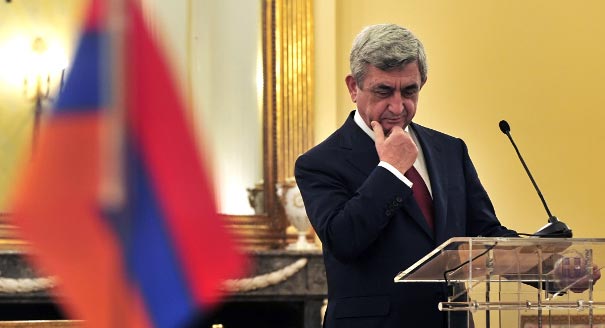
Source: Getty
Twenty years ago, the worst episode of the Armenian-Azerbaijani conflict over Nagorny Karabakh occurred near the small town of Khojali, where more than 400 Azerbaijanis fleeing the town were killed by Armenian soldiers or paramilitary fighters.
Twenty years ago this week, the worst episode of the Armenian-Azerbaijani conflict over Nagorny Karabakh occurred near the small town of Khojali. On the bitterly cold morning of February 26, 1992, more than 400 Azerbaijanis fleeing the town were killed by Armenian soldiers or paramilitary fighters. The victims included military personnel but the great majority of them were civilians. The killings were documented in detail by journalists at the time and later by the human rights organizations Human Rights Watch and Memorial.
For Azerbaijanis, the Khojali killings have become a touchstone for their losses in the Karabakh conflict. As the symbol of a national tragedy, they are marked with even greater ceremony each year, although some of these commemorations seem inappropriate to an outsider, such as when schoolchildren are shown pictures of dead bodies.
Needless to say, for the Armenian side, this is a difficult topic. They suffered their own losses at the hands of Azerbaijanis during the conflict. Simultaneously with the killings at Khojali, (a town Armenians called Khojalu) Azerbaijani rockets were falling on the town of Stepanakert killing Armenian civilians. But, keen to minimize their own acts of aggression, many Armenians have sought to deny that their soldiers killed civilians that day.I have been personally caught up in the Khojali story. In December 2000, while researching my book on the Karabakh conflict, Black Garden, I interviewed Serzh Sarkisian, the man who is now president of Armenia and was then Armenia’s minister of defense. When I asked him about Khojali, he said that “a lot was exaggerated” but he did not deny that Armenians had killed Azerbaijani civilians. He told me: “Before Khojalu, the Azerbaijanis thought that they were joking with us, they thought that the Armenians were people who could not raise their hand against the civilian population. We needed to put a stop to all that. And that’s what happened. And we should also take into account that amongst those boys were people who had fled from [the anti-Armenian pogroms in] Baku and Sumgait.”
Over the years, this passage has been quoted many times. Some Armenians have suggested that the interview never happened, while Azerbaijanis have ignored my admonition to treat the book as a whole and not to quote from it selectively.
Every year I am also asked to give interviews about Khojali and I refuse. It feels wrong to give an “analysis” of a massacre and I do not want to give short answers without supporting context that can be used in the propaganda efforts of one side in the conflict or the other.
This is why we have transcribed the Russian-language interview with Sarkisian and are now publishing it. This confirms that the then defense minister did indeed say what I quote him to have said, while putting it in the context of a long exposition of his views on the Karabakh question.
While researching my book, I did around 120 interviews with people who had experience with the Karabakh conflict. Listening back to Serzh Sarkisian, I hear an extremely determined and passionate voice. It is no surprise to me that he rose to be the president of Armenia.
The interview contains many other fascinating insights and information, which will be of interest to those who follow this complex conflict. The current Armenian president recalls how he had many Azerbaijani friends in Nagorny Karabakh but believed that conflict with Azerbaijan became inevitable; he talks of his good relationship with Azerbaijani officials, Safar Abiev and Ramil Usubov; he relates that he talked twice over the radio during the war to notorious Chechen commander Shamil Basayev, who was fighting on the Azerbaijani side; he denies that Russia gave vital military help to Armenia, saying that Azerbaijan received much more Russian weaponry than the Armenians did; he gives his version of how the Armenians won a military victory; he gives his version of how and why he and his comrades disagreed with then-Armenian president Levon Ter-Petrosian in 1998, forcing him to resign; he recalls how he lost friends and his eighteen-year-old nephew during the conflict.
I hope that the publication of this interview will put doubts to rest about what was said about Khojali. It also puts Serzh Sarkisian’s words in their full context. Readers of this interview can make their own considered judgments.

Senior Fellow, Carnegie Europe
Thomas de Waal is a senior fellow at Carnegie Europe, specializing in Eastern Europe and the Caucasus.
Recent Work
Thomas de Waal
Thomas de Waal
Carnegie does not take institutional positions on public policy issues; the views represented herein are those of the author(s) and do not necessarily reflect the views of Carnegie, its staff, or its trustees.

Are Germany’s economic, industrial, and political struggles becoming a liability for the EU’s ability to rise to the geopolitical moment?

Rym Momtaz, ed.

European Commission President Ursula von der Leyen is about to give her annual address on the state of the EU. Here’s what she won’t—but should—say.
Rym Momtaz

The EU’s responses to two recent incidents expose the gulf between European perceptions and capabilities. Unless the union can bridge that gap, it will never become a real geostrategic power.
Rym Momtaz

European states control several Overseas Countries and Territories around the world that carry strategic, economic, and environmental weight. As great powers challenge the rules-based order, defending them is a geopolitical imperative for Europe.

Marc Pierini

In supporting Europe’s far-right, MAGA and Russia both want the same thing: a weaker EU. Europe must defend itself without abandoning the openness these forces exploit.

Armida van Rij