

Commentary
Russia is testing the waters of NATO’s mutual defense clause. What do strikes in Romanian territorial waters mean for the alliance’s posture toward Moscow?
Dimitar Bechev
Source: Getty
What Warsaw would value most would be a new U.S. administration that recognizes the EU as a security partner, and actively supports its efforts to revitalize European ambitions.
The lack of support for both U.S. presidential candidates within Poland is striking. The fact that President Obama has some of his lowest popularity ratings across Europe in Poland is not so surprising given his attempt to reset relations with Russia, his decision to shift his focus from Europe in favor of the Asia-Pacific, and his unfortunate reference to Polish death camps. However, the cool reception that awaited Governor Romney—with his winning manners, nice teeth, and flattering attention toward Poland—when he visited in August, is a worrying sign.
Poland’s coolness to Obama and Romney should not be misinterpreted. They are unpopular not because Poland is becoming anti-American, but rather for specific reasons. Obama is disliked because he forced the Poles into a difficult but inevitable decision—choosing European integration over the transatlantic alliance. Romney is disliked because he threatened to undermine that choice.
The current attitude of Poles toward the United States is therefore not actually about America per se, it is about political choices. After the fall of Communism, East Germans talked about the torture of choice. Communism had removed personal autonomy, but new freedoms brought their own problems, like having to make trade-offs and take responsibility for decisions. So it is in Poland―for the first time in twenty years Warsaw has to make serious foreign policy choices, and it is painful.
Since the 1990s, Polish policymakers have had it relatively easy. During that period the country’s priorities consisted primarily of gaining entry to the European Union and NATO. Even after accession to both organizations, Poland’s path from “policy-taker”—putting in place the legal acquis and domestic transformations necessary for membership—to international policymaker occurred in a comparatively benign environment. It is only now, in the midst of a deep financial crisis and with emerging powers challenging the Western-led international order, that Poland is being faced with difficult choices, not least between the EU and NATO.
The U-turn by President Obama on U.S. commitment to a central European missile defense program forced a decision on Warsaw and tipped the balance in favor of EU foreign and security policy. If Poles remain convinced that missile defense is not going ahead, even as agreements with Poland and Romania on bases for the replacement program come into force, and if the Obama Administration’s efforts at strategic reassurance do not seem to have resonated, it is probably because people here still need to convince themselves that the choice for Europe is the right one.
Polish unhappiness is partly a result of feeling forced to commit to closer economic integration with the eurozone as a price necessary to pay for political clout. Without the financial crisis Poland could have perhaps achieved a status quo like Sweden—another country that is not a member of the euro, albeit one without Poland’s acute security concerns—and put off membership indefinitely. Instead, Poland has needed to engage in order to resuscitate the EU’s foreign and security policy, which has become central to its security.
The so-called big three in EU foreign policy—the UK, France, and Germany—have not taken a concerted interest in EU foreign and security policy since a brief effort to overcome their differences after the Iraq war. As for the smaller EU members, they simply lack ambition in this direction. It now falls to midsized states, like Poland, to seek to mobilize the rest and turn the EU into an effective security provider. Poland’s dynamics within Europe are in effect dominating its relations with the United States.
Warsaw’s efforts to enhance its credibility and build bridges do seem to be bearing fruit. Berlin, for instance, looks upon Warsaw as a responsible partner, at least in the effort to enforce fiscal discipline in Europe. There is still occasional annoyance in Berlin at a country that sometimes seems to make more of a priority of being included at the negotiating table than having an agenda of its own to promote. It is a sign of the times, though, that Germany’s ambassador to Poland does not look at Warsaw as diplomatic purgatory but has chosen to return there for a second posting.
The new French ambassador to Poland is also a willing returnee, and has taken up his post in the wake of a charm offensive by President François Hollande, who is loudly looking for new European partners not just in southern Europe but in the east too. Having shaken off the attachment to the Franco-German tandem that dominated policy during the Sarkozy years, Paris has pledged to behave in an inclusive manner toward Poland. And, despite having understood that Poland’s prime partner today is Germany and that it is not prepared to be played against its ally, the new French government, it seems, is still prepared to invest in relations with Warsaw.
Relations with France remain troubled, however, as many French decisionmakers are at ease with the prospect of a smaller EU, one without the eastern Europeans. Faced with this kind of thinking, Warsaw must quickly lose its reputation for instrumentalizing the EU. It will not be easy to dispel suspicions that it uses the EU for narrow, short-term interests and will seek alternative international partners if this does not work out. With the bloc’s multi-annual budgetary negotiations currently underway, for example, Poland is fighting for all the cash it can get from its partners, confirming old stereotypes.
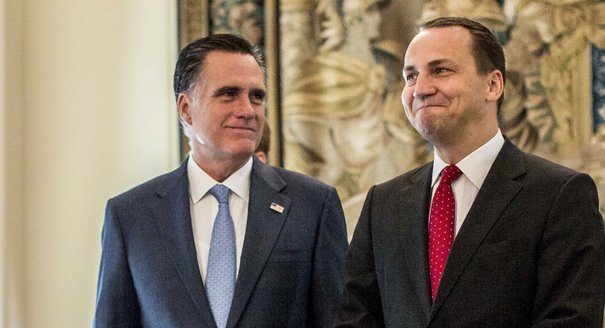
Warsaw’s need to win over doubters in Paris and Brussels, as well as eurosceptics in London, is one reason why Governor Romney’s visit to Warsaw was met with such coolness. The visit was seen as having the potential to undermine Poland’s pro-European credentials and to stir up old tensions associated with mistrust of Central and Eastern Europe’s Atlanticism. There was also a feeling within Poland that Romney’s efforts to engage old allies, and to behave as if the world were still the unipolar place of the post-Cold War period, spoke of nostalgia and self-deception—an inability to live with the realities that had forced the Polish rethink.
Of course, in the period following Romney’s visit there was inevitable criticism of what commentators saw as Poland’s political immaturity. Warsaw, the critics said, had been too quick to take offense at a visit that was both flattering and potentially useful. The country’s foreign policy establishment had been prickly, they said insulted, when Romney’s team asked if they needed to bring a translator to the meeting with Poland’s—Oxford-educated—foreign minister.
Moreover, even though many were skeptical of Romney’s chances of winning at that stage in the electoral campaign, Polish policymakers should still have taken the opportunity to engage the presidential hopeful. Instead, the critics say, Warsaw put forward no positive agenda for cooperation—an opportunity squandered by a government that has got ahead of itself.
But it is not Poland that lacks political maturity. Warsaw simply made a difficult political choice. What it asks from its American partners is that they live up to their own claims of political maturity and acknowledge the new geopolitical realities Poland faces. Warsaw would like the winner of the presidential election to support its decision to work with its partners in Europe.
Any signs of isolationism from a new U.S. administration will confirm Warsaw’s decision. So too, conversely, will the predictions that the disparities in defense spending between the United States and the EU will soon make it impossible for Europeans to cooperate effectively with Washington.
But what Warsaw would value most would be a new administration that recognizes the EU as a security partner, and actively supports its efforts to revitalize European ambitions. Romney’s advisers interpreted Polish hostility to President Obama as evidence of a longing for the past. They were wrong. The Poles have moved on.
Roderick Parkes heads the EU program at the Polish Institute of International Affairs (PISM).The views expressed here are the author’s own.
Roderick Parkes
Stiftung Wissenschaft und Politik
Carnegie does not take institutional positions on public policy issues; the views represented herein are those of the author(s) and do not necessarily reflect the views of Carnegie, its staff, or its trustees.

Russia is testing the waters of NATO’s mutual defense clause. What do strikes in Romanian territorial waters mean for the alliance’s posture toward Moscow?

Dimitar Bechev

With its public finances in shambles, the far right polling at 35 percent ahead of the 2027 presidential election, and a growing protest movement, is France’s crisis a threat to the EU’s geopolitical awakening?

Rym Momtaz, ed.

Ahead of a tough winter for Ukraine, Donald Trump’s swing back toward Russia bodes ill. But instead of panicking, Kyiv’s European allies are focusing on action.
Rym Momtaz

Funding Ukraine remains a priority for European leaders. As Russia’s war of aggression heads into another winter, two feasible options to mobilize support for Kyiv should be fast-tracked.


Vladyslav Rashkovan, Gregory P. Wilson

While the EU and European governments are embracing the much-lauded middle-power moment, this entails three difficult conundrums.

Richard Youngs