

Q&A
- +1
Amr Hamzawy, Andrew Leber, Eric Lob, …
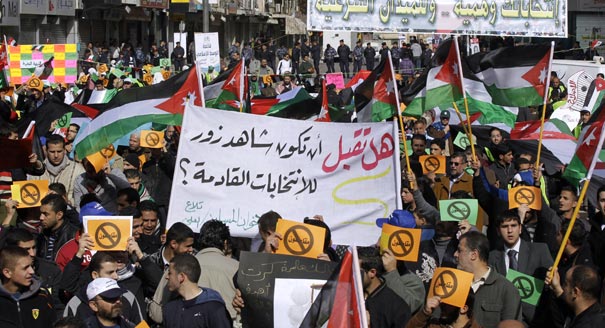
Source: Getty
Despite parliamentary elections, the way Jordan is governed is unsustainable in the post–Arab Awakening moment. Jordanians want the king to lead a genuine reform effort.
Jordanians elected a new parliament last week in the first vote since the Arab uprisings broke out. With little enthusiasm for the insufficient political reforms initiated by the government thus far, voter turnout was low. And, unsurprisingly, the result is a new parliament that is similar to the widely unpopular one it is replacing.
Jordan needs to move beyond the election. Real change is needed now.
Only 56 percent of registered voters—or more accurately 40 percent of eligible ones—turned out, and the reasons are clear. The electoral law, traditionally designed to produce structurally weak parliaments subservient to and dependent on the executive, has only minimally been changed.The current electoral law is not capable of producing a parliament independent and credible enough to exercise real oversight of government. And this caused the political wing of the Muslim Brotherhood in Jordan, the Islamic Action Front, and other groups to boycott the polls.
While Jordanians have overwhelmingly indicated they do not want to overthrow the monarchy, they have also made it clear that they are seeking real change. Most Jordanians still see the monarchy as an important unifying force and an institution that provides security to all ethnic groups. In their eyes, the king should have real powers enabling the monarchy to intervene in major, existential issues when needed.
Nevertheless, people in Jordan are deeply frustrated with the status quo. Protests have been a constant for the last two years, although the size of the crowds has varied.
The way the country has been governed—with a relatively small decisionmaking circle and a very weak legislative check on power—is no longer sustainable in the post–Arab Awakening moment.
This all means that it will be a difficult year for Jordan. The country will need to cope with several major challenges: a parliament that most Jordanians already realize is no different than the old one, an economic crisis that needs immediate and sustained attention, and a Syrian regime crumbling at its border that will further embolden Jordan’s Islamic opposition.
Given that the opposition is out in the street today rather than in parliament, the regime does not have the luxury of facing challenges with reform rhetoric alone.
This is a moment of truth for Jordan. Positive constitutional amendments were instituted in the last two years, including the establishment of a constitutional court and an independent election commission. But they are hardly sufficient to convince Jordanians of the seriousness—and the sustainability—of the reform process.
The king needs to initiate a process today that addresses three key demands.
First, the electoral law must be changed to increase the seats allocated to party lists in each electoral cycle. A gradual plan with an established time frame will help begin the critical process of developing a true political-party culture that allows new parties to establish themselves.
This will gradually redistribute the balance of power away from a dominant executive toward a more representative parliament that reflects the concerns and aspirations of the population.
Second, corruption must be confronted head-on. This is an issue that unites the demands of all Jordanians. Steps are needed not only to bring known cases to court but also to institute a set of legislative laws that will make it more difficult for corrupt practices to happen in the first place and will provide an institutional check on abuses when they do occur.
Third, an economic plan must be developed to free Jordan of its historic patronage system and move the country toward a merit-based economy. Such a plan should, over time, deal with the chronic problems of unemployment and dependence on outside aid, but it should not overlook the needs of the less privileged. Growth must be more inclusive and needs to address the challenge of developing a self-sustaining Jordanian economy.
This is a difficult—but doable—undertaking. It requires political will and not just technical expertise to succeed as it tests the vested interests of a layer of society that has so far successfully resisted any reforms that would ultimately rob it of its unfair benefits.
There is still an excellent chance for Jordan to prove to the region that reform from above can work. But this requires a fundamentally new mindset—a realization that the tools needed for future stability are different from those that ensured its survival in the past.
Jordanians are clear that they want that process to be led by the king. They are equally clear that the new generation will no longer live by the rules their parents did. The days immediately after the vote are the beginning. Jordan needs to prove that it can meet the challenge.

Vice President for Studies
Marwan Muasher is vice president for studies at Carnegie, where he oversees research in Washington and Beirut on the Middle East. Muasher served as foreign minister (2002–2004) and deputy prime minister (2004–2005) of Jordan, and his career has spanned the areas of diplomacy, development, civil society, and communications.
Recent Work



Amr Hamzawy, Andrew Leber, Eric Lob, …
Marwan Muasher
Carnegie does not take institutional positions on public policy issues; the views represented herein are those of the author(s) and do not necessarily reflect the views of Carnegie, its staff, or its trustees.
The EU’s new migration policy is not suited to today’s realities. With climate change increasingly becoming a driver of displacement, Europe needs to rethink its deterrence-focused approach.

Shana Tabak
Europe seems to have accepted its sidelining in the Middle East. The EU must reassert its support for the international rules-based order and step up engagement.

Rym Momtaz
Preparing candidate countries for EU membership is no longer enough. As the enlargement process becomes a reality, the union must also prepare its own societies.

Iliriana Gjoni
Countries face several hurdles in joining the EU, including the final stage of ratifying their accession treaties. Procedural reforms and substantive adjustments could help move the process forward.

Stefan Lehne
Europe has an interest in supporting Armenian leader Nikol Pashinyan as he tries to make peace with neighbors and loosen ties with Russia. But it is depersonalized support in the long term, not quickfire flash, that will win the day.

Thomas de Waal