When Chinese President Xi Jinping coined the phrase “a new type of relationship between major countries” during a summit with U.S. President Barack Obama in June 2013, everyone assumed he was talking about relations with the United States. But the Chinese leadership may have had other countries in mind, and these nations may prove even more vital for China.
Xi’s foreign visits since the summit—as well as those of Chinese Premier Li Keqiang—have demonstrated that a primary focus of China’s next era of foreign policy will be emerging and neighboring powers, especially in Southeast Asia. Indonesia in particular will take center stage in China’s new approach to the region.
Statements by Chinese leaders confirm Beijing’s interest in turning to its Southeast Asian neighbors. At the World Peace Forum, a high-level international security meeting that took place shortly after the U.S.-China summit, Chinese Foreign Minister Wang Yi affirmed that Chinese diplomacy will “take its surrounding region as a priority” with the goal of fostering “a more peaceful, stable and prosperous neighboring environment.”
This statement kick-started a new foreign policy in which Beijing is using economic investments to strengthen bilateral relations with countries in Southeast Asia. The Chinese leadership has emphasized on many occasions that China will promote a new initiative of building a “community of common destiny” with members of the Association of Southeast Asian Nations (ASEAN). This initiative may come to define the regional arrangement, like the European Union or the North American Free Trade Agreement.
This focus on improving bilateral ties and forging strategic partnerships with key neighbors may be one of the most substantial changes in Chinese diplomacy during Xi’s term. Ever since its admission into the World Trade Organization in 2001, Beijing has been increasing China’s presence at the multilateral level. And because multilateralism provides a platform for cooperation with other powers, China will likely continue to strengthen its voice in the multilateral organizations it is member of, such as ASEAN and the Asia-Pacific Economic Cooperation (APEC). However, multilateralism tends to privilege the status quo. All members of a multilateral institution are required to abide by the organization’s rules and norms. As a rising and emerging power, China needs a more flexible arrangement to accommodate its expanded interests, so Xi is putting greater emphasis on bilateral concerns.
China’s new approach to its Southeast Asian neighbors is determined in part by the individual countries’ relationships with Beijing and with the other major world power, the United States. When it comes to close U.S. allies, such as Japan and the Philippines, China has adopted a rather hardline policy with little flexibility on principle issues. Because Beijing sees minimal potential to improve relations with states that are so firmly in the U.S. camp, it is unlikely to alter this approach.
China’s policies toward those countries that already cooperate closely with Beijing on economic matters, such as India and Vietnam, are also unlikely to change. Overlapping economic interests firmly link Beijing to New Delhi and Hanoi. As a result, China does not spend considerable time focusing on its relations with India and Vietnam beyond ensuring that they do not worsen.
Beijing pays more attention to China’s relationships with South Korea, Thailand, and Australia because bolstering these ties has the potential to advance China’s economic interests. These countries have found a way to successfully maintain relationships with Beijing and Washington by balancing strong security alliances with the United States and robust trade ties with China.
China seeks to strengthen its economic relations with these nations without challenging their alliances with the United States. During a visit to Thailand, Premier Li grabbed headlines as the first foreign official to address the Thai parliament in at least ten years. In his speech, he pledged that China would import 1 million tons of Thai rice over the next five years (it imported 143,000 metric tons last year) and increase imports of Thai rubber. He also highlighted China’s desire to invest in a high-speed railway in Thailand.
But while increasing economic cooperation with these nations is one goal of China’s new foreign policy, Beijing’s primary focus is elsewhere in Southeast Asia. China is concentrating most of its efforts on improving bilateral relations with Myanmar, Cambodia, Indonesia, and Malaysia. These countries are particularly attractive to Beijing because they have no formal alliance with the United States, and they already share significant economic interests with China. Beijing sees the potential for even more Chinese investment in all four states.
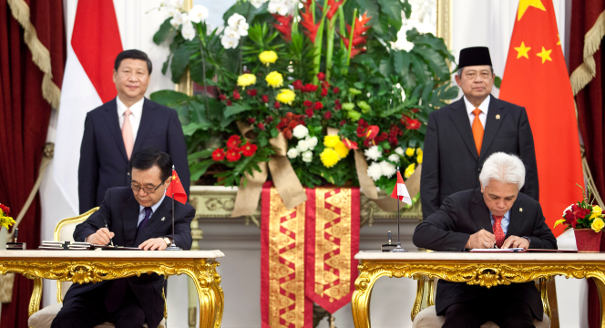
The Chinese leadership has made efforts to develop friendlier relations with these nations at the multilateral and bilateral levels. During a meeting with General Susilo Bambang Yudhoyono, the president of Indonesia, in October 2013, Xi announced China’s intent to establish an Asian infrastructure investment bank to drive China’s new diplomatic goal of proactively providing public goods to the region at large. The bank is intended to promote Chinese investments in creating infrastructure throughout the region, but its primary focus will be on building transportation infrastructure in these key nations.
Many of Beijing’s bilateral efforts have focused on strengthening ties with Indonesia, a cornerstone of China’s turn to Southeast Asia. Xi concluded a tour of the region in fall 2013 with a high-profile visit to Indonesia, where he was the first foreign leader to address the Indonesian parliament. He emphasized the need for a stronger bilateral relationship as well as the need to improve China-ASEAN relations overall.
It is no surprise that Xi is paying so much attention to Indonesia. In part, this is due to China’s long-standing philosophy that developing countries need to help other developing countries. But it is also because increasing economic cooperation with Jakarta could greatly benefit Beijing. As the largest economy in Southeast Asia, Indonesia is a growing market with fewer trade restrictions than the West, and it represents tremendous potential for Chinese exporters.
Indonesia is also in a very strategic position at the geopolitical level. For Washington’s rebalancing strategy toward Asia to succeed, the United States will need to draw Indonesia closer to its side. The U.S. government shutdown forced Obama to miss two important regional gatherings in late 2013, the East Asia Summit and the APEC meeting. His absence was noted with criticism by many Southeast Asian countries.
At the same time, Xi is hoping to draw Indonesia closer to China. Beijing wants to be able to count on Jakarta’s support whenever disputes arise with the United States on issues such as the South China Sea territorial disputes or disagreements over military exercises.
And for China, courting Indonesia is about more than just keeping the United States in check. Forming more robust ties with Indonesia is critical to Beijing’s overall success in developing stronger relations with its Southeast Asian neighbors. Many ASEAN member countries remain ambivalent about and unenthused by China’s friendly overtures, but they may be more open to improving relations with Beijing if Jakarta were to do so first. Further development of the interconnected regional economic networks between Beijing and Jakarta would provide these nations with improved infrastructure, preferential economic rights, and other benefits that would smooth the path to a closer relationship with China.
In addition to the potential economic opportunities and geopolitical benefits of closer ties with Jakarta, Beijing recognizes that Indonesia is looking for a security guarantee from a bigger power, like China or the United States—and that the same is true of Myanmar, Cambodia, and Malaysia. Even the strongest of these nations, Indonesia, does not have the military force to defend itself. China would benefit from convincing these countries to pursue security alliances with Beijing instead of with Washington.
The United States already has an advantage in this matter because of its more advanced military technology, but it does not have enough economic power to sustain a stronger strategic relationship with these nations. Here, China has the advantage.
And now, after the Chinese leadership’s successful goodwill trips to Southeast Asia, it is up to Beijing to maintain that advantage. To keep these countries from simultaneously pursuing a security commitment from the United States and an economic relationship with China, it is imperative for Xi to draft a new regional strategy to consolidate China’s advantage in Southeast Asia.
This article was published as part of the Window into China series