
• Research
  • Strategic Europe
  • About
  • Experts
Carnegie Europe logoCarnegie lettermark logo
EUUkraine
  • Donate
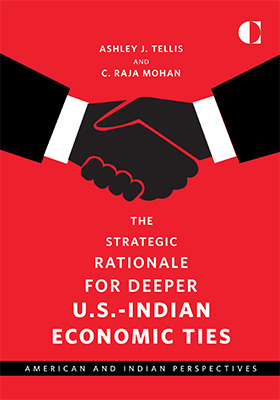
The Strategic Rationale for Deeper U.S.-Indian Economic Ties
Report

The Strategic Rationale for Deeper U.S.-Indian Economic Ties

The U.S.-India relationship was often distant during the Cold War, but the partnership is now critical for both countries’ strategic aims.

Link Copied
By Ashley J. Tellis and C. Raja Mohan
Published on Aug 7, 2015

Additional Links

Full TextBrief

The U.S.-India relationship was often distant during the Cold War, but the partnership is now critical for both countries’ strategic aims. India is important to the U.S. effort to maintain its international primacy, while the United States is essential to India’s attainment of its great power ambitions. Deepened economic intercourse, including one day through a comprehensive U.S.-Indian free-trade agreement, is vital to realizing both countries’ aspirations.

The Case for Deeper Economic Cooperation

  • The United States has consistently pursued a policy of securing hegemony, yet China now threatens the economic and geopolitical underpinnings of U.S. power.
     
  • India, since the British Raj, has harbored aspirations for great power status and regional hegemony alongside ideals of liberal internationalism.
     
  • Through stronger bilateral economic ties, American resources could enhance India’s productivity, expand its technological frontier, and spur further economic liberalization. Meanwhile, the United States would gain access to India’s lower-cost exports, relatively cheap labor, and vast domestic market, increasing America’s international competitiveness.
     
  • Increased U.S. competitiveness internationally would reinforce Washington’s global primacy, permitting it to effectively balance China’s rising power. The economic benefits accruing to India from deeper economic links with the United States would advance Indian national development, regional hegemony, and international prominence.

How the United States and India Can Promote Economic Cooperation

  • The United States must be willing to walk difficult roads to enhance economic cooperation with India, given that such integration is essential to its regional and international interests. While domestic U.S. constituencies have become wary of Indian economic practices and free-trade agreements more generally, they must be outweighed by larger considerations of revitalizing economic growth bilaterally and preserving U.S. global hegemony.
     
  • India must understand that sustained economic growth hinges on expanding its global trading links, and that its prior policies of trade expansion through shallow free-trade agreements are no longer viable. Partnership with the West, particularly the United States, is critical to achieving India’s twin aspirations for national development and regional primacy. India’s existing tactic of buying time and space for domestic development without making commitments to genuine trade liberalization is counterproductive for these aims.
     
  • A step-by-step approach to deepening bilateral trade and investment to make a free-trade agreement possible at some point in the future may be the most effective way to advance each country’s specific geopolitical interests. Such an approach would incrementally tackle challenges to a comprehensive agreement, and it would best serve India’s development aspirations and buttress the United States’ international preeminence.
Read Full Text

About the Authors

Ashley J. Tellis

Former Senior Fellow

Ashley J. Tellis was a senior fellow at the Carnegie Endowment for International Peace.

C. Raja Mohan

Former Nonresident Senior Fellow, Carnegie India

A leading analyst of India’s foreign policy, Mohan is also an expert on South Asian security, great-power relations in Asia, and arms control.

Authors

Ashley J. Tellis
Former Senior Fellow
C. Raja Mohan
Former Nonresident Senior Fellow, Carnegie India
North AmericaUnited StatesSouth AsiaIndiaEconomyForeign Policy

Carnegie does not take institutional positions on public policy issues; the views represented herein are those of the author(s) and do not necessarily reflect the views of Carnegie, its staff, or its trustees.

More Work from Carnegie Europe

  • Commentary
    Is the Radical-Right Threat Existential or Overstated?

    Amid increased polarization and the influence of disinformation, radical-right parties are once again gaining traction across Europe. With landmark elections on the horizon in several countries, are the EU’s geostrategic vision and fundamental values under existential threat?

      Catherine Fieschi, Cas Mudde

  • Commentary
    Strategic Europe
    Europe and the Arab Gulf Must Come Together

    The war in Iran proves the United States is now a destabilizing actor for Europe and the Arab Gulf. From protect their economies and energy supplies to safeguarding their territorial integrity, both regions have much to gain from forming a new kind of partnership together.

      • Rym Momtaz

      Rym Momtaz

  • Commentary
    Strategic Europe
    Taking the Pulse: Is France’s New Nuclear Doctrine Ambitious Enough?

    French President Emmanuel Macron has unveiled his country’s new nuclear doctrine. Are the changes he has made enough to reassure France’s European partners in the current geopolitical context?

      • Rym Momtaz

      Rym Momtaz, ed.

  • Commentary
    The Iran War’s Dangerous Fallout for Europe

    The drone strike on the British air base in Akrotiri brings Europe’s proximity to the conflict in Iran into sharp relief. In the fog of war, old tensions in the Eastern Mediterranean risk being reignited, and regional stakeholders must avoid escalation.

      Marc Pierini

  • Commentary
    Strategic Europe
    The EU Needs a Third Way in Iran

    European reactions to the war in Iran have lost sight of wider political dynamics. The EU must position itself for the next phase of the crisis without giving up on its principles.

      Richard Youngs

Get more news and analysis from
Carnegie Europe
Carnegie Europe logo, white
Rue du Congrès, 151000 Brussels, Belgium
  • Research
  • Strategic Europe
  • About
  • Experts
  • Projects
  • Events
  • Contact
  • Careers
  • Privacy
  • For Media
  • Gender Equality Plan
Get more news and analysis from
Carnegie Europe
© 2026 Carnegie Endowment for International Peace. All rights reserved.