Europe seems to have accepted its sidelining in the Middle East. The EU must reassert its support for the international rules-based order and step up engagement.
Rym Momtaz
This book examines how the region’s major powers are building their national power as geopolitical competition intensifies.
Source: National Bureau of Asian Research
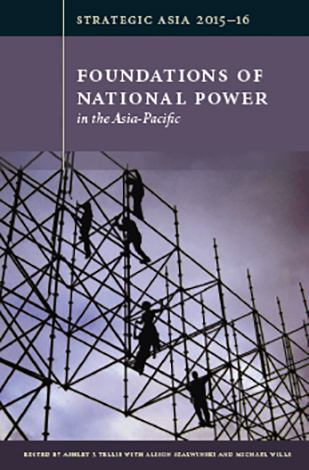
Co-edited and introduced by Ashley J. Tellis, Strategic Asia 2015-16: Foundations of National Power in the Asia-Pacific examines how the region’s major powers are building their national power as geopolitical competition intensifies. In each chapter, a leading expert analyzes a country’s economic, technological, human, and natural resources and assesses how well its political system translates those capabilities into military and diplomatic power.
Order this book, or read the introduction by Ashley J. Tellis for free.
Ashley J. Tellis is a senior associate at the Carnegie Endowment for International Peace and research director of the Strategic Asia Program at the National Bureau of Asian Research (NBR), served in the U.S. Department of State as senior adviser to the Undersecretary of State of Public Affairs, and previously as senior adviser to the Ambassador at the U.S. Embassy in India. He also served on the National Security Council Staff as special assistant to the President and senior director for Strategic Planning and Southwest Asia. He is the author of India’s Emerging Nuclear Posture (2001) and co-author of Interpreting China’s Grand Strategy: Past, Present, and Future (2000), as well as the co-editor of the eleven most recent volumes of Strategic Asia, published by NBR.
Alison Szalwinski is a project manager at NBR.
Michael Wills is senior vice president of research and operations at NBR.
Former Senior Fellow
Ashley J. Tellis was a senior fellow at the Carnegie Endowment for International Peace.
Alison Szalwinski
National Bureau of Asian Research
Alison Szalwinski is assistant director for political and security affairs at NBR.
Michael Wills
National Bureau of Asian Research
Michael Wills is senior vice president for strategy and finance at NBR.
Carnegie does not take institutional positions on public policy issues; the views represented herein are those of the author(s) and do not necessarily reflect the views of Carnegie, its staff, or its trustees.
Europe seems to have accepted its sidelining in the Middle East. The EU must reassert its support for the international rules-based order and step up engagement.
Rym Momtaz
Amid uncertainty caused by the Iran war, the global drive for nonproliferation has stalled. With Europe diplomatically marginalized and countries reassessing their nuclear options, efforts to curb the spread of nuclear weapons risk becoming irrelevant.
Jane Darby Menton
Between the United States’ market-driven approach and China's state-led industrial strategy, Europe is reckoning with how it can remain competitive in the global economy. But is Europe in danger of becoming a U.S. or China colony?
Noah Barkin, Anu Bradford
The full list of humiliations Europe has endured since Donald Trump returned to the White House makes for grim reading. But Washington’s adversarial approach to its allies undermines its own power base.
Rym Momtaz
The National Rally’s electoral strength, coupled with its internal fragility at a crucial political juncture, contributes to foreign policy vagueness.
Catherine Fieschi