

Commentary
Judy Dempsey
{
  "authors": [
    "Judy Dempsey"
  ],
  "type": "commentary",
  "blog": "Strategic Europe",
  "centerAffiliationAll": "",
  "centers": [
    "Carnegie Endowment for International Peace",
    "Carnegie Europe"
  ],
  "collections": [],
  "englishNewsletterAll": "",
  "nonEnglishNewsletterAll": "",
  "primaryCenter": "Carnegie Europe",
  "programAffiliation": "",
  "programs": [],
  "projects": [],
  "regions": [
    "Europe"
  ],
  "topics": [
    "EU",
    "Security"
  ]
}
Source: Getty
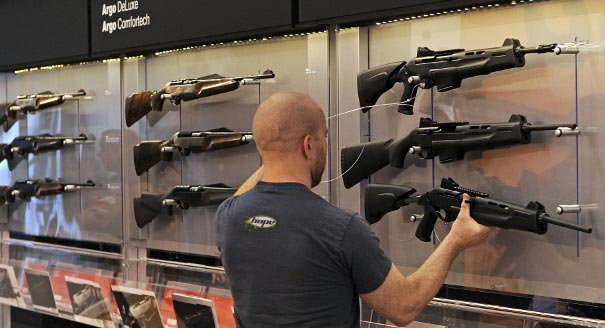
As long as politicians remain complacent about the moral and political problems caused by arms exports, Europe’s companies will simply carry on with business.
Arms exports are something neither European governments nor the European Union (EU) like discussing.
But they cannot avoid being put in the limelight once a year. That happens every time the Stockholm International Peace Research Institute (SIPRI) publishes its list of the 100 top-selling arms companies.
The list, by no means exhaustive—it excludes China, Ukraine, and many small and highly successful German companies—makes fascinating reading, for three reasons.
First, the arms trade is thriving, despite the global financial crisis and the economic downturn across most of Europe.
Sales of arms and military services increased by $411.1billion in 2010. SIPRI says that was a 1 percent increase compared to 2009 and a 60 percent increase since 2002.
Second, the United States and Europe continue to dominate the arms-producing and military services companies.
Forty-four U.S.-based companies accounted for over 60 percent of all arms sales listed by SIPRI. The 30 European companies on the list make up just under 30 percent. France and German lead the pack, followed by the United Kingdom.
Third—and most importantly—Europe’s arms trade puts it at odds with the EU’s commitment to human rights. Member states continue to sell large amounts of weapons to dictatorships, authoritarian regimes, and countries with poor human rights records whose leaders use weapons to suppress dissent.
“European governments have sold weapons to bad guys for a long time,” said Bates Gill, SIPRI director in an interview with Carnegie Europe. “There are plenty of precedents for that in spite of the high-sounding principled language about monitoring arms sales.”
The EU has a Code of Conduct on Arms Exports. In theory, it defines common rules about the exports of military technology and equipment.
In practice it is the member states that have the final say on granting export licenses to arms companies.
“There is a complete disconnect between EU principles and its image and enforcing any coherent policy concerning arms exports,” Mr. Gill added.
Europe’s arms sales came under intense scrutiny during the Arab Spring. For years, most European governments had granted export licenses to the regimes across North Africa and the Middle East, never checking what the equipment was used for.
Of course, Europe was not alone. The United States, China, Russia, and Ukraine were doing the same, with Russia and China continuing to sell weapons to the region.
Human rights organizations both in Europe and in the region argued that Europe was prolonging repression at the expense of defending its principles.
Mr. Gill said European governments wanted to protect jobs back home. This is truer than ever now, with the eurozone crisis and budget cut backs forcing governments to decrease defense spending.
Since the Arab Spring, the EU did impose some restrictions on arms sales to North Africa and the Middle East.
But the restrictions, says Mr. Gill, still allow for all sorts of loopholes and interpretations. And in any case, unless there is a blanket arms embargo on any one country, the member states are at liberty to set their own rules for arms exports.
This is what Germany did last year when Chancellor Angela Merkel broke with tradition by agreeing a €1.5 billion deal to sell its most modern tank, the Leopard 2A7+ to Saudi Arabia.
Despite the public outcry about the sale and even opposition from within Mrs. Merkel’s own coalition, especially since Saudi Arabia had helped quash demonstrations in neighboring Bahrain, the deal went ahead. Israel did not object.
Such deals—there are many more examples—beg the question about the effectiveness of the EU’s code of conduct, let alone about the commitment of the member states to defend human rights values.
EU member states are reviewing the code of conduct. But analysts are not optimistic: member states are not even legally obliged to declare what their companies sell. Their code has achieved neither transparency nor consistency.
As long as politicians remain complacent about the moral and political problems caused by arms exports, Europe’s companies will simply carry on with business. The European Parliament and NGOs need to keep reminding governments of the importance of effective restrictions.

Nonresident Senior Fellow, Carnegie Europe
Judy Dempsey is a nonresident senior fellow at Carnegie Europe
Recent Work
Judy Dempsey
Judy Dempsey

European Commission President Ursula von der Leyen is about to give her annual address on the state of the EU. Here’s what she won’t—but should—say.

Rym Momtaz

The aftermath of the Ceuta crisis shows Europe has drawn the wrong lessons. Rather than doubling down on failed migration policies, the EU needs to address the underlying roots of such episodes.

Richard Youngs

An overwhelming victory by a far-right-wing party in a small state in eastern Germany will have major repercussions for Chancellor Friedrich Merz’s coalition.
Judy Dempsey

Canadian Prime Minister Mark Carney has twice inspired praise for standing up to U.S. President Donald Trump: at the 2026 World Economic Forum in Davos and on Canada-U.S. trade negotiations. Is Carney showing a third way better than the EU has in dealing with the Trump administration?
Rym Momtaz, ed.

The EU’s responses to two recent incidents expose the gulf between European perceptions and capabilities. Unless the union can bridge that gap, it will never become a real geostrategic power.
Rym Momtaz