

Commentary
Judy Dempsey
{
  "authors": [
    "Judy Dempsey"
  ],
  "type": "commentary",
  "blog": "Strategic Europe",
  "centerAffiliationAll": "",
  "centers": [
    "Carnegie Endowment for International Peace",
    "Carnegie Europe"
  ],
  "collections": [],
  "englishNewsletterAll": "",
  "nonEnglishNewsletterAll": "",
  "primaryCenter": "Carnegie Europe",
  "programAffiliation": "",
  "programs": [],
  "projects": [],
  "regions": [
    "Europe",
    "Russia"
  ],
  "topics": [
    "Climate Change",
    "EU",
    "Security"
  ]
}
Source: Getty
Azerbaijan's energy resources are no excuse for Europe's disregard for human rights. Values and interests can be separated.
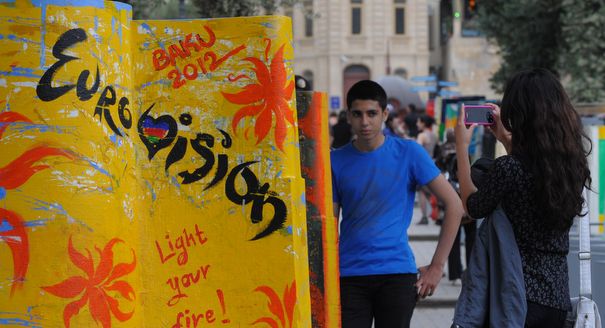
What has this weekend’s Eurovision Song Contest got to do with the European Union and the Council of Europe?
A lot.
The contest will be held in Baku, the capital of Azerbaijan.
Azerbaijan is a member of the EU’s Eastern Neighborhood Policy whose goal is to bring countries in the region closer to Europe through supporting the rule of law and strengthening democracy.
Azerbaijan is also a member of the Council of Europe that is based in Strasbourg and which is the European organization for upholding human rights.
Over the past several years, Azerbaijan’s record on human rights has deteriorated and its efforts to consolidate democratic practices have decreased, according to Human Rights Watch and other advocacy groups.
So you would think that this should be an ideal chance for the European Union and the Council of Europe to join forces and use the Song Contest to highlight the crackdown on the independent media and rights activists.
After all, this glitzy, kitschy annual event is attended by tens of thousands of people, not to mention the millions of television viewers.
Not a bit of it.
In fact, there is almost no criticism coming from Brussels or Strasbourg.
The main reason is that Azerbaijan has lots of oil and gas.
That makes it so strategically important for Europe, that the EU, according to a new report by the European Council on Foreign Relations, “is more concerned about its own energy interests and security in Azerbaijan than for the state of democracy there.”
Even when the EU has been vocal about democracy in Azerbaijan, “individual member states and the EU institutions have in reality cooperated with the regime in Baku without imposing conditionality,” adds ECFR.
Lets turn to the Council of Europe that consists of 47 countries representing 800 million citizens.
The Council of Europe is one of those organizations that all countries of Eastern Europe and the former Soviet Union were desperate to join once the communist regimes had collapsed.
For Vaclav Havel, the former and late president of the Czech Republic, the Council of Europe was “the most important European political forum.”
It was, he said, a club of democracies committed to upholding the highest level of human rights protection. Being admitted as a member meant a country met the highest standards of democracy and human rights.
It’s a different matter for Azerbaijan.
The Council of Europe, like the EU, has often preferred to turn a blind eye to the growing human rights abuses by President Ilham Aliyev’s regime.
Clearly, Azerbaijan’s vast wealth and energy resources mean that the country is not vulnerable to outside political pressure or the withdrawal of financial assistance.
It means that the inconsistent policy of conditionality practiced by the Council of Europe and the EU has little impact on the regime.
It means that the divisions in both organizations make it easier for Azerbaijan to play off member states against each other.
It also means that the Aliyev regime can afford to pay lobbyists in several European capitals to improve Azerbaijan’s image and especially to dissuade Council of Europe delegations from criticizing Azerbaijan’s human rights record.
The way in which Azerbaijan has organized a lobby network in Strasbourg is the subject of a new report published this week by the European Stability Initiative, an independent think tank based in Berlin and Istanbul.
It documents how several delegations have blocked attempts inside the Council of Europe to reprimand Azerbaijan. These include diplomats from Belgium, Spain, Malta, Turkey, Russia, and Poland.
It documents cases of diplomats accepting free and lavish trips to Azerbaijan, as well as gifts while ignoring flawed elections.
Of course, not all diplomats or lawmakers succumb to this.
Christoph Straesser is a German federal lawmaker and the Rapporteur for Political Prisoners for the Council of Europe’s Parliamentary Assembly.
The Azeri regime has for many months refused to issue a visa for Straesser. Azeri diplomats told Strategic Europe that he [Straesser] was overstepping his mandate. He could visit Azerbaijan as a private citizen.”
Straesser is sticking to his mandate which includes seeking access to the political prisoners.
But the sad thing is that many Parliamentary Assembly members are not backing Straesser to the hilt.
Instead, they are siding with Azerbaijan in a way that is undermining the Council of Europe’s credibility.
“It is a story of how Europe’s oldest human rights organization has been neutered,” wrote Gerald Knaus, director of the European Stability Initiative and author of the report.
When it comes to having any kind of long-term strategy towards this vulnerable region in the Caucasus, the attitude by the EU and the Council of Europe towards Azerbaijan matters.
It shows that the EU is unable to separate interests from values.
If it wants to import Azeri oil and gas, well and good.
But that does not mean it cannot at the same time pursue a policy of defending human rights and speaking out against political prisoners and the suppression of the media.
The EU and Council of Europe also know that if they turn a blind eye to abuses in Azerbaijan, either because of interests or the power of lobbyists, it means disowning those seeking to establish democratic institutions in Azerbaijan.
By supporting Aliyev’s authoritarian regime, it’s as if Europe has learned nothing from the Arab Spring.

Nonresident Senior Fellow, Carnegie Europe
Judy Dempsey is a nonresident senior fellow at Carnegie Europe
Recent Work
Judy Dempsey
Judy Dempsey
Carnegie does not take institutional positions on public policy issues; the views represented herein are those of the author(s) and do not necessarily reflect the views of Carnegie, its staff, or its trustees.

Before the next wave of EU enlargement takes place, the union needs to grapple with thorny questions of how power is distributed among its members.


Emil Sondaj Hansen, Ditte Brasso Sørensen

A summer of escalation in the Black Sea has hurt Ukraine economically and is exacerbating world food security. A truce is needed—as is a broader reframing of Europe’s Ukraine strategy.

Thomas de Waal

Are Germany’s economic, industrial, and political struggles becoming a liability for the EU’s ability to rise to the geopolitical moment?

Rym Momtaz, ed.

European Commission President Ursula von der Leyen is about to give her annual address on the state of the EU. Here’s what she won’t—but should—say.
Rym Momtaz

The aftermath of the Ceuta crisis shows Europe has drawn the wrong lessons. Rather than doubling down on failed migration policies, the EU needs to address the underlying roots of such episodes.

Richard Youngs