

Commentary
Judy Dempsey
{
  "authors": [
    "Judy Dempsey"
  ],
  "type": "commentary",
  "blog": "Strategic Europe",
  "centerAffiliationAll": "",
  "centers": [
    "Carnegie Endowment for International Peace",
    "Carnegie Europe"
  ],
  "collections": [],
  "englishNewsletterAll": "",
  "nonEnglishNewsletterAll": "",
  "primaryCenter": "Carnegie Europe",
  "programAffiliation": "",
  "programs": [],
  "projects": [],
  "regions": [
    "Asia",
    "North America"
  ],
  "topics": [
    "EU"
  ]
}
Source: Getty
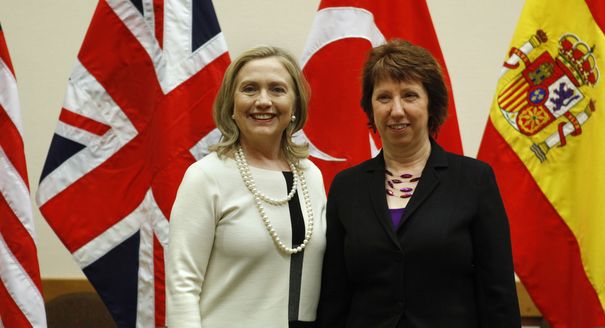
Because Europe and the United States have shared values the State Department wants both to work together to promote them in the Asia-Pacific region.
A confidential foreign policy document is making the rounds among EU officials.
The State Department sent it to the External Action Service, the EU’s new foreign ministry led by Catherine Ashton.
The two-page document, the first of its kind to be addressed to Brussels, calls for the United States and Europe to work together in Asia at a time when Washington is shifting its foreign policy attention towards that region.
The fact that the State Department set out a detailed timetable over the next few months as to how this might be achieved suggests that the External Action Service it being taken very seriously by Washington.
Of course it helps that Secretary of State Hillary Clinton and Ashton get on so well. But even better, the existence now of a foreign service in Brussels could give the United States and Europe a chance to work strategically on certain issues.
The document is called “Enhancing U.S.-E.U. Dialogue and Engagement on Asia-Pacific Issues”
It states clearly that a key feature of U.S.-EU cooperation in the 21st century “will be the efforts we make in the Asia-Pacific region to maintain peace and stability, promote democracy, human rights and the rule of law and enhance global prosperity. It is imperative that we build a comprehensive framework steered at a senior level to coordinate our efforts in the region.”
All that sounds very worthy.
But the document, to its credit, moves quickly away from generalities to concrete ideas about how Washington and Brussels can work together in the region.
The ASEAN Regional Forum that will be held in July has been chosen for the launch of the dialogue.
The plan is that Clinton and Ashton will release a joint statement “highlighting the importance of U.S.-EU strategic cooperation in the Asia-Pacific and outlining shared perspectives on pressing regional issues.”
Clearly, the United States believes that ‘teaming up’ with Europe and showing to the region that the United States and Europe have shared interests and values, is more effective than going it alone.
It could help dilute suspicions, especially by China, that the United States is out to counter Beijing’s ever-growing influence in the region.
The State Department has put forward five priorities for this new dialogue. Here they are:
Shared interests: That means working together on human rights, the changes taking place in Burma, and dealing with more complex issues including North Korea and the South China Sea Disputes.
“The United States and the EU should have a more powerful voice on our shared interests by coordinating and reinforcing our strategic messages,” the paper proposes.
Economic Concerns and Development Coordination: This covers topics from market access and investment to intellectual property rights issue. As for development assistance, the document calls for synergies. This makes sense. There is far too much duplication and competition between development agencies. We saw this in Afghanistan. Lets hope it will not happen in Burma.
High-Level Engagement: The document proposes that the United States and the EU should engage the region, and at a high level, on a wide range of issues. It is not clear from the document what this would entail.
Commitment to Multilateralism: At a time when the region’s own multilateral institutions are evolving, the document proposes that the United States and the EU encourage the establishment of a robust regional architecture that reinforces the systems of rules and responsibility “essential to promoting peace, stability and prosperity.” Fine words. We need more details.
Enhanced Security Engagement: I can see the EU balking at this proposal:
“We are witnessing an increasing desire by many in the region for outside players to have a larger security and military presence and engagement plan in the region. The United States and the EU can explore elevating their discussions on these issues, with particular regard to expanding cooperation in areas such as maritime, security, anti-piracy efforts, cyber security and counterterrorism.”
The United States has thrown down the gauntlet to Brussels. Because Europe and the United States have shared values it wants both to work together to promote them in the Asia-Pacific region.
Interests are an entirely different matter. But if this pithy document can concentrate the minds of the EU’s top policy makers in the External Action Service on thinking strategically, there could be some real progress, not just with Asia, but with the United States itself.

Nonresident Senior Fellow, Carnegie Europe
Judy Dempsey is a nonresident senior fellow at Carnegie Europe
Recent Work
Judy Dempsey
Judy Dempsey
Carnegie does not take institutional positions on public policy issues; the views represented herein are those of the author(s) and do not necessarily reflect the views of Carnegie, its staff, or its trustees.

Trump is distracted and Ukraine wants Europe to step up. The continent’s leaders must find their voice and assert it in talks with Russia.

Alissa de Carbonnel

Mounting economic strain and battlefield losses will not necessarily make the Kremlin less dangerous. They could instead push Moscow toward a more aggressive hybrid campaign designed to test NATO’s Eastern flank, exploit allied hesitation, and fracture European resolve.

Maksym Beznosiuk

Over the past ten years, NATO has held almost as many summits as it did during the entirety of the Cold War. Are they still useful, or is it time to stop holding annual meetings?

Rym Momtaz, ed.
Nearly a year and a half after Europeans leaned into sucking up to Trump, the strategy has produced some benefits when it comes to Ukraine.
Rym Momtaz
Far-right leader Marine Le Pen can—and will—run in France’s next presidential election. What does the outcome of her appeal against a 2025 embezzlement conviction mean for the country’s political future?

Catherine Fieschi