

Commentary
Judy Dempsey
{
  "authors": [
    "Judy Dempsey"
  ],
  "type": "commentary",
  "blog": "Strategic Europe",
  "centerAffiliationAll": "",
  "centers": [
    "Carnegie Endowment for International Peace",
    "Carnegie Europe"
  ],
  "collections": [],
  "englishNewsletterAll": "",
  "nonEnglishNewsletterAll": "",
  "primaryCenter": "Carnegie Europe",
  "programAffiliation": "",
  "programs": [],
  "projects": [],
  "regions": [
    "Europe",
    "Middle East"
  ],
  "topics": [
    "EU",
    "Security"
  ]
}
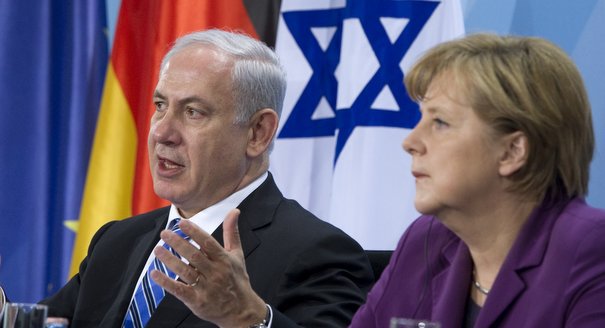
Source: Getty
Angela Merkel is a staunch defender of Israel but far from silent over Benjamin Netanyahu's settlement policies.
As if it wasn’t known until now. Germany is building submarines for Israel that are designed to deploy nuclear missiles.
Politicians have been aware of this for years, ever since the former Social Democrat chancellors, Willy Brandt and Helmut Schmidt began negotiations with Israel about supplying such submarines.
Later, Helmut Kohl, the former conservative chancellor, sealed the deal that has continued without interruption.
Nevertheless, this week, Der Spiegel, the German weekly newsmagazine, published a lengthy article about the submarines. The peg was that for the first time ever, Israel had allowed foreign reporters down into one of the vessels.
Some German politicians in Chancellor Angela Merkel’s conservative coalition were embarrassed if not infuriated by the article, particularly because both countries had tacitly agreed not to discuss this issue openly. And besides, Israel has consistently adopted a policy of ambiguity about its own nuclear weapon program.
Israel, however, had its own agenda for giving Der Spiegel such access. It was a public relations exercise aimed at demonstrating to Iran that Israel has nuclear-armed submarines. So if Iran dares to attack Israel, Israel has a second strike capability. The submarines are Israel’s insurance policy if Iran one day gets the bomb or if another country attacks Israel.
Despite the magazine’s details about the construction and costs of the submarines and more importantly, the growing concern among Germans that Israel might start a war by striking Iran’s nuclear program targets, the reaction among the public and politicians was muted.
The reason is that when it comes to Israel’s security, there is little or no discussion. As former chancellor Gerhard Schroder once put it succinctly: “Israel gets what it needs.”
But this has not stopped a debate about the changing relationship between Germany and Israel as a younger generation believes that the Holocaust should no longer prevent Germany from being able to criticize Israel.
Take Merkel’s attitude.
She is one of the staunchest defenders of Israel. In the coalition treaty agreed in 2009 between her conservative bloc and the pro-business Free Democrats, Israel is referred to as a “Jewish” state.
A year earlier, in a speech to the Knesset, Merkel said that the responsibility for Israel is “part of Germany’s raison d’Etat. It means for me, as a German chancellor, that Israel’s security is never negotiable.”
Joachim Gauck, who was recently inaugurated as Germany’s president, questioned Merkel’s policy during his visit last month to Israel.
“I don’t want to imagine every scenario that could get the chancellor in tremendous trouble when it comes to politically implementing her statement that Israel’s security is part of Germany’s reason of state.” He later had to modify his views.
Her commitment to Israel has not stopped Merkel from criticizing Prime Minister Benjamin Netanyahu’s settlements policy.
Time and again, even standing beside Netanyahu in public, Merkel has spoken out against the settlements. In private, she has shouted at Netanyahu on the telephone, criticizing him for going back on his word to her about ending the freeze on building new settlements. In Merkel’s view, the settlements are illegal. They make it more difficult than ever for a two-state solution.
The relationship between the two leaders has deteriorated so much that senior Israeli officials can no longer expect automatic access to the Chancellery and Merkel no longer speaks to Netanyahu on a regular basis.
Berlin’s attitude towards the Netanyahu government has implications for the rest of Europe.
Until recently, Israel could rely on Germany to weaken any tough European Union statements with regard to the Israeli-Palestinian conflict. That is no longer the case.
This worries the Israeli government and the public, but not to the extent of persuading Israel to change its policies on settlements.
Indeed, the more Europe criticizes the Netanyahu government, the more the Netanyahu government criticizes Europe, including Germany for being anti-Israel, in a way, some Israeli diplomats claim, that could give rise to anti-Semitism. The German government is quick to refute such claims.
What Netanyahu’s government does not want to realize is that from Merkel’s viewpoint, both policies on Israel align: delivering submarines to safeguard the state’s existence against enemies from abroad, and stopping the settlements to allow for a two-state solution within. Both, Merkel believes, are needed if Israel is to continue existing as a Jewish state.

Nonresident Senior Fellow, Carnegie Europe
Dempsey is a nonresident senior fellow at Carnegie Europe
Recent Work
Judy Dempsey
Judy Dempsey
Carnegie does not take institutional positions on public policy issues; the views represented herein are those of the author(s) and do not necessarily reflect the views of Carnegie, its staff, or its trustees.
French President Emmanuel Macron has unveiled his country’s new nuclear doctrine. Are the changes he has made enough to reassure France’s European partners in the current geopolitical context?

Rym Momtaz, ed.
European reactions to the war in Iran have lost sight of wider political dynamics. The EU must position itself for the next phase of the crisis without giving up on its principles.

Richard Youngs
Europe isn’t as weak in the new geopolitics of power as many would believe. But to leverage its assets and claim a sphere of influence, Brussels must stop undercutting itself.

Dimitar Bechev
Europe’s reaction to the war in Iran has been disunited and meek, a far cry from its previously leading role in diplomacy with Tehran. To avoid being condemned to the sidelines while escalation continues, Brussels needs to stand up for international law.

Pierre Vimont
France and Germany’s failure to agree on the Future Combat Air System (FCAS) raises questions about European defense. Amid industrial rivalries and competing strategic cultures, what does the future of European military industrial projects look like?
Rym Momtaz, ed.