

Commentary
Judy Dempsey
{
  "authors": [
    "Judy Dempsey"
  ],
  "type": "commentary",
  "blog": "Strategic Europe",
  "centerAffiliationAll": "",
  "centers": [
    "Carnegie Endowment for International Peace",
    "Carnegie Europe"
  ],
  "collections": [],
  "englishNewsletterAll": "",
  "nonEnglishNewsletterAll": "",
  "primaryCenter": "Carnegie Europe",
  "programAffiliation": "",
  "programs": [],
  "projects": [],
  "regions": [
    "Europe"
  ],
  "topics": [
    "Climate Change",
    "EU"
  ]
}
Source: Getty
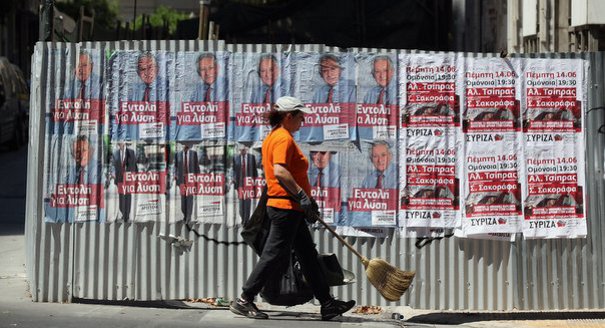
No matter which party wins on Sunday, Greece’s next government needs to achieve a giant leap in political culture if it is to make the Greek economy more competitive, the state more efficient, and civil society more vibrant.
There is nothing like Orwellian double speak.
Just take Greece’s electoral system. It is called “reinforced proportionality”.
When voters go to the polls on Sunday, they will be endorsing a highly undemocratic system that allots 50 extra parliamentary seats to the party that comes home with the most votes.
The idea behind this bonus system was to ensure stable, one-party governments.
At the time, it did not seem to matter that reinforced proportionality was designed to favor the two family-based parties, the conservative New Democracy, or ND, home to the Karamanlis family, and the centrist Panhellenic Socialist Movement, or PASOK, home to the Papandreou family.
These two family parties have run Greece like two feudal landlords ever since the collapse of the military junta in 1974.
They made sure that they had a political foothold in professional or amateur clubs and associations, be it sports, business, or simple leisure activities. It didn’t matter. What mattered was that they signed up to ND or PASOK.
But that’s over, now.
The two-family party system, throttled by the economic crisis and austerity measures, has largely given way to extreme right and left-wing parties.
At the last election in May, ND came first and received the 50 seat bonus. But even together with PASOK, its long-time rival, it still wasn’t strong enough to form a government. Hence, this Sunday’s new election.
Alexis Tsipras, the leader of the populist left-wing Szriza party that won 17 percent in the May elections may become head of the largest party on Sunday. Then what?
Clearly, he will be automatically allotted his 50 extra seats. But unless the opinion polls have gotten it all wrong, those extra seats will not give his party a parliamentary majority. He will have to form a coalition. His options for coalition partners are limited.
Tsipras has made it clear that he had no intention of withdrawing from the euro. But neither has he any intention of sticking to the austerity package. In which case, the EU and the IMF have threatened to cut off all further payments to Greece.
From their perspective, it would be better if Greece’s old parties made a comeback. At least they are, in principal, committed to keeping to the austerity measures.
But do they have the political maturity to see reforms through?
Look at what happened in April.
In the throes of this financial crisis and while the austerity measures were badly hurting ordinary Greeks, ND and PASOK hurriedly voted through a bill that grossed them an extra 29 million euros in state funding. They declared it an advance on payments they would be due to have received later to finance their election campaigns.
Most opposition parties decried the payout. It was “a provocation” of voters who were trying to cope with the austerity and economic crisis.
In Brussels, Guy Verhofstadt, leader of the liberal group in the European Parliament and former Belgian prime minister, was furious. European taxpayers, he wrote, were funding Greek political parties.
"The cost of politics in Greece is a scandal,” Verhofstadt wrote in a letter to Jose Manuel Barroso, president of the European Commission.
“Pasok and New Democracy are responsible for all the structural problems of Greece and like leeches they have been sucking out millions of taxpayers' money", he wrote.
Verhofstadt added that in 2010, the political parties in Greece were one of the highest funded in Europe as a proportion of tax revenue (0,14%). That was 7 times more than in Germany (0,02%).
"Why should we continue with the second Greek bailout package if the two largest parties in Greece do not show any signs of changing the system? It is not acceptable for the European tax payer to effectively pay for the 'recapitalization' of the Greek political parties," he added.
Little did Verhofstadt know that ND and PASOK are broke, which says a lot about their ability even to administer their own finances.
Despite all their years in power and the way they entrenched themselves in a system of patronage and clientelism, they can no longer pay their staff. They owe the banks 250 million euros.
What does that say about their ability to administer billions of euros in EU and IMF bailout funds?
No matter which party wins on Sunday, Greece’s next government needs to achieve a giant leap in political culture if it is to make the Greek economy more competitive, the state more efficient, and civil society more vibrant.
But how likely is that?

Nonresident Senior Fellow, Carnegie Europe
Judy Dempsey is a nonresident senior fellow at Carnegie Europe
Recent Work
Judy Dempsey
Judy Dempsey
Carnegie does not take institutional positions on public policy issues; the views represented herein are those of the author(s) and do not necessarily reflect the views of Carnegie, its staff, or its trustees.

Are Germany’s economic, industrial, and political struggles becoming a liability for the EU’s ability to rise to the geopolitical moment?

Rym Momtaz, ed.

European Commission President Ursula von der Leyen is about to give her annual address on the state of the EU. Here’s what she won’t—but should—say.
Rym Momtaz

The aftermath of the Ceuta crisis shows Europe has drawn the wrong lessons. Rather than doubling down on failed migration policies, the EU needs to address the underlying roots of such episodes.

Richard Youngs

An overwhelming victory by a far-right-wing party in a small state in eastern Germany will have major repercussions for Chancellor Friedrich Merz’s coalition.
Judy Dempsey

Canadian Prime Minister Mark Carney has twice inspired praise for standing up to U.S. President Donald Trump: at the 2026 World Economic Forum in Davos and on Canada-U.S. trade negotiations. Is Carney showing a third way better than the EU has in dealing with the Trump administration?
Rym Momtaz, ed.