

Commentary
Judy Dempsey
{
  "authors": [
    "Judy Dempsey"
  ],
  "type": "commentary",
  "blog": "Strategic Europe",
  "centerAffiliationAll": "",
  "centers": [
    "Carnegie Endowment for International Peace",
    "Carnegie Europe"
  ],
  "collections": [],
  "englishNewsletterAll": "",
  "nonEnglishNewsletterAll": "",
  "primaryCenter": "Carnegie Europe",
  "programAffiliation": "",
  "programs": [],
  "projects": [],
  "regions": [],
  "topics": [
    "EU",
    "Security"
  ]
}
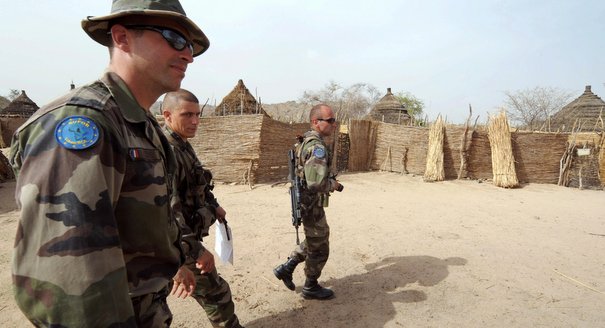
Source: Getty
France, the former colonial power in the region, has already referred to Mali becoming a “West African Afghanistan”.
Are you interested in a twelve-month grueling and possibly dangerous job far away from home?
Are you an EU citizen, healthy, flexible, and fluent in French? Have you qualified in Hostile Environment Awareness Training?
If yes, please apply soonest to the European External Action Service (EEAS) to join its special security mission to Niger.
The three-dozen or so EU personnel will consist of military, political, and intelligence advisors. They will help train Niger’s police and security forces to fight terrorism and organized crime.
Hurry up if you want to join them, because they are supposed to be on the ground by August.
And this is the background to this tantalizing job offer: The EEAS has begun to think strategically about the Sahel, a region long neglected by world powers.
The reason is that Europe fears the Sahel may turn into a new refuge for terrorists.
The EEAS’s strategy report, published over a year ago, is a thorough piece of analysis that sets out a long-term policy for the region in addition to considering short-term measures.
Any expert will tell you that what happens there will have immense repercussions for the region, but also Europe.
A look at the map of Sub-Sahara and the recent news about how radical Islamists, now in control of northern Mali, sacked Muslim holy sites in Timbuktu shows the combustibility of the region.
The neighboring countries’ leaders are terrified.
The Sahel consists of three core countries: Mauritania, Mali, and Niger. It is one of the poorest regions in the world and is plagued by drought and famine, drug and human trafficking, criminal gangs, and weak states. See Anouar Boukhars’s recent analysis on, for example, Mauritania.
That’s not all. When Al Qaeda was forced to leave Afghanistan in 2001 after the U.S. invasion, some of its members relocated to Yemen and to Mali.
Ansar Dine, a group of Islamic fundamentalists with close ties to al-Qaeda in the Islamic Maghreb, or AQIM, exploited the ethnic divisions in Mali, and the fall-out from the Arab Spring.
After the collapse of the Qaddafi regime, Tuareg mercenaries from northern Mali, Niger, and Algeria who had been in the pay of the late Muammar Qaddafi, returned home.
They boosted the Tuareg separatist movement in northern Mali, managing to drive out the military and proclaim this past May an independent state called Azawad.
In a decision that was controversial even among Tuareg tribes, the separatists then teamed up Ansar Dine, which is well armed and well financed.
Judging from what happened in Timbuktu, it now seems the Tuaregs have been completely outmaneuvered by Ansar Dine which has pledged to introduce Sharia law.
The government of Mali had failed miserably to contain the Tuareg separatists. In protest, a disgruntled and poorly equipped army staged a coup in the capital, Bamako.
The combination of separatism, fundamentalism and an army coup in Mali has made the country’s neighbors, Mauritania to the west and Niger extremely vulnerable.
EU, French, United Nations, and U.S. diplomats working in the region are in no doubt that if Al-Qaeda and its offshoots do manage to establish footholds in the Sahel, they will use them as launching pads into neighboring countries. Sooner or later, the wave of terrorism could reach Europe.
France, the former colonial power in the region, has already referred to Mali becoming a “West African Afghanistan”.
Ashton’s team is not naïve enough to believe that sending a few dozen European personnel to Niger will alone have any immediate impact on neighboring Mali or the rest of the Sahel.
What the EEAS is trying to do is to establish close links to the Community of West African States (ECOWAS), the African Union, the United States, and the UN.
“The key thing is that we have to keep the international community together to achieve our immediate goals,” said one EU diplomat who is an expert on the region.
Those include restoring civilian rule to Bamako and helping Mali’s neighbors as much as possible.
The EU knows there is no quick fix, as the EEAS’s Strategy Report makes clear. But at least the EEAS is putting the Sahel on the radar screens. “I only regret we did not begin thinking strategically about the region three years ago,” a veteran regional expert said.
Nonresident Senior Fellow, Carnegie Europe
Judy Dempsey is a nonresident senior fellow at Carnegie Europe
Recent Work
Judy Dempsey
Judy Dempsey
The EU can impose sanctions but struggles to enforce them without the United States. With Washington increasingly disinterested in backing European interests, the bloc must now fend for itself.
Nicu Popescu, Tiago Antunes
Russia is testing the waters of NATO’s mutual defense clause. What do strikes in Romanian territorial waters mean for the alliance’s posture toward Moscow?

Dimitar Bechev
With its public finances in shambles, the far right polling at 35 percent ahead of the 2027 presidential election, and a growing protest movement, is France’s crisis a threat to the EU’s geopolitical awakening?

Rym Momtaz, ed.
Ahead of a tough winter for Ukraine, Donald Trump’s swing back toward Russia bodes ill. But instead of panicking, Kyiv’s European allies are focusing on action.
Rym Momtaz
While the EU and European governments are embracing the much-lauded middle-power moment, this entails three difficult conundrums.
Richard Youngs