

Commentary
With its public finances in shambles, the far right polling at 35 percent ahead of the 2027 presidential election, and a growing protest movement, is France’s crisis a threat to the EU’s geopolitical awakening?
Rym Momtaz, ed.
{
  "authors": [
    "Karl-Heinz Kamp"
  ],
  "type": "commentary",
  "blog": "Strategic Europe",
  "centerAffiliationAll": "",
  "centers": [
    "Carnegie Endowment for International Peace",
    "Carnegie Europe"
  ],
  "collections": [],
  "englishNewsletterAll": "",
  "nonEnglishNewsletterAll": "",
  "primaryCenter": "Carnegie Endowment for International Peace",
  "programAffiliation": "",
  "programs": [],
  "projects": [],
  "regions": [
    "Europe",
    "North America"
  ],
  "topics": [
    "Security"
  ]
}
Source: Getty
It is time to forget about the nuclear free world and tackle the real issues.
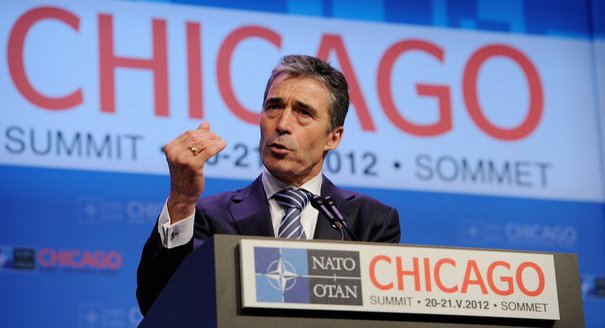
At its Chicago summit, NATO approved the “Deterrence and Defense Posture Review”. Never heard of it? Don’t worry—you’re not the only one! It is one of those wonderful communiqué style documents—absolutely incomprehensible and written by and for the nuclear wonks within the Alliance. Still it is arguably one of the summit’s most important achievements, as it ends NATO’s dispute on the future of those U.S. nuclear weapons that are still stationed in Europe. Germany had long requested the withdrawal of the few American nuclear bombs stored on its soil. For other NATO members, particularly for those in the East, these bombs symbolize the highest level of U.S. security guarantees for Europe—tacitly directed against a potential threat from Russia.
As a result, NATO was for a long time at odds over what is seemingly the core of the nuclear question: how to deter whom with what? Does NATO still need American nukes deployed on European territory, as during the Cold War, or can’t they be put offshore on American submarines? Can’t we agree with Moscow on a withdrawal of all nuclear weapons in Europe, as Russia still keeps thousands of them on its European territory? Wouldn’t such an arrangement get us closer to the nuclear free world President Obama had enthusiastically announced at the beginning of his presidency?
Confronted with the danger of a nuclear Iran, with an unpredictable North Korea, and with an increasingly confrontational government in Moscow, NATO finally found nuclear realism. In Chicago, the Alliance agreed that U.S. nuclear weapons in Europe remain necessary for NATO’s deterrence requirements—hence, they remain deployed in Germany, Italy, and elsewhere. Moreover, “all elements” of nuclear deterrence have to be kept efficient—this means that weapons need to be modernized when they become technically obsolete. Arms control with Russia should be tried, but the chances of success remain slim. Global nuclear disarmament remains a nice idea but it has been put on the backburner.
One can agree or disagree with these points, but the fact that this agreement was signed at the highest political level in NATO—including by the German chancellor—creates a reality. NATO now has a nuclear consensus which cannot be put into question any more—not even by the foreign minister of a major member state or by the “Russia first” faction in NATO.
As important as the agreement itself was the fact that NATO dared to tackle these controversial questions at all, instead of sweeping them under the carpet. The Deterrence Review process was as important as the result.
This is why discussions need to go on dealing with the follow-on problems. Will NATO’s deterrence equation change if Teheran possesses a nuclear bomb? What if other countries in the Middle East or in East Asia strive for nuclear weapons as well? What is the relationship between nuclear deterrence and missile defense? Who will pay for costly deterrence capabilities when the financial crisis hits us even harder? These are some of the issues that make a further NATO nuclear dialogue necessary. It is time to forget about the nuclear free world and tackle the real issues.
Karl-Heinz Kamp is research director of the NATO Defense College in Rome. The views expressed here are the author’s own.
Karl-Heinz Kamp
NATO Defense College
Carnegie does not take institutional positions on public policy issues; the views represented herein are those of the author(s) and do not necessarily reflect the views of Carnegie, its staff, or its trustees.

With its public finances in shambles, the far right polling at 35 percent ahead of the 2027 presidential election, and a growing protest movement, is France’s crisis a threat to the EU’s geopolitical awakening?

Rym Momtaz, ed.

Ahead of a tough winter for Ukraine, Donald Trump’s swing back toward Russia bodes ill. But instead of panicking, Kyiv’s European allies are focusing on action.
Rym Momtaz

While the EU and European governments are embracing the much-lauded middle-power moment, this entails three difficult conundrums.

Richard Youngs

Much has been said of the changes Brussels is trying to make to the EU enlargement process. Here’s why gradual integration might—or might not—be the answer.

Dimitar Bechev

The European Commissioner for Trade is headed to China. But after President Xi’s bridge-building visit to Washington, can a more isolated EU overcome Beijing’s stranglehold on critical raw materials? Who will blink first?
Rym Momtaz, ed.