

Commentary
Judy Dempsey
{
  "authors": [
    "Judy Dempsey"
  ],
  "type": "commentary",
  "blog": "Strategic Europe",
  "centerAffiliationAll": "",
  "centers": [
    "Carnegie Endowment for International Peace",
    "Carnegie Europe"
  ],
  "collections": [],
  "englishNewsletterAll": "",
  "nonEnglishNewsletterAll": "",
  "primaryCenter": "Carnegie Europe",
  "programAffiliation": "",
  "programs": [],
  "projects": [],
  "regions": [],
  "topics": [
    "EU"
  ]
}
Source: Getty
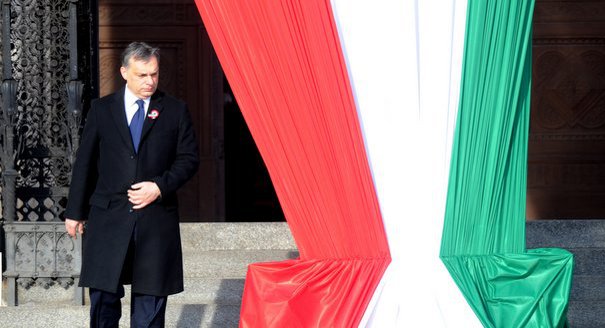
By condoning the Horthy and Nyiro commemorations, Hungarian Prime Minister Viktor Orban has really crossed a red line.
When a far-right wing political party decides to put up statues and name streets after Admiral Miklos Horthy who ruled Hungary between 1920 and 1944 and was an ally of Nazi Germany, you would expect Prime Minister Viktor Orban and his conservative Fidesz government to object.
Not a bit of it.
“It’s solely the local government that decides on establishing a monument,” Orban told the Austrian daily Die Presse.
Orban was speaking after the mayor of Csokako, a small village west of the capital Budapest, unveiled a bust of Horthy by the Hungarian Guard and the Sixty-Four Counties Youth Movement. These are far-right groups affiliated with members of Jobbik, the parliamentary far-right wing party.
Csokako is not an isolated case.
The Reform College of Debrecen in eastern Hungary, where Horthy studied, recently unveiled a plaque to their former student.
The town square in Gyomro, just outside Budapest, has been renamed after Horthy.
A statute was also unveiled in the village of Kereki, near Lake Balaton.
In the interview with Die Presse, Orban acknowledged that the debate over Horthy has been “long and difficult” and he wanted it to continue. “Hungary is a democracy. If people want to discuss something, they have to discuss it.” It was not his role as prime minister to make the final verdict.
I disagree. Strongly. Horthy was one of the worst political figures Hungary ever produced. He was a dictator, an aggressive nationalist, and an ally of Hitler, leading his country into a disastrous war.
Horthy’s unswerving support for a “big Hungary” still resonates among some Fidesz supporters. They know it is unrealistic to believe that Hungary’s borders could be re-drawn. But Orban has put great store in reaching out to Hungarian minorities abroad, ensuring that they have the right to Hungarian citizenship. His strident nationalist rhetoric has upset Slovakia and Romania, home to sizeable Hungarian minorities.
But the worst part of this gradual rehabilitation of Horthy is that it seems to condone Horthy’s treatment of the Jews.
Hungary once had a thriving Jewish community. Horthy introduced anti-Jewish laws, placing Jews into ghettos, expropriating their assets, and barring them from universities and top jobs. Many thousands died in forced labor camps.
Horthy, however, did not deport the Jews to the concentration camps. He refused Hitler’s requests to do so.
The deportations only began when the Nazis invaded Hungary in March 1944. By then, Horthy had been ousted by the Nazi Arrow Cross movement.
During the following summer, an estimated 437,000 Hungarian Jews were sent to Auschwitz, with little need of help by German guards.
While Fidesz has been passive with regard to the ‘rehabilitation’ of Horthy, it has been active in the case of the writer Jozsef Nyiro, (1889-1953) who publicly railed against Jews.
Nyiro was a staunch supporter of Ferenc Szalasi, leader of Hungary’s fascist and fiercely anti-semitic Arrow Cross party. After World War Two, Nyiro was not included in the school curriculum.
Until now, that is.
The inclusion in the curriculum was “clearly about his literary work,” according to the government spokesman, Andras Giro-Szasa in an e-mailed response to questions by Bloomberg.
This past May, Laszlo Kövér a leading Fidesz member and Speaker of the Hungarian Parliament, tried to organize a reburial service for the writer who was born in Jimbor (Szekelyzsombor in Hungarian) in Transylvania, Romania, which had been part of Hungary before 1918.
Romania banned the ceremony.
“Romania does not accept commemorations and anniversaries for people who were known for anti-Romanian, anti-Semitic and pro-fascist behavior,” said Victor Ponta, the Romanian Prime Minister.
Orban said the reburial of Nyrio was a “funerary matter”—whatever that means.
Jewish leaders in Hungary and elsewhere are angry and worried about Orban’s rehabilitation of Nyiro and the way he has turned a blind eye to the Horthy memorials.
Elie Wiesel, the Nobel Prize laureate and Holocaust survivor vented his anger in a letter to Kövér. He accused the government of glossing over the country's dark past.
"I found it outrageous that the Speaker of the Hungarian National Assembly could participate in a ceremony honoring a Hungarian fascist ideologue,” Wiesel wrote. He returned the Great Cross, a Hungarian government award that he had received in 2004.
So why is Fidesz allowing this adulation of Horthy and Nyiro?
Hungary’s economic crisis and indeed the criticism by the EU of Orban’s management of the economy has fuelled nationalist sentiments.
Support for Fidesz, which was elected in 2010 with a two-thirds majority in parliament, has plummeted.
Beyond this bit of electoral populism, it is clear that Orban deeply believes in the idea of the Hungarian nation and is nostalgic of its former glories.
By condoning the Horthy and Nyiro commemorations, Orban has gone a step further than right-wing parties in Western Europe, vile as they may be.
The Netherlands, France, and the UK have all produced populist, xenophobic parties whose policies are sometimes condoned by the more mainstream rightwing parties.
But none of them have gone quite so far as Orban in allowing these parties to rewrite the nasty bits of their countries’ past.
Hungary, this time, has really crossed a red line.

Nonresident Senior Fellow, Carnegie Europe
Judy Dempsey is a nonresident senior fellow at Carnegie Europe
Recent Work
Judy Dempsey
Judy Dempsey
Carnegie does not take institutional positions on public policy issues; the views represented herein are those of the author(s) and do not necessarily reflect the views of Carnegie, its staff, or its trustees.
Trump is distracted and Ukraine wants Europe to step up. The continent’s leaders must find their voice and assert it in talks with Russia.

Alissa de Carbonnel

Mounting economic strain and battlefield losses will not necessarily make the Kremlin less dangerous. They could instead push Moscow toward a more aggressive hybrid campaign designed to test NATO’s Eastern flank, exploit allied hesitation, and fracture European resolve.

Maksym Beznosiuk
Over the past ten years, NATO has held almost as many summits as it did during the entirety of the Cold War. Are they still useful, or is it time to stop holding annual meetings?

Rym Momtaz, ed.
Nearly a year and a half after Europeans leaned into sucking up to Trump, the strategy has produced some benefits when it comes to Ukraine.
Rym Momtaz
Far-right leader Marine Le Pen can—and will—run in France’s next presidential election. What does the outcome of her appeal against a 2025 embezzlement conviction mean for the country’s political future?
Catherine Fieschi