

Commentary
Judy Dempsey
{
  "authors": [
    "Judy Dempsey"
  ],
  "type": "commentary",
  "blog": "Strategic Europe",
  "centerAffiliationAll": "",
  "centers": [
    "Carnegie Endowment for International Peace",
    "Carnegie Europe"
  ],
  "collections": [],
  "englishNewsletterAll": "",
  "nonEnglishNewsletterAll": "",
  "primaryCenter": "Carnegie Europe",
  "programAffiliation": "",
  "programs": [],
  "projects": [],
  "regions": [
    "Europe"
  ],
  "topics": [
    "Climate Change",
    "EU",
    "Security"
  ]
}
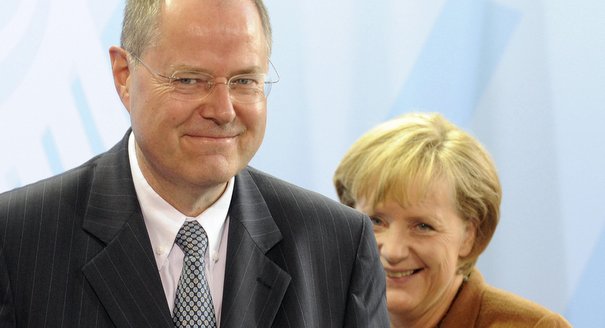
Source: Getty
In the run-up to Germany's 2013 federal election, the country will become even more inward looking, making it more difficult for Europe to revamp its foreign and security policy.
Bored with the euro crisis and the eternal squabbling inside Chancellor Angela Merkel’s center-right coalition, political observers in Germany now have something new to focus on.
The opposition Social Democrats have chosen Peer Steinbrück to run against Merkel. Steinbrück, 65, an economist and veteran politician, served as finance minister in Merkel’s first coalition government (2005-2009). She, it was always said, appreciated his intelligence and reliability as a minister.
Yet Steinbrück has a quick temper (although he is a keen chess player and makes model ships), and does not suffer fools gladly. Merkel, in contrast, is never prone to public outbursts, and few have any idea if she has any hobbies, if at all
And there is another, possibly crucial difference between the two main contenders for Germany’s most important public office: Merkel has her own conservative Christian Democratic Union party solidly behind her, long having weeded out any internal competition for the party leadership.
Steinbrück, in contrast, is not much liked by many Social Democrats, especially from the left wing of the party. Internally, he made a lot of enemies when he openly showed disdain for their lamentations over the social and labor market reforms that former Social Democratic chancellor Gerhard Schröder pushed through.
Steinbrück owes his candidacy not to his popularity at the grass root level, but to the fact that he is thought to be able to reach out to voters from the political center. He has upped the stakes by making it clear that he would personally decline to serve another term in a grand coalition under Merkel’s leadership.
Federal elections are not due until next September, so perhaps it’s a bit of a gamble for the Social Democrats to declare their candidate so early. Even political allies admit that the biggest risk may be Steinbrück’s own loud mouth.
During the height of the global financial crisis, the then finance minister boasted that Germany was immune from any contagion because its banking system and finances were all in order.
As it turned out, some big German mortgage banks had to be bailed out and the government pumped billions into the labor market to convince companies to keep on their work force for shorter hours, rather than dismissing them.
There are many reasons why Europe should care about the next German election and its outcome.
It is not just because Germany is the most populous of the EU countries with the largest economy. And it is not just because Germany has set the agenda for dealing with the euro crisis.
Rather, it is what choosing Steinbrück means for the future direction of Germany, and therefore European policy.
Steinbrück has no foreign policy experience at all, compared to Frank-Walter Steinmeier, the former foreign minister in Merkel’s first coalition. If the political agenda right now were dominated by foreign policy crises, Steinmeier would almost certainly have been the one to challenge Merkel.
But the Social Democrats opted for Steinbrück because of his experience as finance minister. He has been one of the most articulate and trenchant critics of Merkel in her handling of the euro crisis. He has always argued that Merkel reacted too slowly, was too inflexible and just did not appreciate the gravity of the crisis.
With this choice of candidate, it is clear that the election will be fought over the euro crisis and financial system reforms.
This has implications for Europe.
It means that at least until the federal elections, Germany will remain inward-looking, focusing on economic issues. Security, foreign, and defense issues will take second place.
At most, there might be a debate over where the European Union is heading. Certainly, Germany’s EU partners will not be able to look to Germany (not that they could have done so in recent years) to provide any new initiatives concerning the bloc’s strategy towards China, Russia, or the Middle East.
In short, Germany and Europe are in for a long period of looking inwards, as the EU has done for the past few years.
Should Steinbrück win next September, he will eventually discover the lure of foreign policy as all of his predecessors have done. Given that the polls show the Social Democrats lagging behind Merkel’s conservatives by about ten points, that seems fairly unlikely.
But he will give the Chancellor more of a run for her money than any of the other Social Democratic contenders could have done. And thanks to his quick wit and lack of prudence, the public can look forward to a lively contest over the next twelve months.

Nonresident Senior Fellow, Carnegie Europe
Judy Dempsey is a nonresident senior fellow at Carnegie Europe
Recent Work
Judy Dempsey
Judy Dempsey
Carnegie does not take institutional positions on public policy issues; the views represented herein are those of the author(s) and do not necessarily reflect the views of Carnegie, its staff, or its trustees.

Are Germany’s economic, industrial, and political struggles becoming a liability for the EU’s ability to rise to the geopolitical moment?

Rym Momtaz, ed.

European Commission President Ursula von der Leyen is about to give her annual address on the state of the EU. Here’s what she won’t—but should—say.
Rym Momtaz

The aftermath of the Ceuta crisis shows Europe has drawn the wrong lessons. Rather than doubling down on failed migration policies, the EU needs to address the underlying roots of such episodes.

Richard Youngs

An overwhelming victory by a far-right-wing party in a small state in eastern Germany will have major repercussions for Chancellor Friedrich Merz’s coalition.
Judy Dempsey

Canadian Prime Minister Mark Carney has twice inspired praise for standing up to U.S. President Donald Trump: at the 2026 World Economic Forum in Davos and on Canada-U.S. trade negotiations. Is Carney showing a third way better than the EU has in dealing with the Trump administration?
Rym Momtaz, ed.