

Commentary
Nathalie Tocci, Jan Techau
{
  "authors": [
    "Jan Techau"
  ],
  "type": "commentary",
  "blog": "Strategic Europe",
  "centerAffiliationAll": "",
  "centers": [
    "Carnegie Endowment for International Peace",
    "Carnegie Europe"
  ],
  "collections": [],
  "englishNewsletterAll": "",
  "nonEnglishNewsletterAll": "",
  "primaryCenter": "Carnegie Europe",
  "programAffiliation": "",
  "programs": [],
  "projects": [],
  "regions": [
    "Europe"
  ],
  "topics": [
    "EU"
  ]
}
Source: Getty
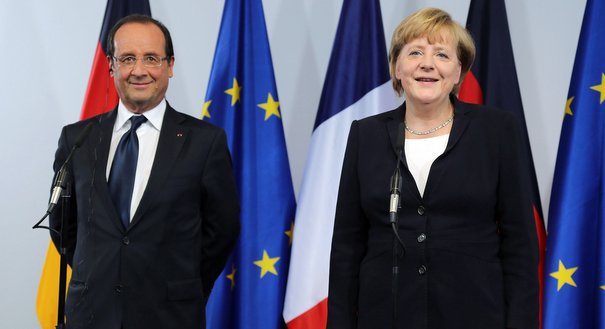
Europe's existential political and economic crisis has made it clear that the EU can't be properly managed without a functioning Franco-German axis.
Europe's existential political and economic crisis has made it clear that the EU can't be properly managed without a functioning Franco-German axis. Under the new French president, however, this crucial relationship is in tatters, with little hope of an imminent improvement. Should Europe's core remain absent from the stage for too long, it could have catastrophic results for the EU, and for the rest of the world. Germany can be strong without France, but it cannot be effective in the EU without it.
France has been the big danger lurking in the background of the euro crisis for the last few years. Overshadowed by the clear and present danger posed by Greece, Portugal, Spain, and Italy, France's abysmal economic and political state went unnoticed for a long time. With the situation getting rapidly worse, and with the growing impression that President Francois Hollande's government is hapless and not up to the task, France has become a source of serious concern. French economic data looks just short of catastrophic. The unemployment rate is going steadily up, and public finances are in disarray. Most of the modest reforms implemented during Nicolas Sarkozy's tenure have been either repealed or hollowed out, thereby further diminishing the country’s already damaged reputation in the financial markets.
Hollande's own measures, such as the recent de-facto bail-out of Peugeot, look like populist attempts to stave off the unavoidable. Competitiveness, a traditional problem in state-centric France, has become a big topic on the Seine, aptly illustrated by the political travails surrounding a recent report by Louis Gallois, former CEO of EADS. Quicker than even most pessimistic observers anticipated, the fragmented domestic political arena, which had managed to unite around an anti-Sarkozy agenda before the presidential elections, has begun to show signs of disintegration and bitter infighting. The fairy-tale promises Hollande made during the campaign are now increasingly at odds with a very harsh economic reality. Unfortunately, 17 years outside the Elysee made the left politically hungry. Now Hollande is in an impossible bind. He must accommodate those that made his ascendance to the presidency possible, while economic factors push him in exactly the opposite direction. The result is a shrinking power base, political paralysis, and very weak leadership.
During recent talks in Paris, the sense of depression and gloom was palpable. The nightmare scenario there goes like this: budget consolidation in France fails, trust in the overall economic solidity of the country slips, credit ratings go down, the French bonds spreads go up, the government finds it increasingly difficult to re-capitalize in the financial markets at comfortable rates, banks start getting into trouble, France itself becomes a weak element in the overall European setup, thereby triggering a general loss of confidence in the ability of Europeans to get out of their slump, madness ensues. This scenario is partly based on the understanding that, in contrast to President Francois Mitterrand in the early 1980s, who implemented socialist economic reforms with devastating results only to make a complete U-turn after a few years, the current government has a much smaller margin of error. With markets already suspicious and the crisis far from having been convincingly dealt with, there is simply no time to continue making the same mistakes for the next few years.
French vulnerability has left the government focused on domestic affairs, when its role as the Yang to Germany's Ying in leading Europe is more required than ever. Worse, under Hollande, the country sees Germany more as an opponent than as a partner. France's surprisingly open requests for German money with no strings attached have left not only the German's speechless. Hollande's siding with the Southern Europeans in their quest for German tax payers' money has also increased tensions between Berlin and Paris. It did not take former president Sarkozy too long to accept realities and form the infamous Merkozy tandem, which gave EU crisis management a sturdy, if often criticized, backbone. Observers on both sides now fear that such a partnership will be impossible to form between Merkel and Hollande, even if the French president were to finally cave in to the circumstances and move closer to German positions.
The absence of the Franco-German axis is most painfully visible in Brussels. Even though, in an EU of 27 member states, Paris and Berlin have less relative weight, their trailblazing and guiding capacity is in even higher need than before. This guidance was often provided through letters sent to other member states before crucial EU council meetings, signed by both the chancellor and the president. Under Hollande, that practice has come to a halt as both sides no longer see eye to eye on any of the crucial subjects, from euro bonds to bail-outs, from banking unions to the role of the European Central Bank. So the Council, which has become even more important as the nerve center for EU crisis management, works a lot less efficiently, with many decisions less well prepared, and consensus generally less easy to forge. It is clear that the permanent Council presidency, as an institution, is not strong enough to step in and fill the leadership vacuum created by the chill in Franco-German relations.
In short, French weakness, the result of decades of avoiding reform and a state-centric economic culture, has a triple-impact on Europe: it adds to the continent's economic woes, makes EU decision-making more tedious, and renders Germany's current strength, which can only truly be exploited with a strong French partner at its side, partly pointless. Should something very decisive and realistic not happen very soon in Paris, the past few years of our beloved crisis will look like the sunny prelude to a much, much bigger disaster.

Director, Europe Team, Eurasia Group
Techau is director with Eurasia Group's Europe team, covering Germany and European security from Berlin. Previously, he was director of Carnegie Europe.
Recent Work

Nathalie Tocci, Jan Techau
Jan Techau

Much has been said of the changes Brussels is trying to make to the EU enlargement process. Here’s why gradual integration might—or might not—be the answer.

Dimitar Bechev

The European Commissioner for Trade is headed to China. But after President Xi’s bridge-building visit to Washington, can a more isolated EU overcome Beijing’s stranglehold on critical raw materials? Who will blink first?

Rym Momtaz, ed.

The domestic impacts of how long it is taking to end the war in Ukraine have pushed the French electorate to the political extremes and compromised the country’s diplomatic capacity.
Rym Momtaz

Before the next wave of EU enlargement takes place, the union needs to grapple with thorny questions of how power is distributed among its members.


Emil Sondaj Hansen, Ditte Brasso Sørensen

Are Germany’s economic, industrial, and political struggles becoming a liability for the EU’s ability to rise to the geopolitical moment?
Rym Momtaz, ed.