

Commentary
Judy Dempsey
{
  "authors": [
    "Judy Dempsey"
  ],
  "type": "commentary",
  "blog": "Strategic Europe",
  "centerAffiliationAll": "",
  "centers": [
    "Carnegie Endowment for International Peace",
    "Carnegie Europe"
  ],
  "collections": [],
  "englishNewsletterAll": "",
  "nonEnglishNewsletterAll": "",
  "primaryCenter": "Carnegie Europe",
  "programAffiliation": "",
  "programs": [],
  "projects": [],
  "regions": [
    "Europe"
  ],
  "topics": [
    "EU",
    "Security"
  ]
}
Source: Getty
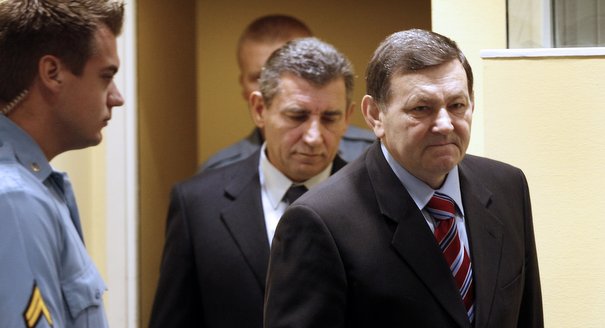
The acquittal of two Croatian generals is a depressing indictment for a court that was meant to end impunity for some of Europe’s worst war criminals.
The decision by the Appeal Chamber of the International Criminal Tribunal for the former Yugoslavia (ICTY) to acquit two Croatian generals who had been sentenced for war crimes against Serbs in 1995 is an extraordinary one.
It is likely to undermine the ICTY’s credibility as an impartial body set up in 1993 to achieve justice for the victims of Europe’s bloodiest war since 1945. It will make reconciliation between Serbia and Croatia even more difficult than it already is. And it will surely send the wrong signal to military commanders and politicians who would contemplate ethnic cleansing.
The Appeal Chamber’s decision, made on November 16, was greeted with jubilation by the Croatian government, the army, and the public. The government sent an official plane to bring home Ante Gotovina and Mladen Markac. They were given a hero’s welcome.
Gotovina was the overall commander of the southern part of the Krajina region during the military offensive against the Serbs, known as “Operation Storm.”
It was launched on August 4, 1995, to retake the Krajina region which had been controlled by separatist ethnic Serbs since early 1991. The offensive lasted thirty-six hours. An estimated 526 Serbs were killed, of which 116 were reportedly civilians. An estimated 200,000 fled.
The EU had always insisted on Croatia handing Gotovina over to the ICTY as a condition for beginning membership negotiations. The UN tribunal had made its indictment against Gotovina for war crimes and crimes against humanity during the Krajina campaign public in 2001. Croatia eventually transferred Gotovina to The Hague, where the court sits, in December 2005.
Markac was commander of the Special Police of the Ministry of the Interior of Croatia and deputy interior minister. After Operation Storm, he was promoted to Colonel General. He was transferred to the ICTY in March 2004.
In April, 2011, the court of first instance at the ICTY sentenced Gotovina and Markac to 24 years and 18 years respectively for their involvement in a “joint criminal enterprise” whose military goal was the expulsion of Serbs from the Krajina region. Last Friday’s Appeal Chamber overturned that verdict.
Over the weekend in Serbia, there was consternation over the decision. Serbia’s Chief Prosecutor for War Crimes, Vladimir Vukcevic, condemned the ICTY.
“This was one of the most notorious war crimes committed during the conflicts in the former Yugoslavia, where thousands of people were killed and expelled and so far no one was held responsible,” Vukcevic said.
It was no surprise that he did not mention the massacre of 8,000 Bosnian Muslims by Bosnian-Serb commanders in and around Srebrenica in 1995, or how Belgrade had come under so much pressure from the United States and the EU to find and then hand over Radovan Karadzic, the Bosnian Serb leader and Ratko Mladic, the Bosnian Serb commander, to the ICTY.
Rasim Ljajic, chief of Serbia’s National Council for Cooperation with the ICTY, said Serbia would in future not provide documents requested by the ICTY. Cooperation would be downgraded to a technical level. This is largely a symbolic act but it will bring further harm to the tribunal’s already shaky reputation. The Serb public had been following the proceedings against Gotovina with particular attention. It was one of the few cases dealing with crimes committed against—and not by—Serbs.
For someone who covered the early stages of the war in Croatia, and who was put on a black list by the Zagreb government because I—and a handful of other journalists—had reported on how the Croats were trying to expel the Serbs, the appeals verdict is very strange and difficult to understand.
Not that the verdict was unanimous. Only three of the five judges thought Gotovina and Markac should be acquitted. The other two disagreed—strongly. Their lengthy dissenting opinions are likely to supply the court’s critics with plenty of ammunition.
Briefly, this is what the Appeal Chamber’s decisions was based upon.
The original trial verdict of last year made an attempt to differentiate between legitimate attacks aimed at Serbian military targets, and unlawful attacks aimed at civilians in the four towns of, Benkovac, Gračac, Obrovac, and Knin. To that end, the judges defined a 200-meter range of error. Hits closer to military targets would be considered legitimate, hits further away would carry the assumption that they were not aimed at military targets in the first place.
The appeals Chamber overturned that. Why? Because factors such as wind speed and air temperature could cause variations in the accuracy of the weapons used by the Croatian army against the four towns.
The prosecution argued that the Serb population was forced to leave because of the level of attacks and because ethnic cleansing was the strategy. But Gotovina’s defense argued successfully that it could not be proven which attacks by explosives caused which civilians to flee.
Gotovina and Markac’s counsel also managed to quash any suggestion that the Croatian army and police were intent on ethnic cleansing the Krajina region. This is despite public statements by Franjo Tudjman, then Croatia’s president, who had made it clear that the expulsion of the civilian population was a military goal.
Read for yourself what the three judges who formed the majority of the appeals court concluded: “Discussion of pretexts for artillery attacks, of potential civilian departures, and of provision of exit corridors could be reasonably interpreted as referring to lawful combat operations and public relations efforts.” Furthermore, they added, “the fact that Croatia adopted discriminatory measures after the departure of Serb civilians from the Krajina does not demonstrate that these departures were forced.” What sort of reasoning is that?
No doubt Karadzic and Mladic who are on trial in the ICTY will exploit the appeals verdict, as will other indictees. More worrying, the ruling can only be “encouraging to military commanders who want to target civilians and to politicians who want to engineer the expulsion of civilians” says Balkan expert, Dr. Eric Gordy.
It’s a depressing indictment for a court—whose reputation was never stellar—that was meant to end impunity for some of Europe’s worst war criminals.

Nonresident Senior Fellow, Carnegie Europe
Judy Dempsey is a nonresident senior fellow at Carnegie Europe
Recent Work
Judy Dempsey
Judy Dempsey

European Commission President Ursula von der Leyen is about to give her annual address on the state of the EU. Here’s what she won’t—but should—say.

Rym Momtaz

The aftermath of the Ceuta crisis shows Europe has drawn the wrong lessons. Rather than doubling down on failed migration policies, the EU needs to address the underlying roots of such episodes.

Richard Youngs

An overwhelming victory by a far-right-wing party in a small state in eastern Germany will have major repercussions for Chancellor Friedrich Merz’s coalition.
Judy Dempsey

Canadian Prime Minister Mark Carney has twice inspired praise for standing up to U.S. President Donald Trump: at the 2026 World Economic Forum in Davos and on Canada-U.S. trade negotiations. Is Carney showing a third way better than the EU has in dealing with the Trump administration?
Rym Momtaz, ed.

The EU’s responses to two recent incidents expose the gulf between European perceptions and capabilities. Unless the union can bridge that gap, it will never become a real geostrategic power.
Rym Momtaz