

Commentary
There is an elephant in the room when it comes to the EU’s upcoming security strategy: Donald Trump. Unless European leaders acknowledge the depth of the transatlantic crisis, true autonomy will remain out of reach.
Stefan Lehne
{
  "authors": [
    "Mark Leonard"
  ],
  "type": "commentary",
  "blog": "Strategic Europe",
  "centerAffiliationAll": "",
  "centers": [
    "Carnegie Endowment for International Peace",
    "Carnegie Europe"
  ],
  "collections": [],
  "englishNewsletterAll": "",
  "nonEnglishNewsletterAll": "",
  "primaryCenter": "Carnegie Endowment for International Peace",
  "programAffiliation": "",
  "programs": [],
  "projects": [],
  "regions": [
    "Europe",
    "North America"
  ],
  "topics": [
    "EU"
  ]
}
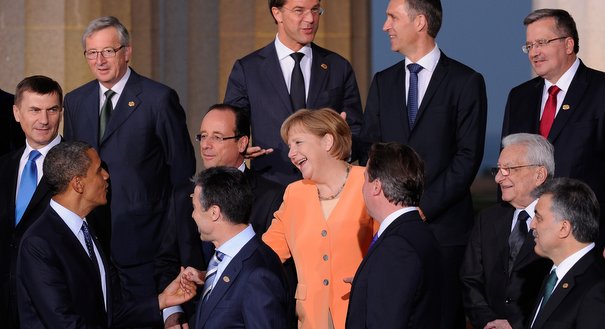
Source: Getty
Europeans will struggle to have credibility with their neighbors unless they demonstrate a readiness to take the defense of their own strategic interests more seriously.
If Barack Obama had been running for president of Europe rather than of the United States, he would have won by a landslide. His re-election for four more years was a relief. But second-term presidents are often very different from their first-term selves: Ronald Reagan, Bill Clinton, and George W. Bush all had very different foreign policies after they were re-elected in 1984, 1996, and 2004. So what will Obama’s re-election mean for Europe? How will Obama II differ from Obama I?
The short answer is that Europeans will find themselves looming smaller for Washington’s personnel, resources, and priorities than ever before. But, if it causes Europeans to escape their infantile condition, this could be a blessing.
The first immediate difference could be at the level of personnel. James Mann has argued that Obama had two teams in his first term. One, designed for public consumption, was the “team of rivals” who were shaped by Vietnam and the Cold War, and the other was his inner circle of political operatives who were younger and shared Obama’s world view. All the experienced old hands of the first term—such as Secretary of State Hillary Clinton, Defense Secretary Robert Gates, National Security Advisor James Jones, Special Representative to Afghanistan and Pakistan Richard Holbrooke, and CIA Director David Petraeus—will be gone in the second term. This could leave Obama free to pick a team closer to his generational outlook, where the main foreign policy influences were 9/11, the Iraq War, and the global financial crisis, who do not have the same emotional commitment to the western alliance as their predecessors.
Obama’s foreign policy is also likely to be more “Obamian” at the level of resources and policy. His first two years were taken up with aftercare for the policies of Bush. Domestically he sought and succeeded in preventing a depression. Internationally his goal was to rebuild American leadership after Iraq. But after the killing of Osama bin Laden, Obama could shift more obviously to his own priorities. He was able to move from surge to drawdown in Afghanistan and to begin his “pivot to Asia”. Many people within the administration have talked of an “Obama doctrine” of low-cost leadership—based on soft power, drone wars, and “leading from behind”—for the age of austerity. Libya illustrated this approach: it cost US taxpayers between $1 and $3 million a day—compared to $300 million a day for the Afghan operation.
The one exemption from this frugality will be the pivot to Asia, which promises a major strategic re-alignment that could be the beginning of a new era of bipolarity. There are all sorts of issues that could still divert Obama from his goal of shifting attention from the Middle East to the Pacific—Iran and Syria are two obvious examples—but Obama’s determination to avoid “leading from the front” on Libya showed how disciplined this president can be. In short, Obama will aim to hold the rest of the world, apart from Asia, at bay by drone strikes, cyber defense, and greater energy self-sufficiency.
This means that Europeans will be expected to take responsibility for sorting out problems in their own neighborhood: something that they should have done years ago. In order to do this, Europeans need to reach out to their neighbors—in particular Russia and Turkey—through a European security initiative. This could start with three elements.
First, whatever the fate of the newly-formed Syrian opposition organization, Europe should not wait any longer in order to engage more directly with the existing and credible internal opposition centered around local revolutionary councils—and start providing them with direct assistance. At the same time, Europe should be more rather than less diplomatically engaged—which has to include creating and preparing for a moment when there is space for political deal making. Making ourselves more relevant in diplomacy will mean being less squeamish about re-establishing channels into the Assad regime and talking problem solving, not just lecturing key states on the other side of the Syria question.
Second, if U.S. efforts to make a diplomatic breakthrough on Iran via direct channels do not bear fruit before Iran huddles down in the spring in advance of its own presidential election, Europe should take the lead in pushing back hard against any shift towards military options and in pursuing an effort to buy time that focuses on partial and immediate sanctions relief in exchange for verifiable suspension of 20 percent enrichment.
Third, Europe should enhance its strategic dialogues with the new democracies in the region, as well as with the Gulf, Turkey, and others, in order to promote closer integration within North Africa and make progress on major win-win economic projects.
Europeans will struggle to have credibility with their neighbors—or the Obama administration for that matter—unless they demonstrate a readiness to take the defense of their own strategic interests more seriously. A serious strategic debate in Europe—which is to say, a Strategic Review commissioned by the European Council—is now essential. A failure to wake up will ensure that the coming presidency will be seen as the one during which America finally gave up on Europe.
Mark Leonard is co-founder and director of the European Council on Foreign Relations and co-author of “Time to Grow Up: What Obama’s Re- Election Means for Europe”
Mark Leonard
Mark Leonard is cofounder and director of ECFR. He hosts the weekly podcast Mark Leonards’s World in 30 Minutes and writes a column on global affairs for Project Syndicate. Previously, he worked as director of foreign policy at the Centre for European Reform and as director of the Foreign Policy Centre. He has spent time in Washington, DC as a transatlantic fellow at the German Marshall Fund of the United States and in Beijing as a visiting scholar at the Chinese Academy for Social Sciences. In September 2021, he published his latest book The Age of Unpeace: How Connectivity Causes Conflict.
Carnegie does not take institutional positions on public policy issues; the views represented herein are those of the author(s) and do not necessarily reflect the views of Carnegie, its staff, or its trustees.
There is an elephant in the room when it comes to the EU’s upcoming security strategy: Donald Trump. Unless European leaders acknowledge the depth of the transatlantic crisis, true autonomy will remain out of reach.

Stefan Lehne
Defense tech innovations will be at the heart of Europe’s new security strategy. But so far, Brussels has been making moves without a broader plan, undermining readiness and credibility.

Raluca Csernatoni

When the U.S.-Iran memorandum of understanding was announced, the UK, France, Germany, and Italy declared their readiness to help demine the Strait of Hormuz and lift nuclear sanctions on Tehran. But does Europe need new tools to recover a diplomatic role?

Rym Momtaz, ed.
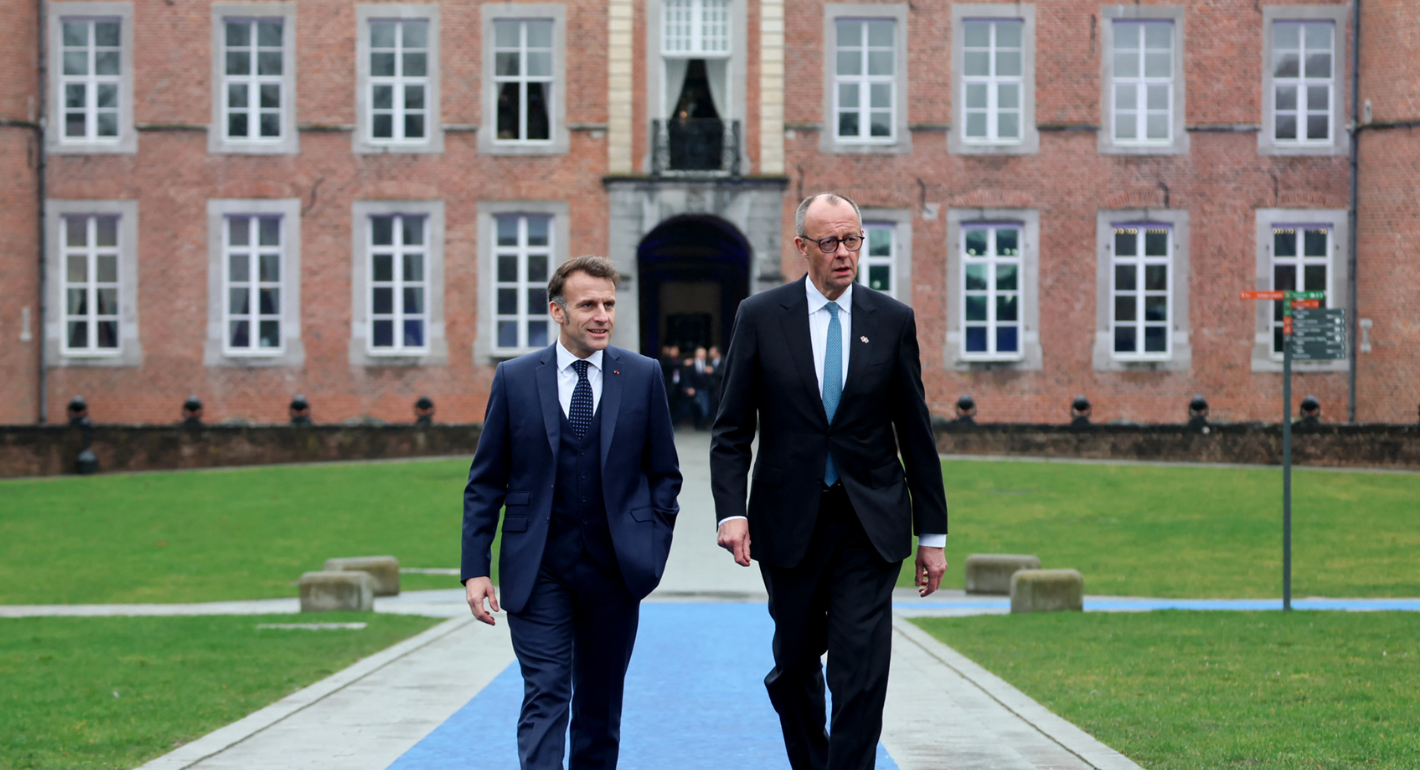
The Franco-German relationship is on the rocks again. But unlike previous moments of tension, the epochal changes on the world stage require that both step up investment in their bilateral ties.
Rym Momtaz
The EU is putting together a new security strategy to meet today’s myriad challenges. But for any proposal to be effective, the union needs to grapple with its identity and ambitions.

Pierre Vimont