

Commentary
Judy Dempsey
{
  "authors": [
    "Judy Dempsey"
  ],
  "type": "commentary",
  "blog": "Strategic Europe",
  "centerAffiliationAll": "",
  "centers": [
    "Carnegie Endowment for International Peace",
    "Carnegie Europe"
  ],
  "collections": [],
  "englishNewsletterAll": "",
  "nonEnglishNewsletterAll": "",
  "primaryCenter": "Carnegie Europe",
  "programAffiliation": "",
  "programs": [],
  "projects": [],
  "regions": [
    "Europe"
  ],
  "topics": [
    "EU",
    "Security"
  ]
}
Source: Getty
Every week leading experts answer a new question from Judy Dempsey on the international challenges shaping Europe's role in the world.
Every week leading experts answer a new question from Judy Dempsey on the international challenges shaping Europe's role in the world.
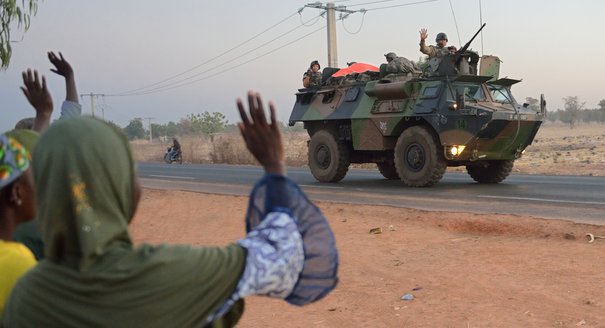
The decision to launch "Operation Serval" was taken when it became clear that the Malian government could no longer defend the southern part of the country against the radical Islamic groups which already control northern Mali. This development made the UN plan to establish a West African force which would regain control of the entire territory impossible to implement in the foreseeable future.
When President Traoré called for immediate assistance, France engaged somewhat reluctantly in this new operation. President Hollande had originally planned to support the West African force only by "leading from behind," providing training, intelligence, logistical support, and special forces to help reconquer the northern part of Mali by next summer.
The decision to act directly was only taken when it became clear that the original schedule would be difficult to meet and that most of Mali could fall into the hands of radical Islamist groups. France feared seeing the entire Sahel become another grey zone where terrorists could prosper and train, similar to Afghanistan or Somalia, but just a few thousand kilometers away from Europe. This concern is the reason behind the French diplomatic and military commitment to security in the region. It also explains the strong support provided by London and Washington including in the military dimension.
It is, of course, too early to assess if France will succeed, given the numerous challenges associated with the campaign: the size of the vast cross border territory in which the Islamist groups operate, the number of players and the threats to French nationals in the region (there are already eight hostages). However, the strong commitment of all regional actors including Algeria which allowed the overflight of French jets, and many Economic Community Of West African States (ECOWAS) countries which have decided to contribute troops create the conditions for substantially reducing the influence of radical jihadist groups in the Sahel, assuming their complete eradication is unlikely.
President Hollande therefore made a sound choice when he decided to act swiftly and engage significant air assets. Even though the loss of a helicopter pilot proves how dangerous this task is, Holland entered an important and worthwhile commitment. Its success is all the more likely if both ECOWAS and the EU can launch their supporting operations in due time.
As the United States is leaving Afghanistan, closing a decade of wars gone well past their expiry date, some suggest that France has started its own with the intervention in Mali. Yet while it is true that it is easier to start military interventions than to end them, it seems unlikely that Mali will turn into a French Afghanistan.
The best outcome of the operation would be that the French military manages to quickly reverse the advances of the rebels and give the Malian government a new platform to maintain effective control of the territory. This would prevent a new free haven for international terrorism from developing in Mali. France can then leave the rest to the African mission as foreseen in the UN mandate.
The worst case scenario is that France gets bogged down on the ground and then pulls out quickly in order to avoid a quagmire, leaving the mess to a semi-prepared African military mission.
Whatever the outcome, the Mali operation says a lot about the fragmented approach to crisis management and military coordination in the EU. At least this time there wasn’t the same kind of internal split that the EU experienced over Libya. Still, military coordination takes place outside the EU institutions and directly between France, UK, and member states like Germany, Denmark, and Belgium.
Ashton has called for an extraordinary meeting of the EU’s foreign ministers that might remedy that but the EU’s main talk is about how it can provide a training mission to the Malian army, a laudable thing for the longer-term, but not one that can add anything to the current military situation.
My colleague, Richard Gowan, has analyzed the EU’s crisis management capacity in a policy brief covering how the EU responds to a new generation of wars and crises such as the conflict in Mali. He suggests that the resource-strained EU needs to think more in terms of partnerships with other regional organizations.
If Mali turns out well, and if a smooth transfer to ECOWAS and African nations can be managed, it could set the example of a successful inter-regional cooperation rather than follow in the footsteps of Afghanistan.

Nonresident Senior Fellow, Carnegie Europe
Judy Dempsey is a nonresident senior fellow at Carnegie Europe
Recent Work
Judy Dempsey
Judy Dempsey

Are Germany’s economic, industrial, and political struggles becoming a liability for the EU’s ability to rise to the geopolitical moment?

Rym Momtaz, ed.

European Commission President Ursula von der Leyen is about to give her annual address on the state of the EU. Here’s what she won’t—but should—say.
Rym Momtaz

The aftermath of the Ceuta crisis shows Europe has drawn the wrong lessons. Rather than doubling down on failed migration policies, the EU needs to address the underlying roots of such episodes.

Richard Youngs

An overwhelming victory by a far-right-wing party in a small state in eastern Germany will have major repercussions for Chancellor Friedrich Merz’s coalition.
Judy Dempsey

Canadian Prime Minister Mark Carney has twice inspired praise for standing up to U.S. President Donald Trump: at the 2026 World Economic Forum in Davos and on Canada-U.S. trade negotiations. Is Carney showing a third way better than the EU has in dealing with the Trump administration?
Rym Momtaz, ed.