

Research
- +5
Alper Coşkun, Fatih Ceylan, Tacan İldem, …
{
  "authors": [
    "Sinan Ülgen"
  ],
  "type": "commentary",
  "blog": "Strategic Europe",
  "centerAffiliationAll": "",
  "centers": [
    "Carnegie Endowment for International Peace",
    "Carnegie Europe"
  ],
  "collections": [
    "Turkey’s Transformation",
    "Brexit and UK Politics"
  ],
  "englishNewsletterAll": "",
  "nonEnglishNewsletterAll": "",
  "primaryCenter": "Carnegie Europe",
  "programAffiliation": "",
  "programs": [],
  "projects": [],
  "regions": [
    "Europe",
    "Türkiye",
    "Israel",
    "United Kingdom",
    "Middle East"
  ],
  "topics": [
    "EU",
    "Foreign Policy"
  ]
}
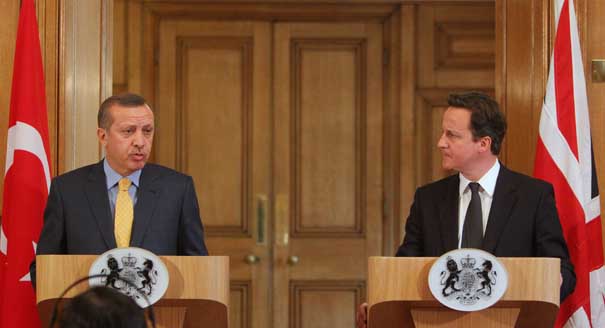
Source: Getty
Europe’s global ambitions would suffer a huge setback if Britain would choose to leave the EU in 2017 and if Turkey would, at the same time, give up on membership.
From a strategic perspective, 2017 is shaping up to be a critical year for the EU. That is when the long-term future of the EU as an actor on the world stage will be determined. There are two questions central to this dynamic: whether a UK exit can be prevented and whether a Turkey entry can be ensured. These two issues are likely to converge in the year 2017.
British Prime Minister David Cameron has already called for a UK referendum to be held in 2017 on Britain’s relationship with the EU. In a recent and widely commented speech, he charted the roadmap for an eventual UK decision on whether to stay in or to get out of the EU. Losing the UK as a member would be a severe blow to the EU’s ambitions to become an influential global player. The UK is Europe’s third largest economy. Even more importantly, it is one of the two lead nations, along with France, to advance the EU’s security identity.
A UK exit would likely precipitate a decision by Ankara on its own relationship with the EU. Unless there is a breakthrough in the negotiations, the new Turkish government emerging from the 2015 elections will in any case feel compelled to review its stance on Europe. This will become much more urgent if the UK decides to exit. Just like in Britain, a debate is already taking shape in Turkey about the country’s relationship with the EU. Frustrated with the inability to achieve progress in the negotiations, the Turkish body politic as well as public opinion are now more inclined to consider alternatives to EU accession.
In a surprise move, the ebullient Prime Minister Recep Tayyip Erdogan announced in a TV interview last week that Ankara could seriously consider membership in the Shanghai Cooperation Organisation (SCO) as an alternative to the EU. He added that the Russian President Putin had encouraged him to consider this option.
Turkey has already applied to the SCO to obtain observer status. A deeper commitment to the SCO would signal a clear shift in Turkey’s foreign policy priorities, undermining Turkey’s Western credentials and heralding a transition toward increased strategic autonomy from the West. That is why Erdogan’s comments provoked lively reactions both from within and outside the country. Still, at this stage, his remarks should be interpreted more as an expression of accumulated frustration over the stalled accession process rather than of imminent foreign policy realignment.
Turkish public opinion, however, might be increasingly willing to accept such a policy shift. According to a recent opinion poll carried out by the Istanbul based EDAM think tank, public support for EU membership has now dropped to 33 percent. It was around 74 percent in 2005 when the accession talks started. Now, almost 60 percent of the population wants to discontinue the accession negotiations. Fifteen percent want Turkey to join and/or establish a rival organization.
Turkish elites remain more pro-EU than the rest of the population. For them, EU accession would guarantee that Turkey’s European identity will prevail in a country where multiple identities are striving to shape the future of society. According to the poll, members of the foreign policy expert community still overwhelmingly support EU membership, with 88 percent of participants favoring the continuation of the accession talks.
If disenchantment with Europe continues to gain strength, by 2017, the EU will be faced with the twin challenge of losing the UK as an existing member and Turkey as a potential member. The geopolitical consequences of such a drift are likely to be significant. This could lead to a realignment of powers which sees, for example, Turkey and the UK competing with the EU for power, influence, and markets.
The former British prime minister Tony Blair has pleaded for Europe to adjust to the geopolitical realities of the 21st century and switch from the original rationale of peace to one of power. Losing both Britain and Turkey would demonstrate the EU’s failure to respond to Blair’s appeal.

Senior Fellow, Carnegie Europe
Sinan Ülgen is a senior fellow at Carnegie Europe in Brussels, where his research focuses on Turkish foreign policy, transatlantic relations, international trade, economic security, and digital policy.
Recent Work

Alper Coşkun, Fatih Ceylan, Tacan İldem, …
Carnegie does not take institutional positions on public policy issues; the views represented herein are those of the author(s) and do not necessarily reflect the views of Carnegie, its staff, or its trustees.

Trump is distracted and Ukraine wants Europe to step up. The continent’s leaders must find their voice and assert it in talks with Russia.

Alissa de Carbonnel

Mounting economic strain and battlefield losses will not necessarily make the Kremlin less dangerous. They could instead push Moscow toward a more aggressive hybrid campaign designed to test NATO’s Eastern flank, exploit allied hesitation, and fracture European resolve.

Maksym Beznosiuk

Over the past ten years, NATO has held almost as many summits as it did during the entirety of the Cold War. Are they still useful, or is it time to stop holding annual meetings?

Rym Momtaz, ed.
Nearly a year and a half after Europeans leaned into sucking up to Trump, the strategy has produced some benefits when it comes to Ukraine.
Rym Momtaz
Far-right leader Marine Le Pen can—and will—run in France’s next presidential election. What does the outcome of her appeal against a 2025 embezzlement conviction mean for the country’s political future?

Catherine Fieschi