

Commentary
Judy Dempsey
{
  "authors": [
    "Judy Dempsey"
  ],
  "type": "commentary",
  "blog": "Strategic Europe",
  "centerAffiliationAll": "",
  "centers": [
    "Carnegie Endowment for International Peace",
    "Carnegie Europe"
  ],
  "collections": [],
  "englishNewsletterAll": "",
  "nonEnglishNewsletterAll": "",
  "primaryCenter": "Carnegie Europe",
  "programAffiliation": "",
  "programs": [],
  "projects": [],
  "regions": [
    "Europe"
  ],
  "topics": [
    "EU"
  ]
}
Source: Getty
Every week leading experts answer a new question from Judy Dempsey on the foreign and security policy challenges shaping Europe’s role in the world.
Every week leading experts answer a new question from Judy Dempsey on the foreign and security policy challenges shaping Europe’s role in the world.
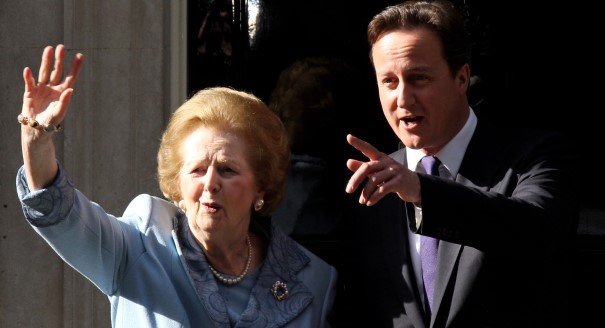
Margaret Thatcher, UK prime minister from 1979 to 1990, died this week aged eighty-seven. Our foreign policy experts compare and contrast her legacy on Europe with that of Britain’s current prime minister, David Cameron.
Not at all. David Cameron sees the EU very differently from Margaret Thatcher.
For a start, as prime minister Thatcher was strongly opposed to referendums on European Community membership. She attacked the Labour government’s decision to call an “in-out” vote in 1975, quoting former UK prime minister Clement Attlee that referendums were “a device of dictators and demagogues.”
Cameron disagrees, and wants a plebiscite by 2017—though doubtless he would argue that the EU’s legitimacy in the UK is now so low that only a popular vote can restore it.
Another difference is that Thatcher began as a passionate pro-European who became a virulent Euroskeptic. Cameron, by contrast, has always been a moderate skeptic and never very interested in the EU.
In 1985, Thatcher backed the plans of the then European Commission president Jacques Delors for a European single market. She also helped to realize those plans by approving the Single European Act, which removed national vetoes on single market rules and thus revived the EU’s momentum.
Only in 1988 did Thatcher turn against Brussels, because Delors pushed for a common social policy and for monetary union—both of which were anathema to her. After leaving office in 1990, her attitudes toward Europe hardened. She became a totem for the Conservative Party’s increasingly powerful Euroskeptical right wing, encouraging it to believe that Britain’s future lay in the “Anglosphere” rather than the EU.
Cameron understands how Britain’s diplomatic clout and economic strength benefit from EU membership. But, because many Conservatives prefer to believe in simpler, Thatcherite truths, Cameron now finds it almost impossible to control his party. Thatcher’s legacy has poisoned Cameron’s inheritance.
Every British leader who followed Margaret Thatcher is, in a certain sense, her heir. But David Cameron does not approach his job with the same fervor as Thatcher. Her house-cleaning has stuck. The UK is not the over-bureaucratized, feather-bedded place it was when she came to power in 1979. Cameron’s role is to steer a Britain too enamored with the financial markets toward a more balanced existence.
Thatcher’s true acolyte is German Chancellor Angela Merkel. She would not see herself as such, and her playing field is very different from the UK of the 1970s that Thatcher inherited. But Merkel’s task is the same. The eurozone suffers from the same sort of sclerosis that burdened Britain forty years ago. Energy and innovation have been stifled by an interlocking system of bureaucratic controls, consensus decisionmaking, and massive subsidies.
The demon facing Europe is not the dangers of renationalization or budget deficits. Rather, it is the destructive forces of globalization, which have robbed even the most isolated countries of places to hide their inefficiencies. Merkel recognizes this and never tires of reiterating that Europe must change from a “solidarity partnership” to a “partnership of responsibility.”
Can Merkel succeed in rebooting economies that have grown fat on subsidies? Probably not—just as Thatcher did not completely reboot Britain. But, like the UK after Thatcher, Europe after Merkel will be a very different place than it was before she arrived.
This week’s media coverage has featured pictures of Margaret Thatcher in a resolute show of solidarity with a trade union leader. Unusual in the British context, perhaps—but the leader in question is Lech Wałęsa, and the media coverage comes from Poland, where Thatcher’s 1988 visit is still perceived as having heralded the country’s integration into the EU.
Contrast those celebratory pictures with the images of David Cameron as he tours European capitals trying to repair the damage done by his January speech on the future of Europe, in which he said he planned to renegotiate the terms of Britain’s EU membership. Cameron’s image had already been tainted in Warsaw by his talk of restricting free movement of labour in the EU, his opposition to a large EU budget, and his accidental creation of a legal architecture that sidelines non-eurozone members from the EU’s economic decisions (the fiscal compact).
Now, even those tempted by his vision of Europe—in the European Parliament, his Conservatives sit in a group with Poland’s main opposition party—are frustrated that he has tied the question of EU reform to the threat of a British exit.
Despite the gulf in their reputations, however, Cameron is clearly Thatcher’s heir. It was she who introduced divisive EU ideology to a Conservative Party whose previous mantra had simply been to stay in power. And it was she who brought intransigence to the negotiating table in Brussels, setting a pattern whereby the UK would rather opt out than compromise.
In short, it was Thatcher who established a losing streak in the EU, which Cameron has continued. The Great Man theory—that the capacity for leadership is inherent—vastly exaggerates the impact of single individuals.
The commentary following the death of Margaret Thatcher has focused on her role in transforming Britain and in helping to end the Cold War.
However, part of the legacy she leaves behind is the deep Euroskepticism she nurtured and deepened, first within the Tory Party and then among the broader electorate. She severely misjudged German reunification, opposing it almost to the bitter end, despite the strong support it received from then U.S. president George H. W. Bush. She had a blind spot on both Germany and Europe, a shortcoming that has marginalized Britain in its relations with the EU and, increasingly, the United States. The “special relationship” is less special in Washington if it means the United States has to choose between Europe and the UK.
David Cameron either believes in this legacy or feels bound to it by his own party. Either way, he has continued to isolate Britain, both from a Germany that very much wants the UK to remain in Europe, and from the EU itself. He has received a clear message—not only from the City and British business, but also from the Obama administration—that his anti-European path will be detrimental to British interests and to its key international relationships.
It may not be fair to blame Cameron for Thatcher’s mistakes, but it is reasonable to expect him to lead his country—even when that means violating her legacy.

Nonresident Senior Fellow, Carnegie Europe
Judy Dempsey is a nonresident senior fellow at Carnegie Europe
Recent Work
Judy Dempsey
Judy Dempsey

The EU can impose sanctions but struggles to enforce them without the United States. With Washington increasingly disinterested in backing European interests, the bloc must now fend for itself.


Nicu Popescu, Tiago Antunes

Russia is testing the waters of NATO’s mutual defense clause. What do strikes in Romanian territorial waters mean for the alliance’s posture toward Moscow?

Dimitar Bechev

With its public finances in shambles, the far right polling at 35 percent ahead of the 2027 presidential election, and a growing protest movement, is France’s crisis a threat to the EU’s geopolitical awakening?

Rym Momtaz, ed.

Ahead of a tough winter for Ukraine, Donald Trump’s swing back toward Russia bodes ill. But instead of panicking, Kyiv’s European allies are focusing on action.
Rym Momtaz

While the EU and European governments are embracing the much-lauded middle-power moment, this entails three difficult conundrums.

Richard Youngs