

Commentary
Judy Dempsey
{
  "authors": [
    "Judy Dempsey"
  ],
  "type": "commentary",
  "blog": "Strategic Europe",
  "centerAffiliationAll": "",
  "centers": [
    "Carnegie Endowment for International Peace",
    "Carnegie Europe"
  ],
  "collections": [],
  "englishNewsletterAll": "",
  "nonEnglishNewsletterAll": "",
  "primaryCenter": "Carnegie Europe",
  "programAffiliation": "",
  "programs": [],
  "projects": [],
  "regions": [
    "Europe",
    "Russia"
  ],
  "topics": [
    "EU"
  ]
}
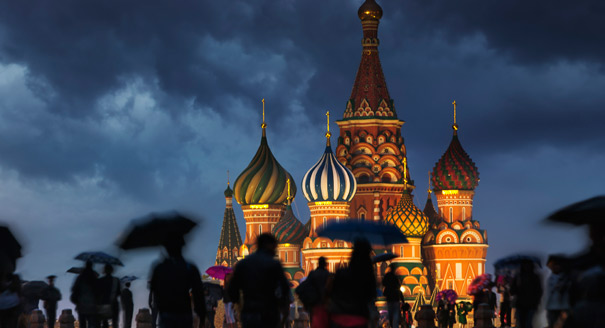
Source: Getty
The EU cannot afford to ignore recent developments in Russia and Eastern Europe. It is time for the EU to develop a serious strategy for dealing with its Eastern neighbors.
How blind the EU can be.
Despite worrying changes in Russia and Eastern Europe over the last six months, the EU’s policy toward both regions remains the same.
If the EU took its foreign relations seriously, the two developments should jolt it into adopting a very different Eastern strategy.
The fact sheets that EU officials drew up ahead of today’s EU-Russia summit in the southern Russian city of Yekaterinburg read nearly the same as the ones drafted six months ago for the last summit in Brussels. The statements prepared for José Manuel Barroso, president of the European Commission, and Herman Van Rompuy, president of the European Council, are also astonishingly similar.
Obviously, from the perspective of Brussels, little has changed in EU-Russia relations. In Russia, however, change has been disturbing.
Vladislav Surkov, the Kremlin’s main ideologist and the man behind the concept of “sovereign democracy,” quit last month. Apparently, the special ideological system he built for President Vladimir Putin was not sufficient to withstand or anticipate the 2011 antiregime demonstrations. More importantly, Surkov was critical of repression. His view was that it is better to co-opt opponents than to lock them up. Putin held a different view.
Then, last week, Sergei Guriev, the liberal economist and director of Moscow’s New Economic School, fled to Paris. He feared reprisals for his criticism of the imprisonment of the former oil boss and oligarch Mikhail Khodorkovsky, and for supporting Alexei Navalny, an opposition leader now on trial.
That’s in addition to yet more harassment of NGOs, from Memorial, founded by the late human rights activist Andrei Sakharov, to the Levada Center, Russia’s respected opinion polling think tank.
In Russia, the room for criticism is becoming even more confined, and the consequences of dissent more severe. Yet the scope for illegal enrichment remains huge: in one high-profile case, recent allegations of widespread corruption have been engulfing next year’s Winter Olympic Games in Sochi.
What should the EU conclude from the above?
According to some analysts, the recent repression shows that Putin’s grip over the Russian elites is weakening. His harsh reactions to protests suggest that he is lacking confidence in his own authority. In any case, one of the few practical things the EU can do is to extend its reach as far as possible beyond the walls of the Kremlin.
Dmitri Trenin, director of the Carnegie Moscow Center, argues that that Moscow no longer sees Europe and its value system as a model. If that is the case, then the EU, instead of waiting for the Kremlin to change, should take its values deep into Russian society.
What happens in Russia also has a bearing on its western neighbors. There, the news isn’t good, either.
In Moldova, a pro-European coalition led by Vlad Filat collapsed last March due to infighting. Since then, politics has been paralyzed, with the atmosphere becoming poisoned by recriminations. This has dashed great hopes in Poland and some other EU countries that Moldova’s politics might be stable enough to finally begin structural reforms aimed at bringing the country closer to the EU—and helping it escape Russia’s influence.
Georgia, too, is becoming a problem for the EU, the United States, and NATO. Prime Minister Bidzina Ivanishvili is under fire from all three for pursuing a policy of revenge against former government officials who supported President Mikheil Saakashvili.
Ukraine’s government and president show no signs of dealing with the country’s dysfunctional politics. The oligarchs who have prevented long overdue reforms continue to have an overbearing and negative influence. For a country that could be stable, democratic, and prosperous thanks to its rich natural resources, this is sad, dangerous, and irresponsible on the part of the Ukrainian leadership.
The governments of Poland, Sweden, and Lithuania, deeply frustrated after several years of intense efforts with countries in the region, realize that sitting back and waiting for change is not an option.
This is because Georgia, Moldova, and Ukraine are easy prey for the Kremlin’s political and economic ambitions. The greater the economic hold Russia has over these countries (with energy the main policy weapon), the more vulnerable the pro-Western democratic movements become. After all, vibrant democracies to Russia’s west are not in Putin’s interests.
Yet vibrant democracies are just what the EU should be striving for. Pretending that nothing much has changed in Russia over the past six months is short-sighted, to say the least. This is not the time for the EU’s policies toward its Eastern neighbors to be preconditioned by its policies toward Russia. The two must be kept separate.
Lithuania, which takes over the six-month rotating EU presidency in July, will host an Eastern Neighborhood summit in the fall. That meeting offers an opportunity to persuade the big member states, especially Germany, to put their full weight behind supporting the EU’s Eastern neighbors. If it works, that could make a big difference.

Nonresident Senior Fellow, Carnegie Europe
Judy Dempsey is a nonresident senior fellow at Carnegie Europe
Recent Work
Judy Dempsey
Judy Dempsey

While the EU and European governments are embracing the much-lauded middle-power moment, this entails three difficult conundrums.

Richard Youngs

Much has been said of the changes Brussels is trying to make to the EU enlargement process. Here’s why gradual integration might—or might not—be the answer.

Dimitar Bechev

The European Commissioner for Trade is headed to China. But after President Xi’s bridge-building visit to Washington, can a more isolated EU overcome Beijing’s stranglehold on critical raw materials? Who will blink first?

Rym Momtaz, ed.

The domestic impacts of how long it is taking to end the war in Ukraine have pushed the French electorate to the political extremes and compromised the country’s diplomatic capacity.
Rym Momtaz

Before the next wave of EU enlargement takes place, the union needs to grapple with thorny questions of how power is distributed among its members.


Emil Sondaj Hansen, Ditte Brasso Sørensen