

Commentary
Michael Pettis
{
  "authors": [
    "Michael Pettis"
  ],
  "type": "commentary",
  "blog": "Strategic Europe",
  "centerAffiliationAll": "",
  "centers": [
    "Carnegie Endowment for International Peace",
    "Carnegie Europe"
  ],
  "collections": [],
  "englishNewsletterAll": "",
  "nonEnglishNewsletterAll": "",
  "primaryCenter": "Carnegie Endowment for International Peace",
  "programAffiliation": "",
  "programs": [],
  "projects": [],
  "regions": [
    "Asia"
  ],
  "topics": [
    "EU"
  ]
}
Source: Getty
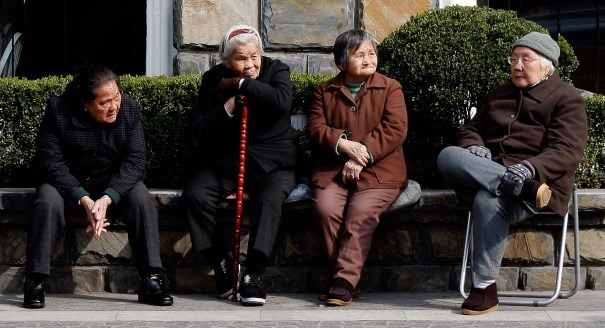
Within a few years China will have more old people than any other country. Beijing will have to become a leader in addressing the problems of an aging population.
An aging population is usually thought of as a problem for rich countries like Japan, Spain, or Italy. But this demographic trend is also becoming a major headache for China, which, despite growing rapidly in the past three decades, nonetheless remains a very poor country.
China’s demographic story is an interesting one. After the horrors of the Sino-Japanese War and the Chinese Civil War in the 1930s and 1940s, the establishment of the People’s Republic of China in 1949 brought with it—as the end of war often does—a major baby boom. During the relatively peaceful years of the 1950s and 1960s, a huge number of Chinese were born.
By the early 1970s, there were so many young people in China that only 52–54 percent of the population was of working age. The rest were either too old or, far more likely, too young to be in work. As a comparison, roughly 62 percent of Americans are currently of working age, a ratio that is expected to hold steady over the next several decades.
In the late 1970s, Beijing put into place its now-famous one-child policy, which restricted the number of children most urban families could have. The result was a very rapid decline in the birth rate in China over the following twenty years.
This policy helped put China in a demographic sweet spot. As the children born in the 1950s and 1960s matured, China’s working population soared, growing by nearly 2 percent a year in the 1980s and 1990s. However, partly because of famines and partly because of poor healthcare, the number of old people in China grew very slowly.
This combination of a huge number of postwar children growing into working age and very few workers aging into retirement caused the economically active population to skyrocket. Today roughly 72 percent of Chinese are of working age, a much higher ratio than in any other major economy.
To have such a large share of the population able to work and produce income is, of course, great for the economy. Not only has the productivity of Chinese workers grown quickly over the last three decades, but their number also rose rapidly even as the number of nonworkers declined. This had to result in very fast economic growth.
And it did. But now, China’s demographic boom is about to reverse. Because of the one-child policy, China today has few children, which means few new people to join the labor force. Meanwhile, Chinese born in the baby boom of the 1950s and 1960s will begin to retire this decade and next, causing a surge in the number of old people in China. While China’s overall population will stay roughly constant over the next three decades, its working population will actually drop by 1½ percent a year during this time.
The explosion in the number of senior citizens, with no equivalent increase in the number of children becoming adults, means that by the middle of the century China’s working-age population will fall to 56–58 percent. China will then have one of the oldest populations in the world, and it will have a relatively small economically productive base on which to support a small number of children and a large number of retirees.
No country has aged as quickly as China is aging now, and virtually no poor country has followed a similar trajectory. This makes it very hard to predict what the consequences of China’s aging will be for China and the world. It is clear, however, that when a country’s working population shifts from growing at nearly 2 percent a year to shrinking by more than 1 percent a year, this should have a big negative impact on growth.
This demographic change should also have an impact on China’s trade with the rest of the world. For many years, as the working population grew faster than the overall population, production was likely to outpace consumption, creating pressure for China to run a trade surplus. In the next few decades, by contrast, China’s workforce will shrink faster than its total population, which means consumption should outstrip production. This should put pressure on China to run a trade deficit.
However China’s balance of trade turns out, any medium- to long-term analysis of China must take into account the tremendous demographic changes likely to take place within the country. Among other things, within a few years China will have far more old people than any other country. China will have to become a leader for the developing world in addressing the problems of an aging population.
That won’t be easy, but as the world’s population stabilizes, it will be an increasingly important issue.

Nonresident Senior Fellow, Carnegie China
Michael Pettis is a nonresident senior fellow at the Carnegie Endowment for International Peace. An expert on China’s economy, Pettis is professor of finance at Peking University’s Guanghua School of Management, where he specializes in Chinese financial markets.
Recent Work
Michael Pettis
Michael Pettis

Before the next wave of EU enlargement takes place, the union needs to grapple with thorny questions of how power is distributed among its members.


Emil Sondaj Hansen, Ditte Brasso Sørensen

Are Germany’s economic, industrial, and political struggles becoming a liability for the EU’s ability to rise to the geopolitical moment?

Rym Momtaz, ed.

European Commission President Ursula von der Leyen is about to give her annual address on the state of the EU. Here’s what she won’t—but should—say.
Rym Momtaz

The aftermath of the Ceuta crisis shows Europe has drawn the wrong lessons. Rather than doubling down on failed migration policies, the EU needs to address the underlying roots of such episodes.

Richard Youngs

An overwhelming victory by a far-right-wing party in a small state in eastern Germany will have major repercussions for Chancellor Friedrich Merz’s coalition.

Judy Dempsey