

Commentary
Judy Dempsey
{
  "authors": [
    "Judy Dempsey"
  ],
  "type": "commentary",
  "blog": "Strategic Europe",
  "centerAffiliationAll": "",
  "centers": [
    "Carnegie Endowment for International Peace",
    "Carnegie Europe"
  ],
  "collections": [],
  "englishNewsletterAll": "",
  "nonEnglishNewsletterAll": "",
  "primaryCenter": "Carnegie Europe",
  "programAffiliation": "",
  "programs": [],
  "projects": [],
  "regions": [
    "Russia"
  ],
  "topics": [
    "Climate Change"
  ]
}
Source: Getty
Every week leading experts answer a new question from Judy Dempsey on the foreign and security policy challenges shaping Europe’s role in the world.
Every week leading experts answer a new question from Judy Dempsey on the foreign and security policy challenges shaping Europe’s role in the world.
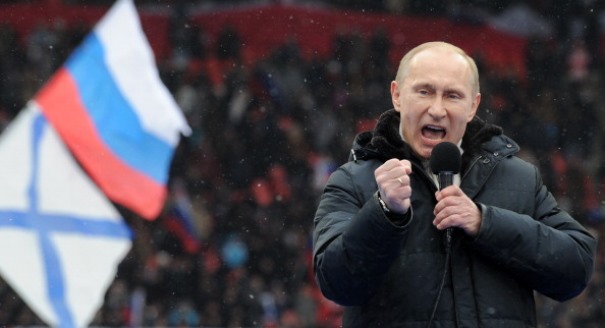
Nobody knows how much more Vladimir Putin can squeeze Russia—not even the president himself. So far, he has been testing the waters, trying to get a feel for how much further he can go with his crackdown. At the moment, Putin meets with weak resistance from a tiny segment of the Russian population—the “angry citizens,” the intellectuals, and the middle class that he prefers to ignore. According to a recent survey, 11 percent of Russians are ready to take to the streets to defend their political rights, with 81 percent of respondents preferring to sit at home.
Even if protest becomes a more powerful tool, Putin will continue to tighten the screws. This is how the law of repression works: once an authoritarian leader has embarked along a repressive path, he cannot stop. For such a leader to backtrack means looking weak and inviting a wave of anger. Putin understands that logic.
Observers can only guess whether Putin appreciates the conundrum he has built for himself: the more he suffocates society, the bigger the backlash will be, and the more painful his fall. That is nothing unique to Russia—it is just the logic of suicidal leadership.
Three factors are saving Putin for the time being: the lack of a political alternative in Russia that can unite the opposition; the oil and gas El Dorado that helps keep Russia moving; and the connivance of the West, which is happy to see Putin keep the lid on the Russian kettle.
God knows what will happen if the kettle explodes. . . .
The balance between the costs and benefits of the Putin system has been tipping away from the latter and toward the former ever since his return to the presidency last year. Before that, the benefits of stability and economic growth were a price most Russians seemed happy to accept for his authoritarianism.
However, Russia’s political culture has begun to change. That is thanks to a combination of economic growth based almost entirely on energy and other natural resources and the relative openness of Russian society, as well as the rise of an urban middle class. The downsides of Putinism—corruption, abuse of the rule of law, intimidation, and coercion—have become less tolerable as Putin’s regime has become more dysfunctional.
The recent episode involving Russian opposition activist Aleksei Navalny shows that the senior leadership around Putin is beginning to split, which could lead to further cracks. Added to this is the start of a revolution in world energy markets, which may undermine the central pillar of Putin’s system.
Putin’s downfall may not be imminent, but his years are numbered, and it is unlikely that he will serve another term as president.
How far Putin can squeeze Russia will depend first and foremost on Europe’s demand for energy, of which Russia is the world’s biggest exporter. The more the Russian president is awash with the cash from rising energy prices, the tighter his grip on power, and the less appealing the country’s emerging civil society.
With Russia’s dependence on gas and oil exports—which account for 50 percent of its budget revenue and 80 percent of all exports—the country benefits from a bullish energy market, but is also vulnerable to price fluctuations. Russia’s budget will be balanced as long as the price of crude oil reaches $117.80 per barrel (it is currently around $107 per barrel). That may suggest that Russia’s interest in promoting stability in the oil-rich Middle East is limited at best.
Russia’s overdependence on energy exports and its shrinking working-age population mean that Putin may be in trouble sooner rather than later. But there is no charismatic competitor on the horizon, and the emerging civil society remains limited to the urban middle class of Moscow and St. Petersburg.
Still, there is no doubt that Putin’s popularity is falling. At 55 percent, his approval rating may appear enviable by average European standards, but this figure is down from 80 percent in 2008. More importantly, only 22 percent of Russians would like to see him reelected in 2018. It is therefore likely that Putin will be challenged during his current presidency, a process that would be greatly accelerated if energy prices were to fall.

Nonresident Senior Fellow, Carnegie Europe
Judy Dempsey is a nonresident senior fellow at Carnegie Europe
Recent Work
Judy Dempsey
Judy Dempsey
Carnegie does not take institutional positions on public policy issues; the views represented herein are those of the author(s) and do not necessarily reflect the views of Carnegie, its staff, or its trustees.
Europe has an interest in supporting Armenian leader Nikol Pashinyan as he tries to make peace with neighbors and loosen ties with Russia. But it is depersonalized support in the long term, not quickfire flash, that will win the day.

Thomas de Waal
Montenegro and Albania are frontrunners for EU enlargement in the Western Balkans, but they can’t just sit back and wait. To meet their 2030 accession ambitions, they must make a strong positive case.


Dimitar Bechev, Iliriana Gjoni
The war in Ukraine is costing Russia its leverage overseas. Across the South Caucasus and Middle East, this presents an opportunity for Europe to pick up the pieces and claim its own sphere of influence.

William Dixon, Maksym Beznosiuk

French President Emmanuel Macron has unveiled his country’s new nuclear doctrine. Are the changes he has made enough to reassure France’s European partners in the current geopolitical context?

Rym Momtaz, ed.
2026 has started in crisis, as the actions of unpredictable leaders shape an increasingly volatile global environment. To shift from crisis response to strategic foresight, what under-the-radar issues should the EU prepare for in the coming year?
Thomas de Waal