

Commentary
Judy Dempsey
{
  "authors": [
    "Judy Dempsey"
  ],
  "type": "commentary",
  "blog": "Strategic Europe",
  "centerAffiliationAll": "",
  "centers": [
    "Carnegie Endowment for International Peace",
    "Carnegie Europe"
  ],
  "collections": [],
  "englishNewsletterAll": "",
  "nonEnglishNewsletterAll": "",
  "primaryCenter": "Carnegie Europe",
  "programAffiliation": "",
  "programs": [],
  "projects": [],
  "regions": [
    "Europe",
    "Middle East",
    "North America"
  ],
  "topics": [
    "Security",
    "Military",
    "EU"
  ]
}
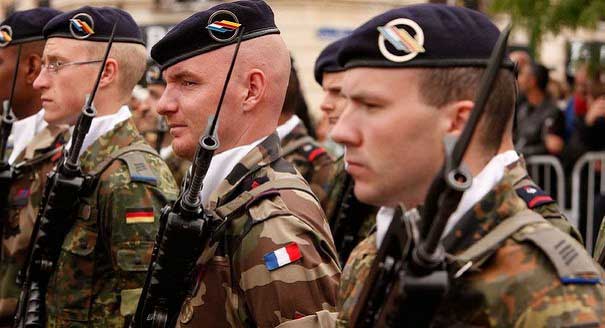
Source: Getty
According to a recent survey, Europeans are unconvinced by military action abroad but still value European leadership in the world. Those two views are tricky to reconcile.
When German government officials became convinced that chemical weapons had been used against Syrian civilians, they presented Chancellor Angela Merkel with several options for how to respond.
Discussions also took place between Berlin and Washington about how to punish the regime of Syrian President Bashar al-Assad, widely believed to be behind the attacks. But with Germany’s federal election campaign drawing to a close, Merkel was in no position to support the use of military force. Germany’s voters would not accept it. It would be politically too damaging for her.
It’s true that Germans have a huge aversion to any kind of military intervention. But they are no longer the only ones, as the annual Transatlantic Trends survey, conducted by the German Marshall Fund of the United States, makes abundantly clear. In Europe, most people now oppose the use of force.
The poll’s findings have important strategic implications for Europe’s security and defense ambitions. If Europeans are not prepared to have the use of force at their disposal, then their diplomatic efforts—at both EU and national level—will be undermined. Moreover, if Europeans are not even prepared to act over the use of chemical weapons in Syria, what can they do to prevent other countries from using them?
Transatlantic Trends interviewed respondents in ten European countries and Turkey. Asked whether force was sometimes necessary to obtain justice, only 31 percent of those polled said yes. Most Americans, in contrast, still believe in the use of force: around 68 percent think it can become necessary, according to the survey.
When questioned about Syria in particular, the Europeans gave an even more clear-cut response. Nearly 75 percent of respondents rejected any military intervention there. Germans, Portuguese, Slovaks, and Spaniards were particularly adamant about not wanting to get involved.
In Turkey, 72 percent of those asked said their country should keep out of Syria. That contrasts sharply with Prime Minister Recep Tayyip Erdoğan’s more aggressive stance, which has been focused on regime change in Syria.
But Americans want to stay out of Syria too, as President Barack Obama discovered the hard way when he lobbied Congress to sanction strikes against Syria.
There are several possible explanations for this reluctance to use force. One is the sheer weight of war-weariness and casualties from the interventions in Iraq and Afghanistan.
Another reason is the fact that in Europe in particular, publics are highly skeptical about the results of the wars in Afghanistan, Iraq, and Libya. They are unsure about the long-term goals and benefits of military intervention, and have become doubtful about imposing Western values on countries undergoing tremendous changes.
Furthermore, the debates in Britain and France about supporting a U.S.-led military intervention also exposed a growing anti-Americanism.
But Transatlantic Trends reveals something else about European publics: they are becoming very inward-looking. More and more Europeans seem to believe that they can live in a comfort zone insulated from the crisis engulfing their neighbors.
This comfort zone negates the need to take responsibility for defending the European liberal order. Indeed, the implicit message from Transatlantic Trends is that if this mood continues, Russia and China will be calling the shots. Yet when European respondents were asked if they believed Russian leadership in world affairs was desirable, 27 percent said no.
Most of Europe’s leaders are neither challenging these insular views nor explaining that crises in Europe’s neighborhoods breed their own regional instability.
Yet herein lies a contradiction. Despite their insularism, Europeans continue to take a positive view of Europe’s role in global affairs. According to the survey, 71 percent of European respondents said that strong European leadership in world affairs was desirable—down only 5 percentage points from 2006.
If that is indeed the case, then European leaders have a difficult act to follow: they will need to reconcile their publics’ global ambitions with a foreign policy that cannot rely on the threat of military force.
Is that what Europe really wants?

Nonresident Senior Fellow, Carnegie Europe
Judy Dempsey is a nonresident senior fellow at Carnegie Europe
Recent Work
Judy Dempsey
Judy Dempsey
Carnegie does not take institutional positions on public policy issues; the views represented herein are those of the author(s) and do not necessarily reflect the views of Carnegie, its staff, or its trustees.

Trump is distracted and Ukraine wants Europe to step up. The continent’s leaders must find their voice and assert it in talks with Russia.

Alissa de Carbonnel

Mounting economic strain and battlefield losses will not necessarily make the Kremlin less dangerous. They could instead push Moscow toward a more aggressive hybrid campaign designed to test NATO’s Eastern flank, exploit allied hesitation, and fracture European resolve.

Maksym Beznosiuk

Over the past ten years, NATO has held almost as many summits as it did during the entirety of the Cold War. Are they still useful, or is it time to stop holding annual meetings?

Rym Momtaz, ed.
Nearly a year and a half after Europeans leaned into sucking up to Trump, the strategy has produced some benefits when it comes to Ukraine.
Rym Momtaz
Far-right leader Marine Le Pen can—and will—run in France’s next presidential election. What does the outcome of her appeal against a 2025 embezzlement conviction mean for the country’s political future?
Catherine Fieschi