

Commentary
Judy Dempsey
{
  "authors": [
    "Judy Dempsey"
  ],
  "type": "commentary",
  "blog": "Strategic Europe",
  "centerAffiliationAll": "",
  "centers": [
    "Carnegie Endowment for International Peace",
    "Carnegie Europe"
  ],
  "collections": [],
  "englishNewsletterAll": "",
  "nonEnglishNewsletterAll": "",
  "primaryCenter": "Carnegie Europe",
  "programAffiliation": "",
  "programs": [],
  "projects": [],
  "regions": [
    "North America",
    "United States",
    "Western Europe",
    "Europe"
  ],
  "topics": [
    "Security",
    "EU"
  ]
}
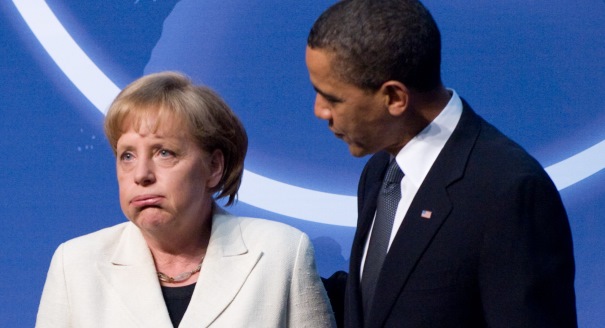
Source: Getty
Postwar feelings of transatlantic solidarity are no more. Today, Americans and Europeans have vastly different perceptions of the outside world and of the threats they face.
When EU leaders agreed last Friday that Paris and Berlin would talk to Washington about the latest revelations of spying by the U.S. National Security Agency, it was a sign of Europeans’ growing frustration with the transatlantic relationship.
The United States has always spied on its allies. But the extent of recent snooping—allegedly grabbing data on 70 million French telephone calls per month and even listening in on German Chancellor Angela Merkel’s cell phone—seems entirely excessive. It’s as if the United States believes Europeans are enemies and potential terrorists rather than friends and allies.
Trust among allies has eroded to the extent that it might finally dawn on both Europeans and Americans not that the old transatlantic relationship is in need of fixing—but that it is over. Building a new one will present enormous challenges for U.S. and European foreign and security policy.
Trust between both sides never was that deep.
In the aftermath of World War II, the transatlantic relationship was built on necessity; it was rarely questioned. The Cold War ensured that this bond, built on the American security guarantee for Western Europe, was kept intact. Remarkably, when the ideological struggle with the Eastern bloc ended with the collapse of the Berlin Wall almost twenty-four years ago, the transatlantic relationship at first continued as if nothing had really changed.
What finally shook both sides out of their complacency were the terrorist attacks of September 11, 2001. For Americans, those events were a collective shock that galvanized public opinion into supporting a ruthless war on terror. The Europeans’ political and emotional support, though genuine at first, evaporated quickly as the full scope of the war on terror became known.
The administration of former president George W. Bush prosecuted that war relentlessly, sending soldiers into Afghanistan and Iraq while also involving some of America’s European allies in renditions. And while the administration of President Barack Obama brought home American troops from Iraq and is withdrawing from Afghanistan, the war on terror continues. It is the ideological nature of this struggle that is straining relations between Europeans and Americans.
On the face of it, the first obvious problem is the continuing existence of the Guantánamo Bay detention camp. That has sullied America’s reputation for decency and upholding civil liberties, as Obama himself has acknowledged. Yet in spite of many declarations of goodwill, he has not yet closed down the camp.
The use of drones is another issue that causes strife between the United States and its European allies. The massive and nontransparent use of drones against suspected terrorists, which is supported by over 65 percent of Americans, has damaged Washington’s reputation in Pakistan and Yemen, but also in Europe.
European leaders know full well that drones are a part of the future military kit—and can replace boots on the ground and limit risks to troops. But without clear and transparent rules for their use, European publics will not support such use for military missions. Those guidelines would have to apply to NATO as well, once the alliance begins using drones.
But even those two issues are not enough to explain the end of the post-1945 transatlantic relationship. The most important cause is the fact that both sides of the Atlantic have completely different perceptions about the threats they face.
The U.S. National Security Strategy pulls no punches about how it views the threats facing the country. When you read the disparate strategic reviews of the EU’s member states, you rarely get the same sense of a country being menaced.
The fact that most EU leaders don’t see any need for a European security strategy shows that that they have shut their eyes to this issue: they want to discuss neither the idea of threats, nor how they should deal with them, nor how they might anticipate them.
It is this complete discrepancy in the perception of threats on the two sides of the Atlantic that marks the difference from the Cold War. Yesterday’s feelings of solidarity and kinship are no longer sustained by a common perception of the outside world.
So what can be done to establish a new modus vivendi? In the short term, very little. European leaders are too divided to agree on which threats to take seriously. Nor do they know what kind of new relationship they want with the United States. Above all, they don’t want to acknowledge that the post-1945 bargain is over.
As for the Obama administration, which is increasingly distancing itself from Europe, it has yet to decide if the relationship is worth rebuilding.
Yet the longer both sides dither, the greater the opportunity for drift and misunderstanding. Russia, China, and other authoritarian countries will relish the eclipse of the postwar Western liberal order. Surely, that is not in the interests of people on either side of the Atlantic.

Nonresident Senior Fellow, Carnegie Europe
Judy Dempsey is a nonresident senior fellow at Carnegie Europe
Recent Work
Judy Dempsey
Judy Dempsey
Carnegie does not take institutional positions on public policy issues; the views represented herein are those of the author(s) and do not necessarily reflect the views of Carnegie, its staff, or its trustees.

The aftermath of the Ceuta crisis shows Europe has drawn the wrong lessons. Rather than doubling down on failed migration policies, the EU needs to address the underlying roots of such episodes.

Richard Youngs

An overwhelming victory by a far-right-wing party in a small state in eastern Germany will have major repercussions for Chancellor Friedrich Merz’s coalition.
Judy Dempsey

Canadian Prime Minister Mark Carney has twice inspired praise for standing up to U.S. President Donald Trump: at the 2026 World Economic Forum in Davos and on Canada-U.S. trade negotiations. Is Carney showing a third way better than the EU has in dealing with the Trump administration?

Rym Momtaz, ed.

The EU’s responses to two recent incidents expose the gulf between European perceptions and capabilities. Unless the union can bridge that gap, it will never become a real geostrategic power.
Rym Momtaz

In supporting Europe’s far-right, MAGA and Russia both want the same thing: a weaker EU. Europe must defend itself without abandoning the openness these forces exploit.

Armida van Rij