

Report
- +9
Richard Youngs, Erik Jones, Dan Baer, …
{
  "authors": [
    "Richard Youngs"
  ],
  "type": "commentary",
  "blog": "Strategic Europe",
  "centerAffiliationAll": "",
  "centers": [
    "Carnegie Endowment for International Peace",
    "Carnegie Europe"
  ],
  "collections": [
    "Arab Awakening"
  ],
  "englishNewsletterAll": "",
  "nonEnglishNewsletterAll": "",
  "primaryCenter": "Carnegie Europe",
  "programAffiliation": "",
  "programs": [],
  "projects": [],
  "regions": [
    "Middle East",
    "North Africa",
    "Egypt",
    "Libya",
    "Tunisia",
    "Syria",
    "Yemen",
    "Southern, Eastern, and Western Africa"
  ],
  "topics": [
    "Political Reform",
    "EU"
  ]
}
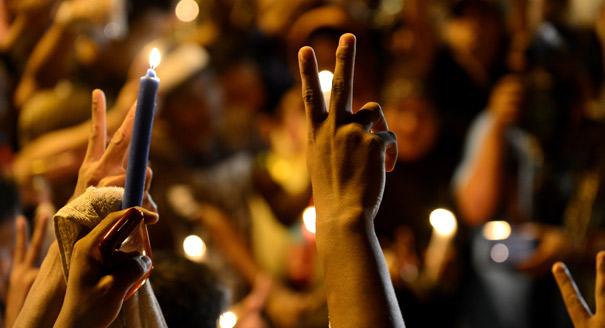
Source: Getty
At the third anniversary of the Arab Spring uprisings, the state of play in the Middle East and North Africa is cause for concern. But is it all as somber as it looks?
Each successive anniversary of the Arab Spring dampens the initial enthusiasm for the uprisings a little more. At the three-year mark from the Tunisian and Egyptian revolts, the Middle East and North Africa now generate progressively more disquieting headlines. Even those observers who held the lowest expectations in 2011 might be shocked at how badly things have turned out.
In Egypt, the army is more fully in control after bludgeoning a new constitution into being. It is introducing restrictions on political freedoms that appear more draconian than those that existed under former president Hosni Mubarak.
In Syria, nearly as many people have died since 2011 as during the entirety of Algeria’s brutal civil war in the 1990s. Peace talks are struggling to gain traction. Militias run riot in Libya, able to sequester a prime minister with apparent impunity. Far from standing as a shining city on the hill, Turkey is mired in its own democratic unraveling.
Crucially, there is variety to the region’s authoritarian resilience. Resistance to reform ranges from the brutal (Syria) through the familiarly draconian (Egypt) to the more subtle (Morocco). In the Gulf states, those in power have resorted to the tactics of financial payoffs.
Radical jihadists have reestablished themselves after a pre–Arab Spring period in which the loose al-Qaeda franchise was palpably on the back foot. Jihadists have gained an unprecedented foothold even in Tunisia—the one country that remains on track toward something broadly recognizable as a democratic transition.
Unsurprisingly, against this background, the litanies of gloom are numerous and sobering. But is the picture as unremittingly despairing as it seems?
Arguably, the most negative possible reversal has not happened: on balance, people in the region have not lost their conviction in open politics.
Nearly every region in the world has passed through a “valley of tears” after initial democratic breakthroughs—a period of crushed expectations in which citizens question the merits of democracy. In the Middle East, some illiberal preferences have taken root, but polls constantly show a popular hunger for democratic change.
When the Muslim Brotherhood began contravening the core aims of Egypt’s 2011 revolution, even some Islamists turned against then president Mohamed Morsi. Many who sympathized with the army’s coup in July 2013, which ousted Morsi, now protest against it. Opinion in Egypt is changeable, as political alliances fluctuate.
Egypt’s problem is less a reversion to the status quo ante than a case of popular unease with power grabs by both the army and the Muslim Brotherhood. It is unclear whether Egypt is heading toward the restoration of full authoritarianism or a limited form of competitive autocracy.
The most striking feature of the Middle East three years on from the first uprisings is its indeterminacy. In many Arab states, there is no single, clear direction of travel. Small advances in democratic rights, stasis, and counterrevolution all occur simultaneously, clashing and colliding in increasingly unpredictable combinations.
As polarization and fragmentation deepen across the region, there is more focus on the need for conciliation, inclusive dialogue, and consensus. Tempering internal division is now the most evident and pressing concern. In some states, national dialogues have failed or are still absent; but even in these most fractious of places, more voices today call for inclusive dialogue and consensus over the basic political “rules of the game.”
The management of political change in the Middle East now shows similarities to the conflict-mitigation and power-sharing forums that have been prominent in African transitions. Indeed, these similarities are stronger than any resemblance to democratic transitions in Eastern or Southern Europe, or Latin America.
This shifted focus is not entirely bad news, and in the long term may be beneficial—even as cautious conflict-resolution dialogues slow the pace of short-term reform and engender frustration among both Islamist and secular reformers. But delicate trade-offs will need to be struck.
Transitions underpinned by dialogue tend to be more stable and less susceptible to violent reversal; but they also tend to extend democratic rights less far. It remains unclear whether the incipient efforts to build more inclusive coalitions and dialogue forums will clear the way for democratic reform or simply help regimes buy time.
And it is this predicament that represents the core challenge for Europe’s strategic presence in the region. Self-evidently, the EU has not made enough of an impact to tip the scales decisively in favor of Arab democracy; it probably never had the power to do so. But it can now better conceptualize the shift in Middle Eastern politics to position itself for the next phase of Arab reforms.
European support for dialogue and consensus has become a signature component of the EU’s Middle East policy. While this is welcome, it must not elide into a policy that gives a stamp of approval to merely facade reform.
In Egypt, the army has killed more than 1,000 people since July 2013. Normally, that would have been expected to cause a huge international outcry, but it appears to have been swept under a carpet of international pseudoneutrality toward the country’s bitter internal conflicts.
Resolving conflict must go hand in hand with structural political change, rather than substitute for or even militate against it.
If the EU and other international actors do not put this balance at the core of their Middle Eastern policies, the Arab Spring’s fourth anniversary is unlikely to be any more upbeat than its third.

Senior Fellow, Democracy, Conflict, and Governance Program
Richard Youngs is a senior fellow in the Democracy, Conflict, and Governance Program, based at Carnegie Europe. He works on EU foreign policy and on issues of international democracy.
Recent Work

Richard Youngs, Erik Jones, Dan Baer, …

Richard Youngs, Thomas Carothers
Carnegie does not take institutional positions on public policy issues; the views represented herein are those of the author(s) and do not necessarily reflect the views of Carnegie, its staff, or its trustees.

In supporting Europe’s far-right, MAGA and Russia both want the same thing: a weaker EU. Europe must defend itself without abandoning the openness these forces exploit.

Armida van Rij

As we close out another season of Strategic Europe, it is worth taking stock of the deep shifts underway.

Rym Momtaz
The EU had to compromise to adopt a twenty-first sanctions package against Russia, exposing growing cracks in the union’s resolve. Is this latest, weaker round worth it to keep pressure on Moscow?
Rym Momtaz, ed.

Trump is distracted and Ukraine wants Europe to step up. The continent’s leaders must find their voice and assert it in talks with Russia.

Alissa de Carbonnel

Mounting economic strain and battlefield losses will not necessarily make the Kremlin less dangerous. They could instead push Moscow toward a more aggressive hybrid campaign designed to test NATO’s Eastern flank, exploit allied hesitation, and fracture European resolve.

Maksym Beznosiuk