

Commentary
Gwendolyn Sasse
{
  "authors": [
    "Gwendolyn Sasse"
  ],
  "type": "commentary",
  "blog": "Strategic Europe",
  "centerAffiliationAll": "",
  "centers": [
    "Carnegie Endowment for International Peace",
    "Carnegie Europe"
  ],
  "collections": [],
  "englishNewsletterAll": "",
  "nonEnglishNewsletterAll": "",
  "primaryCenter": "Carnegie Europe",
  "programAffiliation": "",
  "programs": [],
  "projects": [],
  "regions": [
    "Eastern Europe",
    "Ukraine",
    "Russia"
  ],
  "topics": [
    "Political Reform",
    "Democracy",
    "EU"
  ]
}
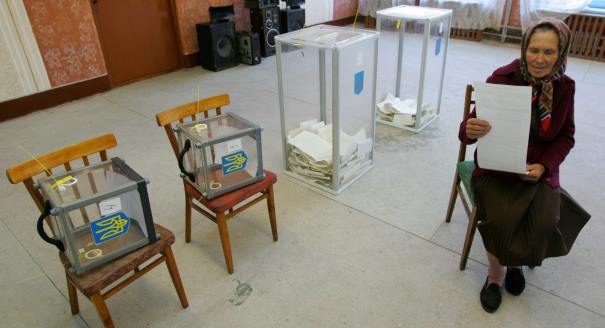
Source: Getty
Ukraine’s presidential election can offer a voice to millions of hitherto silent Ukrainians. It may also be the only way to halt the country’s spiral of violence.
Events in Ukraine are in a downward spiral. Acting President Oleksandr Turchynov has admitted that the government in Kiev has lost control over parts of the country’s southeast. The mass deaths of mainly pro-Russian separatists in Odessa on May 2 have fed into further mobilization and polarization. Western governments and Russia are locked in a new round of mutual accusations and threats of sanctions.
These developments are overshadowing the vital importance of Ukraine’s presidential election scheduled for May 25. This election is the only feasible means to break through the current cycle of violence. It has the potential to give a voice to the vast majority of Ukrainian citizens who have not been participating in the various protests and standoffs since the beginning of the crisis.
The election will therefore provide a first tangible snapshot of the attitudes and preferences of Ukrainian society at large. At the moment, observers simply do not know what the silent majority thinks or wants. The presidential poll represents Ukraine’s best chance to start the process of rebuilding political authority at the center.
According to trustworthy opinion polls, there is a possibility that the election might be decided in the first round (by a vote of more than 50 percent for one candidate). Since Ukraine became independent in 1991, the country’s presidential elections have always required a second-round runoff between the two top candidates.
The current political situation could break this electoral pattern. The two key candidates in the upcoming contest are Petro Poroshenko, an oligarch known as the “Chocolate King” due to his ownership of the confectionery company Roshen, and former prime minister Yulia Tymoshenko. Poroshenko leads by a long way.
According to the Committee of Voters of Ukraine, a nongovernmental organization, a turnout of about 70 percent is expected. In their April poll, 56 percent said they would definitely vote, and 29 percent said they would probably vote. Of those surveyed, 48 percent declared their support for Poroshenko, and 14 percent for Tymoshenko. Three further candidates—Mykhailo Dobkin, a former governor of the Kharkiv region, Serhiy Tihipko, a former vice prime minister, and Petro Symonenko, the leader of the Communist Party—all scored 6–7 percent. Other polls put turnout at around 80 percent and Poroshenko above the 50 percent threshold in the first round.
Poroshenko has held a wide range of political positions, including foreign minister, minister of trade and economic development, head of the Council of Ukraine’s National Bank, and member of parliament. In 2004, he came out in support of Ukraine’s Orange Revolution and presidential candidate Viktor Yushchenko when he allowed his television channel 5 Kanal to become an outlet for the opposition. More recently, Poroshenko backed the Euromaidan antigovernment protests. While he sees Ukraine’s future linked to the EU, he also stresses the need for good relations with Russia.
Poroshenko’s election strategy is a clever one. He is trying to define his program around more long-term expectations of the population: higher living standards and less corruption. Dissatisfaction with the corrupt regime of Viktor Yanukovych, who was ousted as president in February, had been a key concern shared across Ukraine’s regions before the Euromaidan demonstrations.
However, Poroshenko and Tymoshenko have a history of accusing each other of corruption, when they occupied the positions of head of the National Security and Defense Council and prime minister, respectively, in the immediate aftermath of the Orange Revolution. Their disagreements led then president Yushchenko to dismiss the entire cabinet. Poroshenko’s anticorruption stance is therefore not entirely credible, but popular.
Tymoshenko’s emotional and ideological election campaign contrasts with Poroshenko’s projection of a combination of principles and pragmatism. Currently, Tymoshenko’s political record is too tainted to convince voters to give her another chance. Poroshenko, however, has styled himself as an experienced politician and reformer without getting entangled in divisive regional issues. He grew up in the Vinnytsia region in central Ukraine.
Ukraine’s 2014 presidential election is only one step toward restoring political legitimacy in the country—parliamentary elections are just as important to move on to the next stage in Ukrainian politics.
But let’s concentrate on the first step for the moment. The presidential poll may well be the only opportunity to stop Ukraine from descending into further internal conflict, Russian intervention, and the de facto loss of regions in the country’s southeast. Presidential elections are also a typical platform for protest—and this vote could trigger a new round of protests in the capital, in current regional hot spots, and in other regions.
Western governments and international organizations should concentrate their efforts on enabling clean elections, high voter turnout, and the acceptance of the outcome by the Ukrainian elites and society. It is here that the immediate future of Ukraine will be decided—rather than in sanctions against Russia.
Gwendolyn Sasse is a professorial fellow in politics at Nuffield College and university reader in the Department of Politics and International Relations at the University of Oxford.
Nonresident Senior Fellow, Carnegie Europe
Gwendolyn Sasse is a nonresident senior fellow at Carnegie Europe. Her research focuses on Eastern Europe, with a particular focus on Ukrainian politics and society, EU enlargement, and comparative democratization.
Recent Work
Gwendolyn Sasse
Gwendolyn Sasse
Carnegie does not take institutional positions on public policy issues; the views represented herein are those of the author(s) and do not necessarily reflect the views of Carnegie, its staff, or its trustees.

Are Germany’s economic, industrial, and political struggles becoming a liability for the EU’s ability to rise to the geopolitical moment?

Rym Momtaz, ed.

European Commission President Ursula von der Leyen is about to give her annual address on the state of the EU. Here’s what she won’t—but should—say.
Rym Momtaz

The aftermath of the Ceuta crisis shows Europe has drawn the wrong lessons. Rather than doubling down on failed migration policies, the EU needs to address the underlying roots of such episodes.

Richard Youngs
An overwhelming victory by a far-right-wing party in a small state in eastern Germany will have major repercussions for Chancellor Friedrich Merz’s coalition.

Judy Dempsey

Canadian Prime Minister Mark Carney has twice inspired praise for standing up to U.S. President Donald Trump: at the 2026 World Economic Forum in Davos and on Canada-U.S. trade negotiations. Is Carney showing a third way better than the EU has in dealing with the Trump administration?
Rym Momtaz, ed.