

Commentary
Nathalie Tocci, Jan Techau
{
  "authors": [
    "Jan Techau"
  ],
  "type": "commentary",
  "blog": "Strategic Europe",
  "centerAffiliationAll": "",
  "centers": [
    "Carnegie Endowment for International Peace",
    "Carnegie Europe"
  ],
  "collections": [],
  "englishNewsletterAll": "",
  "nonEnglishNewsletterAll": "",
  "primaryCenter": "Carnegie Europe",
  "programAffiliation": "",
  "programs": [],
  "projects": [],
  "regions": [
    "Middle East",
    "Israel",
    "Western Europe",
    "Europe"
  ],
  "topics": [
    "EU",
    "Foreign Policy"
  ]
}
Source: Getty
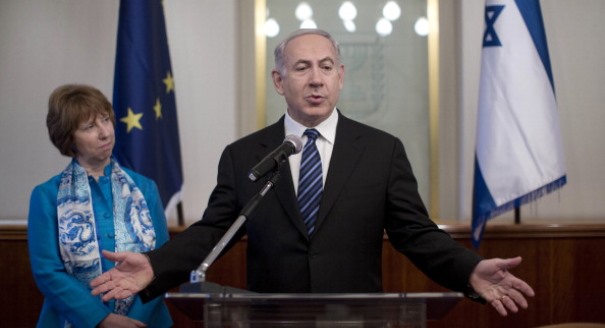
EU-Israeli relations are increasingly dominated by the single issue of settlements in the West Bank. Both sides should focus more on bigger strategic questions.
It is never a smart idea to make a complex relationship overly dependent on progress in one particular policy field. But this is exactly what is currently happening in the relationship between the EU and Israel. Despite the multilayered nature of relations and the generally high quality of cooperation, the issue of Israeli settlements increasingly dominates mutual perceptions and the debate between the two sides. This must be stopped, or the damage could be substantial.
After I was invited to speak on EU-Israel relations at this year’s Herzliya Conference on June 8–11, my preparatory research became a bit of a Groundhog Day experience. Whomever I talked to, the dominant issue came up again and again: the Israeli settlements in the West Bank.
Admittedly, no one failed to mention the enormous and growing trade volume between the two partners. Everyone pointed to the intense science and technology cooperation and Israel’s participation in the European Commission’s Horizon 2020 research grant program. Few omitted to mention the special responsibility Europe has for Israel’s security, and most cited the deep cultural and educational exchanges between European countries and Israel.
During the debates in Herzliya, it became clear that both sides are to blame for this development. On the EU side, focusing on the illegality of the settlements, and letting this argument hijack the agenda and atmospherics of the relationship, is partly an ersatz strategy intended to compensate for the absence of real foreign policy clout in the region. It allows the EU to occupy the moral high ground without much political cost. The EU can score ethical brownie points among valued target audiences without making much of a difference on the ground.
The best example of this is a 2013 European Commission directive that forbids EU member states from becoming involved in projects in illegal settlements. This much-discussed legislation has not created any kind of positive effect on the ground, but its enormous political symbolism has led to a worsening of relations, a strengthening of hard-liners on both sides, and a narrowing of the European debate on Middle Eastern affairs.
On the Israeli side, the current government still underestimates the enormous damage it does to its own reputation and credibility when it authorizes further developments of settlements in disputed areas. Not only has such a policy angered Europeans, it is also increasingly drawing flak from the United States, including from many American Jews, Israel’s strongest allies abroad.
It does not help that members of the current Israeli government rarely miss an opportunity to publicly belittle EU officials, including EU foreign policy supremo Catherine Ashton. And when assessing newly released EU documents, Israeli officials tend to highlight only those paragraphs criticizing Israel, never the ones that offer further cooperation or promise steadfast EU support.
Despite the heroic efforts of its diplomatic representatives in Brussels, the government in Jerusalem assigns too little relevance to the cultivation of good relations with the EU institutions and much rather focuses on bilateral relations with member states. As such, “Europe” is often portrayed in a way that betrays little knowledge about the intricacies and relevance of EU decisionmaking.
The danger is clear. By allowing their relationship to become emotionalized around a highly disputed topic, the two sides are giving fringe players a veto right over political progress. That poisons the atmosphere and distracts from the big strategic issues that should deserve at least as much attention, if not more.
Sensible politicians on both sides should make clear again and again that settlements are but one of many issues of strategic importance in the EU-Israeli relationship. Where is the public debate on the future political order in the Middle East after a deal on the Iranian nuclear issue? Where is the wider intellectual discourse on the impact of Eastern Mediterranean energy reserves on the great gas game in Europe? Where is a shared assessment on how to guarantee stability in Europe’s volatile Southern neighborhood amid a decreasing U.S. footprint in both Europe and the Mediterranean? Where is an honest European analysis of the threats of Islamic extremism, drawing on the immense Israeli experience in this field?
Europe and Israel share not all but many similar challenges, threats, and opportunities. Their relationship should be brimming with rich intellectual exchange at all levels. Instead, both sides risk losing what should be a truly strategic partnership by indulging in their own obsessions about the respective other. It is not too late yet, but it will take some effort to avoid an unhealthy one-issue relationship.

Director, Europe Team, Eurasia Group
Techau is director with Eurasia Group's Europe team, covering Germany and European security from Berlin. Previously, he was director of Carnegie Europe.
Recent Work

Nathalie Tocci, Jan Techau
Jan Techau
Carnegie does not take institutional positions on public policy issues; the views represented herein are those of the author(s) and do not necessarily reflect the views of Carnegie, its staff, or its trustees.

The European Commissioner for Trade is headed to China. But after President Xi’s bridge-building visit to Washington, can a more isolated EU overcome Beijing’s stranglehold on critical raw materials? Who will blink first?

Rym Momtaz, ed.

The domestic impacts of how long it is taking to end the war in Ukraine have pushed the French electorate to the political extremes and compromised the country’s diplomatic capacity.
Rym Momtaz

Before the next wave of EU enlargement takes place, the union needs to grapple with thorny questions of how power is distributed among its members.


Emil Sondaj Hansen, Ditte Brasso Sørensen

A summer of escalation in the Black Sea has hurt Ukraine economically and is exacerbating world food security. A truce is needed—as is a broader reframing of Europe’s Ukraine strategy.

Thomas de Waal

Are Germany’s economic, industrial, and political struggles becoming a liability for the EU’s ability to rise to the geopolitical moment?
Rym Momtaz, ed.