

Commentary
Nathalie Tocci, Jan Techau
{
  "authors": [
    "Jan Techau"
  ],
  "type": "commentary",
  "blog": "Strategic Europe",
  "centerAffiliationAll": "",
  "centers": [
    "Carnegie Endowment for International Peace",
    "Carnegie Europe"
  ],
  "collections": [],
  "englishNewsletterAll": "",
  "nonEnglishNewsletterAll": "",
  "primaryCenter": "Carnegie Europe",
  "programAffiliation": "",
  "programs": [],
  "projects": [],
  "regions": [
    "Western Europe",
    "Europe"
  ],
  "topics": [
    "Foreign Policy",
    "EU"
  ]
}
Source: Getty
EU leaders look set to choose a lackluster candidate as the union’s next foreign policy supremo. Hopefully, she will turn out to be more capable than many predict.
On August 30, European leaders will gather to announce what they hope will be a weak successor to Catherine Ashton as EU foreign policy chief. It would be better for the EU if those hopes were dashed and a strong individual were to emerge.
Since the debate about who will be the new high representative for foreign affairs and security policy started in earnest after the European Parliament elections in May, there has been a feeling that the job doesn’t really count for much. National governments mostly see the post as the least important variable in the EU’s big personnel carousel that will come to an end in a few days, valuable only as compensation for those who don’t get the top jobs in the European Commission or the European Council.
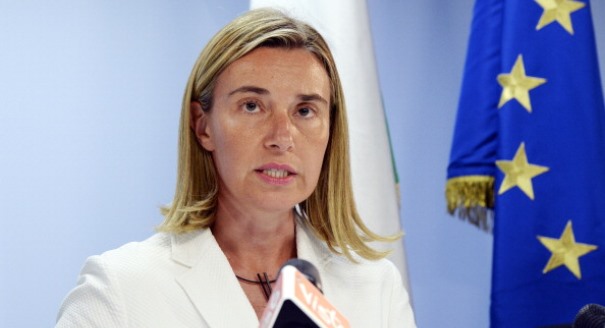
Now, Renzi has brought all Socialist governments in the EU behind his nominee and is likely to prevail at this weekend’s summit. So Federica Mogherini, Italy’s current foreign minister, will almost certainly be the EU’s new “high rep.”
Whether Mogherini will be a strong or a weak foreign policy chief is impossible to predict. But she should not count on the member states to support her in her efforts to bring more cohesion to the EU’s external policies. Too obvious is the disdain that prevails in the member states, at least the bigger ones, vis-à-vis the European External Action Service (EEAS), the unwanted new kid on the block in the EU’s institutional lineup since its formation four years ago.
In the EU, foreign policy has always been the business of the member states, with the Brussels-based institutions playing a distant second or third fiddle. The Lisbon Treaty, which established the high representative’s office in 2009, never meant to change that setup. Yet the same treaty also created the EEAS in 2010 to forge a more coherent foreign policy among 27+ nations, with the “high rep” tasked with the job of coordinator in chief. There are two main reasons why this modest dream has died over the last few years.
First, Catherine Ashton and the performance of the EEAS, with very few exceptions, have not impressed the member states. National leaders realized early on that they had little to fear from the new body and, as a consequence, never developed much respect for it.
In the political game over who influences foreign policy decisionmaking in the EU, the EEAS never became a force to be reckoned with. It just did not play the bureaucratic power game very well. To be fair, the service was given scandalously scant resources to do so, but even the limited means at hand were not used smartly, especially in the beginning, when the game was wide open.
The second reason for the EU’s failure to achieve greater foreign policy coherence has been a general remigration of power back to the member states at the expense of the central institutions. That trend did not favor the EEAS in its pursuit to fulfill the role assigned to it by the Lisbon Treaty. By the time the treaty entered into force, the appetite of member states to play some of their key policies through the institutions was already at a low ebb. That appetite has declined even further ever since.
The best example of this shift can be seen in Germany, a country that has traditionally been the pro-institutional “reserve power” in the EU, always defending the Brussels-based apparatus just a bit longer than everybody else. Chancellor Angela Merkel’s intergovernmental instincts have ended this posture and turned Germany into a normal EU power, robbing the community method—the union’s integrationist decisionmaking approach—of its most powerful advocate.
At the same time, the euro crisis, with its frantic intergovernmental trouble-shooting, only reinforced the renationalizing tendencies that had already been at work for a while.
But is the EU’s enfeebled institutional architecture really a problem for foreign policy, a field that was never meant to be integrated in the first place? It wouldn’t be, if foreign policy consisted only of ad hoc crisis management. Quick responses to contingencies is, and will remain, the domain of the member states because in moments of crisis, responsibility falls where power resides.
Unfortunately, however, foreign policy is about a whole lot more than just dealing with clear and present danger. It is also about the strategic steering of long-term policies. This is doubly true in the EU context, where long-term projects require both the technical expertise of the EU institutions and the political guidance and support of the member states. The mismanaged European Neighborhood Policy is a case where such backing has fallen short.
It is not necessary to fully integrate EU foreign policy, as some archfederalists would like. But it is necessary, in an increasingly nightmarish geopolitical environment, to strengthen the institutions so they can work toward at least the occasional chance of more coherence, more unified action, and more long-term thinking. In other words, that means more of the EU’s “single voice” in foreign policy—that mysterious objective that pundits have been talking about for so long.
One senior EU diplomat with decades of experience said recently that he couldn’t remember a time when the security situation in Europe was as calamitous and intractable as it is today. At such a time, the EU needs a strong high representative capable of leadership both within the EEAS and, if necessary, vis-à-vis the member states.
This is precisely what national leaders do not want. Let’s hope that they have gravely miscalculated and that Federica Mogherini—or whoever gets the job—turns out to be a much stronger foreign policy chief than the member states want and expect.
Director, Europe Team, Eurasia Group
Techau is director with Eurasia Group's Europe team, covering Germany and European security from Berlin. Previously, he was director of Carnegie Europe.
Recent Work

Nathalie Tocci, Jan Techau
Jan Techau
Carnegie does not take institutional positions on public policy issues; the views represented herein are those of the author(s) and do not necessarily reflect the views of Carnegie, its staff, or its trustees.

A summer of escalation in the Black Sea has hurt Ukraine economically and is exacerbating world food security. A truce is needed—as is a broader reframing of Europe’s Ukraine strategy.

Thomas de Waal

Are Germany’s economic, industrial, and political struggles becoming a liability for the EU’s ability to rise to the geopolitical moment?

Rym Momtaz, ed.

European Commission President Ursula von der Leyen is about to give her annual address on the state of the EU. Here’s what she won’t—but should—say.
Rym Momtaz

The aftermath of the Ceuta crisis shows Europe has drawn the wrong lessons. Rather than doubling down on failed migration policies, the EU needs to address the underlying roots of such episodes.

Richard Youngs

An overwhelming victory by a far-right-wing party in a small state in eastern Germany will have major repercussions for Chancellor Friedrich Merz’s coalition.

Judy Dempsey