

Commentary
Nathalie Tocci, Jan Techau
{
  "authors": [
    "Jan Techau"
  ],
  "type": "commentary",
  "blog": "Strategic Europe",
  "centerAffiliationAll": "",
  "centers": [
    "Carnegie Endowment for International Peace",
    "Carnegie Europe"
  ],
  "collections": [],
  "englishNewsletterAll": "",
  "nonEnglishNewsletterAll": "",
  "primaryCenter": "Carnegie Europe",
  "programAffiliation": "",
  "programs": [],
  "projects": [
    "European External Strategy Project"
  ],
  "regions": [
    "Europe",
    "Western Europe"
  ],
  "topics": [
    "Foreign Policy",
    "EU"
  ]
}
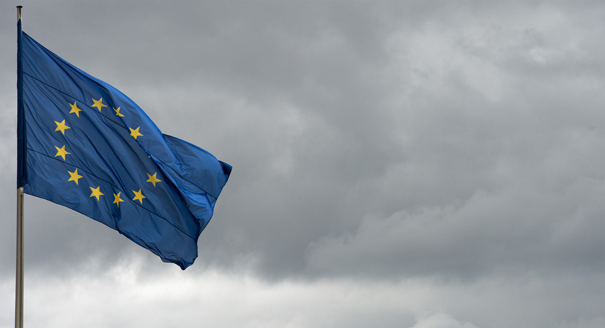
Source: Getty
In addition to growing internal divisions, sclerotic economies, and resurgent nationalism, the EU must now take on geopolitical challenges of a kind it has never faced before.
The weather in Brussels is not the most uncomfortable thing about being in Europe at the moment. The pouring rain and sub–comfort zone temperatures are forcing folks to get their sweaters out in mid-August. But Brusselites are pretty much used to this weather.
What Europeans are not yet acclimatized to is the fact that they face two existential foreign policy crises at their immediate doorstep that far exceed anything they have experienced in at least a generation—if not two—and that they themselves will be asked to play a key role in resolving. Very bad foreign policy weather will prevail in Europe for at least another generation.
In its East, the EU faces an existential crisis where European order itself is at stake. Can peace and rules-based conflict resolution prevail in Europe? The crisis management operation that followed the outburst of violence in Ukraine, and which was remarkably swift and cohesive by EU standards, must now be followed by a long-term strategy throughout the Eastern neighborhood. Can the EU play such a long game in geopolitical rivalry with Russia and in absence of its most powerful foreign policy tool, EU enlargement?
The EU will also have to sustain its fragile policy of combined toughness and openness vis-à-vis Russia—not just over a few months but for many years—despite being economically dependent on Russian resources and politically divided on whether Moscow is a partner or an enemy. The EU will have to balance all this while populations at home have no appetite for risky exposure abroad. Finally, Europe will have to do this in close cooperation with the United States, the EU’s indispensible yet increasingly absent-minded reserve power.
As if this were not enough, Europe faces a second existential threat on its Southern flank. For a long time, Europe viewed its Southern neighborhood much like its Eastern one: as a state-building exercise. Now, it looks like it is in the EU’s Southern neighborhood where it will be decided whether Europe can be a hard security player.
It is increasingly likely that Europe will have to go to war in the region. Military operations in Libya, Mali, and the Central African Republic were probably only small tastes of what really lies ahead if the Islamic State (IS) redefines the politics of the region, if Israelis and Palestinians continue their deathly embrace, if Lebanon or Jordan collapses, and if militant Islam—sponsored by Iran, the Gulf States, Saudi Arabia, and Turkey—continues to inspire the hopeless and the desperate.
The threat from Europe’s Southern neighborhood is existential because Europe’s secularized, liberal, capitalist, open societies are the defined archenemy of the hyperaggressive IS-style ideology, thereby making Islamist fundamentalism both a formidable geostrategic and homeland security challenge.
Even though the region falls outside EU borders, its populations are deeply embedded inside Europe, and thus their divisions and conflicts are, too. Millions of Muslims live in Europe, yet integration remains a significant problem. This contentious issue is likely to continue as Europe will increasingly reply on immigration if it is to sustain its standard of living against its own demographic decline.
It is also existential because European countries, despite their growing unease about Israel’s policies, will inevitably have to side with Israel should a critical threat to the Jewish state arise. Protecting Israel militarily, which is not unthinkable, would make Europe an outright enemy of many of its Southern neighbors, a nightmare scenario of epic proportions.
More so even than in the East, Europe’s halfhearted stabilizing efforts in the South have failed. And also more than in the East, Europe depends on American support to sort out a first-order security problem on its Southern doorstep. But unlike in the East, where Europe is actually rather powerful by itself, it can only be a strategic helper, not the main actor, in the South. But it will have to be an increasingly engaged one, a role that will be a costly, both financially and politically.
As I have written before, Europe’s great peace project is now an external one. In addition to managing its growing internal divisions, sclerotic economies, and resurgent nationalist temptations, the EU now also needs to take on geopolitical challenges of a kind it has never faced before. Maybe external pressure will lead to more cohesion at home. Let’s hope it works out that way. And let’s consider ourselves lucky as long as we have the luxury to complain about the bad weather.

Director, Europe Team, Eurasia Group
Techau is director with Eurasia Group's Europe team, covering Germany and European security from Berlin. Previously, he was director of Carnegie Europe.
Recent Work

Nathalie Tocci, Jan Techau
Jan Techau
Carnegie does not take institutional positions on public policy issues; the views represented herein are those of the author(s) and do not necessarily reflect the views of Carnegie, its staff, or its trustees.

A summer of escalation in the Black Sea has hurt Ukraine economically and is exacerbating world food security. A truce is needed—as is a broader reframing of Europe’s Ukraine strategy.

Thomas de Waal

Are Germany’s economic, industrial, and political struggles becoming a liability for the EU’s ability to rise to the geopolitical moment?

Rym Momtaz, ed.

European Commission President Ursula von der Leyen is about to give her annual address on the state of the EU. Here’s what she won’t—but should—say.
Rym Momtaz

The aftermath of the Ceuta crisis shows Europe has drawn the wrong lessons. Rather than doubling down on failed migration policies, the EU needs to address the underlying roots of such episodes.

Richard Youngs
An overwhelming victory by a far-right-wing party in a small state in eastern Germany will have major repercussions for Chancellor Friedrich Merz’s coalition.

Judy Dempsey