

Commentary
Nathalie Tocci, Jan Techau
{
  "authors": [
    "Jan Techau"
  ],
  "type": "commentary",
  "blog": "Strategic Europe",
  "centerAffiliationAll": "",
  "centers": [
    "Carnegie Endowment for International Peace",
    "Carnegie Europe"
  ],
  "collections": [
    "Europe’s Eastern Neighborhood",
    "Transatlantic Cooperation"
  ],
  "englishNewsletterAll": "",
  "nonEnglishNewsletterAll": "",
  "primaryCenter": "Carnegie Europe",
  "programAffiliation": "",
  "programs": [],
  "projects": [],
  "regions": [
    "Eastern Europe",
    "Ukraine"
  ],
  "topics": [
    "Security",
    "Foreign Policy"
  ]
}
Source: Getty
This week’s NATO summit in Wales has confirmed that the only safe border in Europe is the one protected by the alliance’s Article 5 mutual-defense clause.
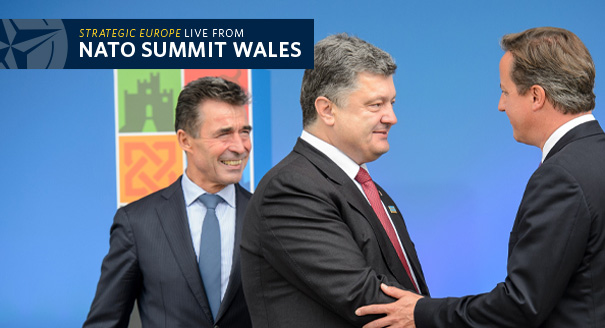
The recurring motif in discussions on the sidelines of the NATO summit taking place on September 4–5 in Wales is this: “But what can NATO do for Ukraine?” The presence of Ukrainian President Petro Poroshenko at the gathering seems to indicate that the Western alliance has somehow made itself Ukraine’s guarantee power.
But this is only true in a largely symbolic sense. In real terms, the West has made it clear from the beginning that it would not extend its security guarantee to Ukraine. Just as no one in the West was willing to go to war over Crimea, no one will go to war over eastern Ukraine. The West has been consistent on this, and a Western military intervention is unthinkable even for those who loathe Russia with every fiber of their being.
On the other hand, this summit clearly delineates where the European peace order ends: at NATO’s eastern border. Ukraine is not part of that territory. Neither is Georgia.
A few months ago, my colleague Ulrich Speck said that it is now clear that the only safe border in Europe is the one guaranteed by NATO’s Article 5 mutual-defense clause. This summit proves that big claim right. The organization goes to great lengths to boost its deterrent power on its eastern flank. But beyond that, it is powerless—and NATO does not aspire to change that.
The tragedy lies in the fact that it could not be any other way, and that the West must still pretend otherwise. Because just as going to war with Russia over Ukraine is unthinkable, leaving a country in the lurch that has risked so much to achieve a Western perspective is unbearable.
So at both the NATO and the EU level, the West claims to be fully on the side of Ukraine when it already knows that it would not be able to sustain that position if push came to shove. In the end, Ukraine is just not important enough. All agree with that assessment. With clenched teeth, I agree with it too. But it leaves a big lump in everyone’s stomach.
In a typically sharp and clear-sighted piece, Edward Lucas has just offered a list of policy suggestions for the West. Lucas, who is a journalist at the Economist, has been one of the most outspoken critics of Russia and an advocate of a very robust Western position vis-à-vis Moscow.
But even his list illustrates that the Western position on the Ukraine issue is empty at the core. If Russian President Vladimir Putin decides to accept the costs bestowed upon him by Western sanctions, the territory east of the Article 5 border is his. Such a course of action would be very expensive for him, but it is eminently possible.
NATO prides itself at this summit that is getting serious on the threat in the East. And it has much to show for its efforts. But the meeting also marks the territorial and political limits of Western power. None of this is really new. And yet this is a clarifying moment.

Director, Europe Team, Eurasia Group
Techau is director with Eurasia Group's Europe team, covering Germany and European security from Berlin. Previously, he was director of Carnegie Europe.
Recent Work

Nathalie Tocci, Jan Techau
Jan Techau
Carnegie does not take institutional positions on public policy issues; the views represented herein are those of the author(s) and do not necessarily reflect the views of Carnegie, its staff, or its trustees.

The aftermath of the Ceuta crisis shows Europe has drawn the wrong lessons. Rather than doubling down on failed migration policies, the EU needs to address the underlying roots of such episodes.

Richard Youngs

Canadian Prime Minister Mark Carney has twice inspired praise for standing up to U.S. President Donald Trump: at the 2026 World Economic Forum in Davos and on Canada-U.S. trade negotiations. Is Carney showing a third way better than the EU has in dealing with the Trump administration?

Rym Momtaz, ed.

The EU’s responses to two recent incidents expose the gulf between European perceptions and capabilities. Unless the union can bridge that gap, it will never become a real geostrategic power.
Rym Momtaz

As we close out another season of Strategic Europe, it is worth taking stock of the deep shifts underway.
Rym Momtaz

The EU had to compromise to adopt a twenty-first sanctions package against Russia, exposing growing cracks in the union’s resolve. Is this latest, weaker round worth it to keep pressure on Moscow?
Rym Momtaz, ed.