

Commentary
Nathalie Tocci, Jan Techau
{
  "authors": [
    "Jan Techau"
  ],
  "type": "commentary",
  "blog": "Strategic Europe",
  "centerAffiliationAll": "",
  "centers": [
    "Carnegie Endowment for International Peace",
    "Carnegie Europe"
  ],
  "collections": [
    "Europe’s Eastern Neighborhood"
  ],
  "englishNewsletterAll": "",
  "nonEnglishNewsletterAll": "",
  "primaryCenter": "Carnegie Europe",
  "programAffiliation": "",
  "programs": [],
  "projects": [],
  "regions": [
    "Europe",
    "Eastern Europe",
    "Ukraine"
  ],
  "topics": [
    "Foreign Policy",
    "EU"
  ]
}
Source: Getty
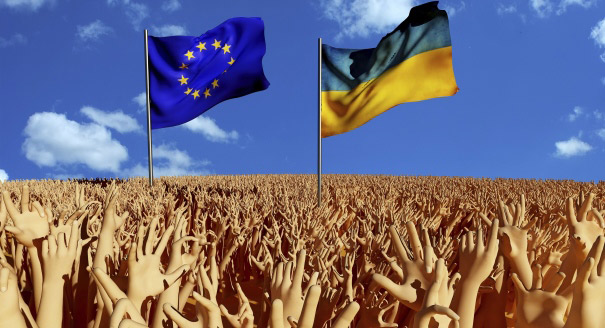
For the first time in its history, the EU has become a regional guarantee power. Yet the union and its member states so far lack the capacity to maintain that role in the long term.
You may believe that the Ukraine crisis was a political earthquake that altered the security landscape in Europe for good. Or you might be convinced that the real changes are marginal and that the distribution of power on the continent is similar to what it used to be.
No matter where you stand on the Ukraine crisis, one momentous shift in European geopolitics is indisputable: the European Union, for the first time in its history, has made itself the de facto guarantee power for another entity’s political success against the declared intentions of a regional rival. The EU’s role in Ukraine vis-à-vis Russia represents a change of fundamental relevance, and yet, in the long term, it looks doomed to fail.
All of these actions were unavoidable and, in all likelihood, the right thing to do.
But now, as immediate crisis management makes way for more long-term considerations, European leaders realize that being a guarantee power requires a lot more than skillfully dealing with breaking news. Going forward, the EU—or, more precisely, the EU’s member states—must step up in a way it has never done before.
Most importantly, the EU needs to formulate a coherent foreign policy goal in Ukraine. Do EU countries simply wish to guarantee Ukraine’s (remaining) territorial integrity and avoid further violence? Does the union want to make sure Poroshenko modernizes the country? Or does the EU have a broader goal of upholding the once universally accepted rules of the post–Cold War order, including Ukraine’s right to pick its alliances?
Whatever the EU’s stated objective turns out to be, it needs to be substantiated by a compelling European interest that goes beyond merely declaring how important democracy and human rights are. Populations and voters across Europe will want to know where their precious tax money is going and what it is worth risking conflict for.
EU countries must then commit to staying in the game in Ukraine for at least another ten years—and most likely much longer. National governments must continue to support that commitment at the highest political level.
Member states should be willing to spend considerable amounts of money on the foreign policy instruments necessary for the EU’s guarantor role, but also to refine those instruments to make them fit for purpose.
And the EU needs to preserve political unity in the face of external pressures: the perpetual countermeasures that will inevitably be taken by Moscow, on the one hand, and the unavoidable relapses, failures, and disappointments that will come out of Ukraine’s murky domestic affairs, on the other.
The chances are that the EU will fail in this endeavor. There is already a sense creeping into the foreign policy crowd that Europeans may have bitten off more than they can chew. Unity among 28 member states is extremely fragile. The remodeling of the European Neighborhood Policy—the instrument that guides EU relations with Ukraine and other Eastern neighbors—will be tedious and fraught with institutional infighting in Brussels. And money is scarce.
More significantly, there are severe doubts that the EU has the political will and the diplomatic toughness to insist on conditionality, the core piece of the neighborhood policy. But without a swift, watertight, and potentially brutal sanctions mechanism for neighbors that do not adhere to an agreed reform process, the transformative power of any new policy will be exactly what it was under the old one: close to zero.
The picture is further complicated by the fact that getting serious about being Ukraine’s guarantor will lead to permanent conflict with Russia. The EU wants Poroshenko to succeed with his reforms. Russia will do everything it can to make him fail. These two opposing approaches cannot be reconciled. Moscow can escalate its intervention in eastern Ukraine at will, including to the level of military action, knowing that the EU will not respond in the same way.
In the absence of a massive and sustained investment by EU member states to address these internal doubts and external threats, the EU’s attempt to be a guarantee power in Ukraine will fail. Until such investment materializes, the process will be an agonizing spectacle for all involved.
The inherent problem is that the EU does not currently have the means to win the contest in which it is engaged with Russia, and yet it needs to compete in that contest. The EU is too weak for idealism—that is, to stand up for its values and principles. And it is already too deeply involved for cold-blooded realism—to accept Russian interests in Moscow’s sphere of influence.
In a dilemma like this, power resources tend to make the difference in the end. So my guess is that the EU will eventually have to give up its role as Ukraine’s guarantor. The union simply won’t be able to sustain its newfound part without the resources to underpin it.
How long it will take for this to happen is very hard to predict. But when that time comes, another turning point will have been reached: the moment when the last illusions about the EU as a peacekeeping power in wider Europe came to an end.

Director, Europe Team, Eurasia Group
Techau is director with Eurasia Group's Europe team, covering Germany and European security from Berlin. Previously, he was director of Carnegie Europe.
Recent Work

Nathalie Tocci, Jan Techau
Jan Techau
Carnegie does not take institutional positions on public policy issues; the views represented herein are those of the author(s) and do not necessarily reflect the views of Carnegie, its staff, or its trustees.

Before the next wave of EU enlargement takes place, the union needs to grapple with thorny questions of how power is distributed among its members.


Emil Sondaj Hansen, Ditte Brasso Sørensen

A summer of escalation in the Black Sea has hurt Ukraine economically and is exacerbating world food security. A truce is needed—as is a broader reframing of Europe’s Ukraine strategy.

Thomas de Waal

Are Germany’s economic, industrial, and political struggles becoming a liability for the EU’s ability to rise to the geopolitical moment?

Rym Momtaz, ed.

European Commission President Ursula von der Leyen is about to give her annual address on the state of the EU. Here’s what she won’t—but should—say.
Rym Momtaz

The aftermath of the Ceuta crisis shows Europe has drawn the wrong lessons. Rather than doubling down on failed migration policies, the EU needs to address the underlying roots of such episodes.

Richard Youngs