

Commentary
The EU can impose sanctions but struggles to enforce them without the United States. With Washington increasingly disinterested in backing European interests, the bloc must now fend for itself.
Nicu Popescu, Tiago Antunes
{
  "authors": [
    "Misha Glenny"
  ],
  "type": "commentary",
  "blog": "Strategic Europe",
  "centerAffiliationAll": "",
  "centers": [
    "Carnegie Endowment for International Peace",
    "Carnegie Europe"
  ],
  "collections": [
    "Europe’s Eastern Neighborhood"
  ],
  "englishNewsletterAll": "",
  "nonEnglishNewsletterAll": "",
  "primaryCenter": "Carnegie Europe",
  "programAffiliation": "",
  "programs": [],
  "projects": [],
  "regions": [
    "Asia",
    "China",
    "Russia"
  ],
  "topics": [
    "Security",
    "Technology",
    "Foreign Policy"
  ]
}
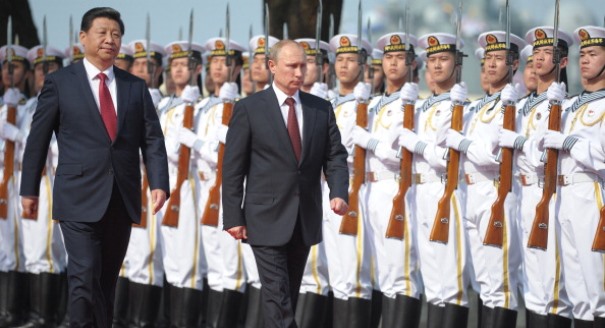
Source: Getty
If the Ukraine crisis continues and relations between Russia and the West deteriorate further, the implications will be grim in a number of areas, including cybersecurity.
The biggest winner to emerge from the nasty and damaging conflict in eastern Ukraine is not even a player in the game. China is sitting quietly and watching where the crisis is taking the more engaged participants. In the process, Beijing has been able to leverage the economic difficulties that Western sanctions have created for Russia by offering Moscow new, if less lucrative, markets for Russian energy products.
Unless the Ukraine conflict is resolved and relations between the West and Russia improve, such Sino-Russian cooperation could become a more permanent feature. That would have severe unexpected consequences.
The Chinese Communist Party leadership has a record of abhorring separatism in most forms because of concerns regarding China’s own Tibetan and Uighur independence movements. From this perspective, Chinese leaders may be expected to frown on the actions of pro-Russian rebels in eastern Ukraine.
Yet to the Beijing leadership, Ukraine’s Euromaidan antigovernment movement, which led to the collapse of Viktor Yanukovych’s presidency in February 2014, must look suspiciously like the Tiananmen Square protests of June 1989—not to mention the dramatic demonstrations that have recently shaken Hong Kong.
For #China, #Euromaidan is more dangerous than the pro-Russian rebels.Tweet This
On balance, the dangers of the pro-European protests trump the concerns raised by the pro-Russian rebels. The original sin, as far as China is concerned, was the collapse of the Soviet Union and the failure of Communist parties there and in Eastern Europe to prevent the uncontrolled shift from a planned to a market economy.
The introduction of capitalism in China has, of course, been much more carefully managed. From that perspective, Russian President Vladimir Putin is very much a man with whom the Chinese can do business, as his public assessment of the 1989–1991 period pretty much squares with Beijing’s.
And Putin needs to do business with the Chinese if the latest horror stories dominating the Western media about a collapsing ruble, dwindling investment, and tumbling oil prices are true.
But Putin is playing the long game. He knows the West faces immense difficulty in formulating a coherent policy with regard to Ukraine. Putin’s Russia is not a pushover like Slobodan Milošević’s Serbia appeared to be in the 1990s. Russia is a well-armed nuclear power, which means that any development resembling a move toward hostilities will have the most profound implications.
Putin also knows that some Eastern Europeans, like the Hungarians and the Serbs, are as attracted to the apparent certainties of Russia (not to mention its energy) almost as much as they are to the benefits conferred by EU membership. Putin further realizes that an influential part of the West’s energy sector is nervous about losing Russia as a partner.
Above all, he appreciates what the West seems not yet to have grasped but will need to at some point: that Ukraine’s economic and political problems are going to be almost impossible to solve without Russian cooperation.
While the West and Russia play chicken over #Ukraine, Putin is deepening relations with China.Tweet This
And so while the West and Russia play a game of chicken over who will buckle first regarding sanctions and the destabilization of eastern Ukraine, Putin is deepening relations with China. The most spectacular example of this was the $400 billion thirty-year deal that Moscow and Beijing signed in May for Russia to supply its southeastern neighbor with natural gas.
Now, Russia and China are talking about enhanced cooperation in cyberspace—the development of a joint set of rules governing the two countries’ approach to cybersecurity, cybercrime, and, of course, what their citizens can and cannot do on the Web. Such a deal is just one of several agreements that the two sides intend to sign when Putin visits Beijing in mid-November.
The deepening cooperation between Moscow and Beijing with regard to the Internet is important. The revelations published by former NSA contractor Edward Snowden inflicted immense damage on the United States. The leaks led many other governments, even ones friendly with Washington, to question the immense influence that U.S. institutions exercise over the technical and political administration of the Internet.
China and Russia are striking out on their own to project a vision of the Internet that is increasingly attractive to fellow BRICS countries and to other emerging economies. There are some indications that India and Brazil, important and growing cyberpowers, prefer the Sino-Russian Web strategy to the U.S. approach.
Steps toward global Web governance are disappearing like footprints in the snow.Tweet This
Until the Ukraine crisis, the United States and Russia had been edging toward a long-term understanding on what Internet governance across borders might look like. The two sides signed a deal on confidence-building measures, and there was some hope that China and Europe may have engaged in further conversations. These talks were critical in attempting to dampen the extraordinary levels of crime and espionage for which the Internet is now responsible.
But such tentative steps toward a global governance of the Internet are now disappearing like footprints making way for a fresh, hard snowfall. If the Ukraine crisis remains unresolved and relations between Russia and the West worsen further, the implications will be grim in several unexpected areas. Among the most damaging effects of this trajectory could be the emergence of a solid Sino-Russian bloc on the Internet.
Misha Glenny
Journalist and Broadcaster
Misha Glenny is a journalist and broadcaster whose books include The Balkans: Nationalism, War and the Great Powers: 1804-2012, McMafia: A Journey through the Global Criminal Underworld, and DarkMarket: How Hackers Became the New Mafia.
Carnegie does not take institutional positions on public policy issues; the views represented herein are those of the author(s) and do not necessarily reflect the views of Carnegie, its staff, or its trustees.

The EU can impose sanctions but struggles to enforce them without the United States. With Washington increasingly disinterested in backing European interests, the bloc must now fend for itself.


Nicu Popescu, Tiago Antunes

Russia is testing the waters of NATO’s mutual defense clause. What do strikes in Romanian territorial waters mean for the alliance’s posture toward Moscow?

Dimitar Bechev

With its public finances in shambles, the far right polling at 35 percent ahead of the 2027 presidential election, and a growing protest movement, is France’s crisis a threat to the EU’s geopolitical awakening?

Rym Momtaz, ed.

Ahead of a tough winter for Ukraine, Donald Trump’s swing back toward Russia bodes ill. But instead of panicking, Kyiv’s European allies are focusing on action.
Rym Momtaz

While the EU and European governments are embracing the much-lauded middle-power moment, this entails three difficult conundrums.

Richard Youngs