

Commentary
Judy Dempsey
{
  "authors": [
    "Judy Dempsey"
  ],
  "type": "commentary",
  "blog": "Strategic Europe",
  "centerAffiliationAll": "",
  "centers": [
    "Carnegie Endowment for International Peace",
    "Carnegie Europe"
  ],
  "collections": [
    "Europe’s Eastern Neighborhood",
    "EU Integration and Enlargement"
  ],
  "englishNewsletterAll": "",
  "nonEnglishNewsletterAll": "",
  "primaryCenter": "Carnegie Europe",
  "programAffiliation": "",
  "programs": [],
  "projects": [],
  "regions": [
    "Europe",
    "Eastern Europe"
  ],
  "topics": [
    "EU",
    "Democracy"
  ]
}
Source: Getty
Every week, a selection of leading experts answer a new question from Judy Dempsey on the foreign and security policy challenges shaping Europe’s role in the world.
Every week, a selection of leading experts answer a new question from Judy Dempsey on the foreign and security policy challenges shaping Europe’s role in the world.
Romania’s November 2014 presidential election showed that Romanians everywhere are ready to break away from the reminiscence of the country’s Communist past and from a democracy kept in abeyance. Romanians voted for stronger connections with the West and the EU, as opposed to China and Russia.
However, as Romania is still at the union’s Eastern border, the country’s external policy is extremely important—especially its relations with Moldova and Ukraine.
All Romanian presidents and presidential candidates have tackled the issue of relations with Moldova in their programs and speeches, recognizing the subject’s political importance.
#Romania is clearly an enabler in the EU enlargement process.Tweet This
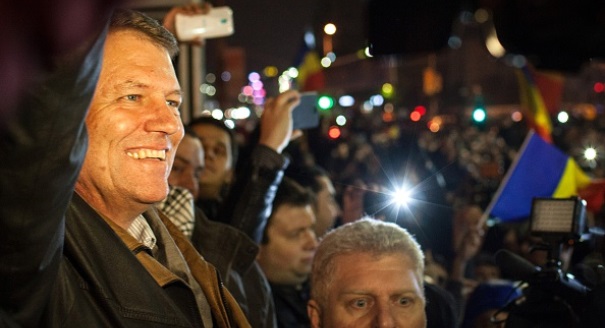
In his presidential program, Romania’s president-elect Klaus Iohannis states that good ties with Moldova are a political imperative and that Moldova’s European route is the priority. Iohannis also mentioned that one of his first visits as president will be to Moldova. Furthermore, the new president stated that Romania’s relations with Ukraine, as well as with Russia, have to be decided together with Bucharest’s international partners in the EU and NATO, not by Romania alone.
Therefore, Romania is clearly an enabler in the EU enlargement process and an important actor in the region. After ten years, the newly elected president has the possibility to rethink Romania’s external affairs in the region. He is seen as a valuable ally of the pro-European movement and capable of strengthening the connections between East and West.
Not really.
Predicting Romania’s future foreign policy at the moment is a bit like gambling. It seems that Klaus Iohannis himself was rather taken by surprise by his own victory in November’s presidential election, as he had never really bothered to elaborate the details of foreign policy matters during the campaign. EU enlargement is a marginal issue in Romania’s domestic debate, anyway.
Predicting #Romania's future foreign policy is a bit like gambling.Tweet This
If Romania is one of the consistent backers of EU enlargement, it is also a passive one. And probably, so it will remain. The sole prospect for change is a possible reopening of discussions in the country’s parliament on the status of Kosovo. Romanian Prime Minister Victor Ponta has many a time voiced the need for such a debate, the major obstacle to which was the steadfast objection of outgoing President Traian Băsescu.
As for Iohannis, one can at most guess his stance on this issue, by considering the earlier policy of his National Liberal Party or his good relations with German Chancellor Angela Merkel. Both factors would indicate he is in favor of recognizing Kosovo’s independence.
It’s a different matter whether a recalibration of Bucharest’s position on Kosovo would trigger a domino effect among the other nonrecognizers and therefore impact on EU enlargement as a whole. Recognition is certainly not the major obstacle on either Kosovo’s or Serbia’s path to the EU.
Of course, the question gains a whole new dimension if Moldova, too, is placed in the enlargement basket (Chişinău intends to file an EU membership application in 2015). No doubt, this would parachute Romania into the frontline of enlargement advocates.
Regardless of where you stand on the results, Romania’s November 2014 presidential election may be a good story for EU enlargement.
The unexpected victory of Klaus Iohannis, the unglamorous, slow-talking ethnic German mayor of Sibiu, revealed the power of civil society. The election witnessed incredible mobilization on- and offline. Partly, this was triggered by the difficulties Romanian voters abroad experienced in casting their ballots, which was attributed to an attempt by the government to tilt the scales in its favor.
#Iohannis changed the narrative that all politicians are corrupt.Tweet This
Iohannis managed to change the narrative that all politicians and parties are the same, meaning corrupt. He succeed despite a campaign rife with populist and even nationalist elements. The combination of a protest vote and legitimate desire for good governance did the rest. Iohannis’s victory therefore amounts to a victory for the liberal democratic principles essential for Europe’s political future.
Romania tends to stick to core EU positions when it comes to EU policymaking. The country is solidly pro-Atlanticist and worried by Russia’s new aggressive policies in Europe’s East. Romania’s presidential election will not change the country’s stance a bit.
On the issue of EU enlargement, Iohannis may be able to play a role that none of his predecessors played. Moldova, Ukraine, and the Western Balkans are bound to become part of his agenda. EU enlargement assumed a limited part in the election campaign, but the topic is significant enough to make it inevitable for the new president’s agenda.
For many years, the EU’s critics pointed fingers at countries like Romania and used these states’ “democratic deficits” as an argument against EU enlargement. Now, there is a chance for a new narrative supported by economic and political governance. Romanian citizens have acted. Romania will need the EU if it is to succeed. European leaders must act in rethinking the EU and should trust in citizens to heed a call against populism.
The newly elected president of Romania embodies its citizens’ demand for a results-based political process that does not reward the networks of the old post-Communist establishment and populist, nationalistic campaigning.
The unsuccessful candidate in the November 2014 presidential election, Prime Minister Victor Ponta, had attempted to portray himself as the “good Romanian,” playing on ethnicity and religion. By contrast, Klaus Iohannis, the president-elect, convinced his compatriots that as four-term mayor of Sibiu he had the track record of a “doer”—someone who can deliver on citizens’ concrete expectations.
#Iohannis's policies may convince others that EU enlargement is worth it.Tweet This
The electoral defeat of the Socialist Ponta recalls a similar situation in neighboring Bulgaria. The Bulgarian Socialist Party led by Sergei Stanishev suffered a big setback in the European Parliament elections in May and then again in Bulgaria’s parliamentary elections in October. Both Ponta and Stanishev failed to convince their publics that under their leaderships, the former Communist parties had distanced themselves from their old networks and their dubious relationships with business. The popularity of local politicians, primarily successful mayors, was a major asset for the Bulgarian Socialists’ rival, the center-right GERB party.
Skepticism in Europe about further EU enlargement in the Western Balkans has been largely based on the negative experience of Romania and Bulgaria in fighting corruption and building institutions that evoke citizens’ trust. The election of Iohannis proves that voters can be persuaded to turn out in high numbers at elections that can produce a reverse trend and concrete deliverables. The new president’s policies may also convince other Europeans that EU enlargement is worth the effort.

Nonresident Senior Fellow, Carnegie Europe
Judy Dempsey is a nonresident senior fellow at Carnegie Europe
Recent Work
Judy Dempsey
Judy Dempsey
Carnegie does not take institutional positions on public policy issues; the views represented herein are those of the author(s) and do not necessarily reflect the views of Carnegie, its staff, or its trustees.

The EU can impose sanctions but struggles to enforce them without the United States. With Washington increasingly disinterested in backing European interests, the bloc must now fend for itself.


Nicu Popescu, Tiago Antunes

Russia is testing the waters of NATO’s mutual defense clause. What do strikes in Romanian territorial waters mean for the alliance’s posture toward Moscow?

Dimitar Bechev

With its public finances in shambles, the far right polling at 35 percent ahead of the 2027 presidential election, and a growing protest movement, is France’s crisis a threat to the EU’s geopolitical awakening?

Rym Momtaz, ed.

Ahead of a tough winter for Ukraine, Donald Trump’s swing back toward Russia bodes ill. But instead of panicking, Kyiv’s European allies are focusing on action.
Rym Momtaz

While the EU and European governments are embracing the much-lauded middle-power moment, this entails three difficult conundrums.

Richard Youngs