

Commentary
Judy Dempsey
{
  "authors": [
    "Judy Dempsey"
  ],
  "type": "commentary",
  "blog": "Strategic Europe",
  "centerAffiliationAll": "",
  "centers": [
    "Carnegie Endowment for International Peace",
    "Carnegie Europe"
  ],
  "collections": [
    "Europe’s Eastern Neighborhood"
  ],
  "englishNewsletterAll": "",
  "nonEnglishNewsletterAll": "",
  "primaryCenter": "Carnegie Europe",
  "programAffiliation": "",
  "programs": [],
  "projects": [],
  "regions": [
    "Europe",
    "Eastern Europe"
  ],
  "topics": [
    "Foreign Policy",
    "Security"
  ]
}
Source: Getty
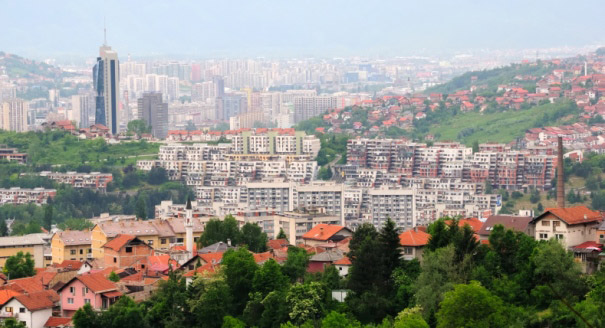
Russia is undermining the EU aspirations of the Western Balkans. German Chancellor Angela Merkel is one of the few European leaders who has pointed that out.
After Angela Merkel delivered a trenchant foreign policy speech at the Lowy Institute for International Policy in Sydney on November 17, the German chancellor took part in a follow-up discussion. Her comments about Russian President Vladimir Putin were not only highly critical of his actions over recent months. Merkel also said she was not convinced that he would stop at Ukraine.
She warned that the EU had to take a tough stance vis-à-vis Russia. “And that doesn’t just apply to Ukraine,” she said. “It applies to Moldova. It applies to Georgia. If the situation continues, we’d have to ask about Serbia. We’d have to ask about the Western Balkan countries.”
Over the past few years, the EU’s policy toward the states of the Western Balkans—Bosnia and Herzegovina, Kosovo, Macedonia, Montenegro, and Serbia—has been one of benign neglect, to say the least.
Behind the scenes, the German Chancellery had played a crucial role in nudging the two sides to the table. For Berlin, this was about bringing long-term stability to the Western Balkans. It was also about bringing the region closer to the EU and, eventually, to EU membership. That is something that Russia is now trying to slow down—if not stop.
Russia has long focused much of its attention on Belgrade, which has traditionally had firm ties with Moscow. Over the past year, Serbia’s President Tomislav Nikolić has forged a close relationship with Putin while trying at the same time to bring Serbia nearer to the EU.
In 2013, during a visit to Putin’s summer residence in Sochi, Nikolić signed a declaration on strategic partnership between Belgrade and Moscow. Later that year, Serbia signed a military cooperation agreement with Russia. And in October 2014, much to Berlin’s chagrin, Serbia rolled out the red carpet for Putin, with Nikolić awarding him the country’s highest order.
These examples are just the tip of the iceberg.
Russia’s state-run Russian Railways, which is headed by Vladimir Yakunin, who is on an EU list of individuals banned from entering any EU country, is upgrading a 350-kilometer (220-mile) stretch of track in Serbia. Gazprom, Russia’s state-owned energy giant, has a majority stake in Serbia’s natural gas supplier. And Lukoil, another giant Russian energy company, holds almost 80 percent of Beopetrol, a Serbian gas-station chain.
The EU's policy toward the Western #Balkans has been one of benign neglect.Tweet This
No wonder Serbia has been reluctant to support EU sanctions on Russia.
Russia is also meddling in neighboring Bosnia and Herzegovina. There, Moscow has long been a staunch supporter of the Republika Srpska, one of the country’s two entities, and of its president, Milorad Dodik. Dodik has repeatedly held up reforms, especially in the judiciary—not that Bosnia’s other leaders have been enthusiastic about introducing long-overdue social, economic, and political reforms.
In fact, a close reading of the European Commission’s latest (and excellent) progress report on Bosnia’s EU membership prospects reveals that the country’s institutions barely function.
Russia’s annexation of Crimea in March 2014 encouraged Dodik to consider seceding from Bosnia. He was apparently stopped from doing so by Aleksandar Vučić, Serbia’s prime minister, who has been trying to balance Belgrade’s ties with Russia, on the one hand, and bringing Serbia closer to the EU, on the other.
Russia has sought to maintain its influence in Montenegro, too, primarily through the energy sector and other big investments. Yet Milo Đukanović, the country’s veteran leader, has defied his critics and Russian pressure by managing to steer Montenegro toward the EU and NATO. He has also openly supported the EU’s sanctions on Russia.
Moscow is focusing increasingly on the Western Balkans because it does not want the region to become part of the West. And even in countries in the broader region that are in the EU, such as Bulgaria, Moscow continues to try to exert its influence through its grip on the energy sector.
#Russia's meddling threatens to undermine the stability of the Western #Balkans.Tweet This
The EU should be worried by Russia’s meddling in its backyard. This meddling threatens to undermine the stability of the region and the fragile security in Bosnia.
Consider what happened on November 11 at the United Nations in New York. Russia abstained from a vote on extending the EU’s military mission in Bosnia, the first time it has done so since the EU was deployed there in 2004. Diplomats said Russia objected to the text, which referred to Bosnia’s prospect of joining the EU.
Just one week before that session, the British and German foreign ministers launched a new initiative for Bosnia with the aim of trying to put the country back on the path of European integration. That path has been held up since 2009 because of a dispute between the EU and the leadership in Bosnia over how certain political posts can only be held by Serbs, Croats, or Bosniaks.
The Anglo-German initiative does not address what Bosnia and the region sorely need: an unambiguous message from Brussels that the Western Balkans matter and that the countries of the region do have a place inside the EU. The fact that the European Commission President Jean-Claude Juncker has put the Western Balkans way down on his agenda shows a shortsighted policy that Russia is all too willing to exploit. Juncker cannot say Merkel hasn’t warned him.

Nonresident Senior Fellow, Carnegie Europe
Dempsey is a nonresident senior fellow at Carnegie Europe
Recent Work
Judy Dempsey
Judy Dempsey
Carnegie does not take institutional positions on public policy issues; the views represented herein are those of the author(s) and do not necessarily reflect the views of Carnegie, its staff, or its trustees.
Europe’s reaction to the war in Iran has been disunited and meek, a far cry from its previously leading role in diplomacy with Tehran. To avoid being condemned to the sidelines while escalation continues, Brussels needs to stand up for international law.

Pierre Vimont
France and Germany’s failure to agree on the Future Combat Air System (FCAS) raises questions about European defense. Amid industrial rivalries and competing strategic cultures, what does the future of European military industrial projects look like?

Rym Momtaz, ed.
France has stopped clinging to notions of being a great power and is embracing the middle power moment. But Emmanuel Macron has his work cut out if he is to secure his country’s global standing before his term in office ends.
Rym Momtaz
Integrating AI into the workplace will increase job insecurity, fundamentally reshaping labor markets. To anticipate and manage this transition, the EU must build public trust, provide training infrastructures, and establish social protections.
Amanda Coakley
Europe’s interests in Syria extend beyond migration management, yet the EU trails behind other players in the country’s post-Assad reconstruction. To boost its influence in Damascus, the union must upgrade its commitment to ensuring regional stability.
Bianka Speidl, Hanga Horváth-Sántha