

Commentary
Nathalie Tocci, Jan Techau
{
  "authors": [
    "Jan Techau"
  ],
  "type": "commentary",
  "blog": "Strategic Europe",
  "centerAffiliationAll": "",
  "centers": [
    "Carnegie Endowment for International Peace",
    "Carnegie Europe"
  ],
  "collections": [
    "Transatlantic Cooperation"
  ],
  "englishNewsletterAll": "",
  "nonEnglishNewsletterAll": "",
  "primaryCenter": "Carnegie Europe",
  "programAffiliation": "",
  "programs": [],
  "projects": [],
  "regions": [
    "Russia",
    "Europe",
    "North America",
    "United States",
    "Western Europe"
  ],
  "topics": [
    "Foreign Policy",
    "EU"
  ]
}
Source: Getty
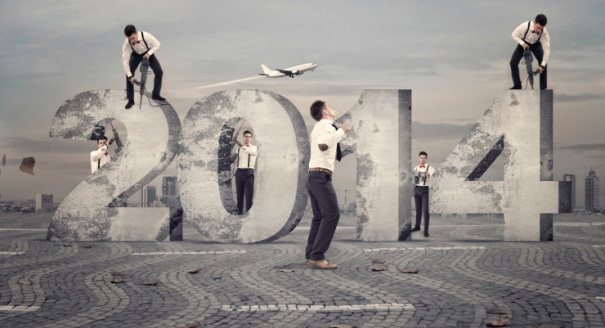
The last twelve months have been unusually eventful. Amid the vicissitudes of 2014, highlights include a resurgent Russia, shrewd Scots, and the EU’s underrated foreign policy.
The year 2014 was arguably one of the worst in international affairs in recent memory. It was not easy keeping track of all the major and minor crises and the unexpected twists and turns of events as they happened. It is even more difficult remembering them all after the fact. But even on a rich canvas such as this one, a few things stand out. So to make sense of it all, here is my foreign policy award list for 2014.
Winner of the Year: Russian President Vladimir Putin, the man who gave growth a new meaning this year by adding territory to the realm he presides over. He is at the height of his power, so he should enjoy the moment while it lasts. Because things are likely going to go downhill from here.
Loser of the Year: the average German. The Germans did not benefit from any meaningful political or economic reform at home this year but had to learn, to their horror, that Chancellor Angela Merkel has developed a real appetite for foreign policy. And she’s good at it, too. This means the cozy days of staying out of it all are over. Finally.Clear-Sightedness of Year: the no vote in the Scottish independence referendum. Caledonians voted to stay inside the United Kingdom, and everybody gave a sigh of relief—only to see the membership of the separatist Scottish National Party increase manifold. Now the race is on between a looming Brexit and falling oil prices: a British departure from the EU could drive the Scots out of the UK, but lower oil revenues might keep them in. Which one will prevail?
Loss of the Year: Ariel Sharon. The former Israeli prime minister had been in a coma for eight years before he died on January 11. Some believe he was a war criminal, others saw him as Israel’s only remaining clear-sighted political heavyweight. In any case, he was the last Israeli prime minister with real guts and the last one with the personal credibility at home to make peace. No wonder the current man in charge looks microscopically small by comparison.
Irony of the Year: that Germany was once again voted the most popular country worldwide in a prominent BBC poll—but was also chosen, in a separate survey, as the country with the lowest sense of humor. Is there anything that follows from that? That great beer and shiny cars are more important than subtle irony? That folks around the world really appreciate people who first don’t get the joke and then don’t realize that’s exactly what makes it so funny? That winning 7:1 against Brazil in football is scary but also way cool? That even when you don’t have a sense of humor, you still want to laugh? Doesn’t matter. The voters have spoken.
#Putin gave growth a new meaning in 2014 by enlarging the realm he presides over.Tweet This
Hamlet of the Year: Barack Obama, the man whose prudence and caution spread insecurity. The U.S. president is a tragic figure. His diplomatic and military cautiousness are warranted and can well be justified in each individual case. And yet a picture emerges of a leader of the free world who does not get it. On Syria, too inconclusive; on the Islamic State, too wobbly; on NATO, too timid; on the Israeli-Palestinian conflict, too restrained; on China, too passive.
Nobody really wants to go back to W. But it seems that Obama does not understand how much depends on America’s firmness, no matter how unpopular that might be both at home and abroad.
Epic Fail of the Year: the collective inability of everyone in the analytical business to foresee the dramatic fall of the oil price. This is already bad enough for economists and geopolitical whiz kids. But it’s catastrophic when your name is Vladimir Putin and your country’s brutal claim to greatness, the well-being of your cronies, and your ability to stay in office ultimately depend on petroleum.
It is breathtaking to realize that one of the most important power factors in world politics—one that is so closely monitored and so thoroughly analyzed around the globe—could change so massively and so quickly without anyone having an inkling. The same goes for the Islamic State, of course. Let’s call international politics a lottery from now on and just go bowling.
Upgrade of the Year: This award goes to the notoriously self-centered Brussels bubble after Politico, a successful U.S. news and gossip outlet, judged the European capital mature enough a market to make a massive journalistic investment in it. Politico Europe will be launched in early 2015, and nobody knows whether it will be profitable. But to be considered a mature market pleasantly surprised the Eurocrowd.
Myth of the Year: the ineffectiveness of Europe’s foreign policy. In a poll of Carnegie scholars in all five global centers, EU foreign policy was deemed the least effective of all major powers’ foreign policies around the world. This largely reflects a consensus in the Washington bubble that the EU is the most useless thing under the sun.
Those in Brussels beg to differ. While EU foreign policy is generally a basket case, in 2014 it was the exact opposite. Not only did the European Neighborhood Policy trigger—unintentionally, of course—the Euromaidan revolution in Ukraine and the fearful overreaction of both Putin and former Ukrainian president Viktor Yanukovych. The EU also reacted swiftly to the ensuing crisis, created a surprisingly robust sanctions regime, put large amounts of money on the table for Ukraine, and managed to maintain unity among 28 member states.
#Merkel has developed an appetite for foreign policy. And she's good at it.Tweet This
The EU even activated German foreign policy leadership, that scarcest of European resources. It was U.S. leadership that was—and is—strikingly absent from the Ukraine/Russia issue. Whether Europe can stay on the ball is another issue. But in 2014, it was on the ball like no other power.
Alzheimer’s of the Year: This one goes to all of us for the immense speed with which we have already forgotten all of the other insane things that happened this year: the Winter Olympics in Sochi, the disappearance of Malaysia Airlines flight 370, the coup in Thailand, the pro-democracy demonstrations in Hong Kong, the shootings in the Canadian parliament, the Ebola outbreak, the 298 fatalities of Malaysia Airlines flight 17 lying in a field in eastern Ukraine, the kidnapping and killing of Mexican students, the murdered rabbis in a synagogue in Jerusalem, the death of Harold Ramis.
More could be said. But there is just not enough room on this blog. Let’s hope 2015 will need less space.
Director, Europe Team, Eurasia Group
Techau is director with Eurasia Group's Europe team, covering Germany and European security from Berlin. Previously, he was director of Carnegie Europe.
Recent Work

Nathalie Tocci, Jan Techau
Jan Techau
Carnegie does not take institutional positions on public policy issues; the views represented herein are those of the author(s) and do not necessarily reflect the views of Carnegie, its staff, or its trustees.

Are Germany’s economic, industrial, and political struggles becoming a liability for the EU’s ability to rise to the geopolitical moment?

Rym Momtaz, ed.

European Commission President Ursula von der Leyen is about to give her annual address on the state of the EU. Here’s what she won’t—but should—say.
Rym Momtaz

The aftermath of the Ceuta crisis shows Europe has drawn the wrong lessons. Rather than doubling down on failed migration policies, the EU needs to address the underlying roots of such episodes.

Richard Youngs

An overwhelming victory by a far-right-wing party in a small state in eastern Germany will have major repercussions for Chancellor Friedrich Merz’s coalition.

Judy Dempsey

Canadian Prime Minister Mark Carney has twice inspired praise for standing up to U.S. President Donald Trump: at the 2026 World Economic Forum in Davos and on Canada-U.S. trade negotiations. Is Carney showing a third way better than the EU has in dealing with the Trump administration?
Rym Momtaz, ed.