

Commentary
Judy Dempsey
{
  "authors": [
    "Judy Dempsey"
  ],
  "type": "commentary",
  "blog": "Strategic Europe",
  "centerAffiliationAll": "",
  "centers": [
    "Carnegie Endowment for International Peace",
    "Carnegie Europe"
  ],
  "collections": [
    "Europe’s Eastern Neighborhood"
  ],
  "englishNewsletterAll": "",
  "nonEnglishNewsletterAll": "",
  "primaryCenter": "Carnegie Europe",
  "programAffiliation": "",
  "programs": [],
  "projects": [],
  "regions": [
    "Europe",
    "Eastern Europe",
    "Moldova"
  ],
  "topics": [
    "Democracy",
    "EU"
  ]
}
Source: Getty
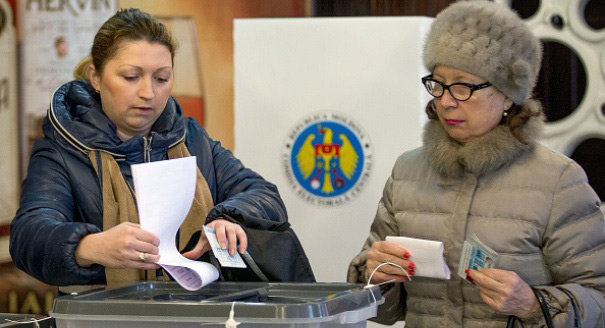
The recent parliamentary election in Moldova has sharpened the competition between the EU and Russia. Moldova’s pro-Western political parties have their work cut out.
Moldova’s pro-European parties appeared to be headed for victory after a parliamentary election on November 30 showed a country torn between moving closer to the EU and improving ties with Russia.
The closely fought campaign, in which the pro-Russian Socialist Party won the most votes, assumed a special significance. The outcome will test the commitment of the EU to this small, corrupt, and poor country that neighbors Romania.
Moldova, like Ukraine and several other Eastern European states, has become part of a geostrategic competition between Brussels and Moscow, with Russia determined not to let the country slip away from its influence.
With 87 percent of the vote counted, the three pro-EU parties—the Liberal Democratic Party, the Democratic Party, and the Liberal Party—together have 44 percent of the vote. The Socialist Party, heavily supported by Russian President Vladimir Putin, who hosted the party’s leaders in Moscow in November and whose picture was on its election campaign posters, won a whopping 21.5 percent.
If the pro-Western parties do manage to form a coalition, as they did after the last election in 2010, they will have to match their rhetoric of reform and combating corruption with serious deeds. That is going to be easier said than done, as the opposition Socialists and Communist are well aware.
As it is, the coalition has a reputation for squabbling, corruption, and often squandering the gains of the past five years.
The lure of the EU-Moldova Association Agreement, which the coalition initialed in November 2013 in Vilnius, Lithuania, just about kept the government in power, even though the Liberals had walked out of the coalition the previous February. Of even greater importance was the EU’s decision in April 2014 to introduce visa-free travel for Moldova’s 3.5 million inhabitants.
#Moldova's coalition has a reputation for squabbling and corruption.Tweet This
In retrospect, the country’s tangible gains, which also included an extensive trade deal with the EU, should have been enough to give the pro-EU parties a comfortable victory. Instead, two main factors have damaged the pro-Western camp.
The first is Moldova’s continuing economic uncertainty. The country has been subjected to an extraordinary degree of blackmail by Russia. Just because Moldova signed the EU Association Agreement, Russia banned imports of Moldovan wines, meat, and vegetables. Russia has also threatened to cut off Moldova’s energy supplies.
In reality, Moldova could survive such embargoes now that certain trade tariffs with the EU have been lifted. The new trade accords with the EU should give reformers the impetus to introduce structural changes in the economy, provided there is sufficient political will to do just that. But reforms would take time to kick in.
The second factor is Russia’s increasing meddling in Moldova. That interference is happening not just in the region of Transnistria, where Russian-backed leaders have for several years been trying to break away from Moldova.
Russia is also meddling in the southeastern region of Gagauzia, which is home to 200,000 Turkic-speaking inhabitants. Analysts suggest that the community has become increasingly pro-Russian as the Kremlin has openly supported its calls for more autonomy, if not independence from Moldova.
The government in Chişinau has reacted to such growing calls by adopting a tough stance against the Gagauz community. Observers warn that this could alienate the minority even further, and that with the support from Moscow, Chişinau could have a major separatist movement on its hands.
Indeed, in a referendum carried out among the Gagauz minority in February 2014, 97.2 percent voted against Moldova’s closer ties with the EU, and 98.4 percent favored Moldova’s integration into the Russian-led Eurasian Customs Union.
#Moldova's future stability is not a foregone conclusion.Tweet This
The leader of the Gagauz region, Mihail Formuzal, who was a major in the Soviet army, has repeatedly opposed Moldova moving closer to the EU. He has claimed such a development would threaten the autonomy of the Gagauz minority.
With a frozen conflict in Transnistria and Russia’s support for the Gagauz, Moldova’s future stability is not a foregone conclusion. This time around, the EU cannot afford to be caught napping—as it was over Ukraine.

Nonresident Senior Fellow, Carnegie Europe
Judy Dempsey is a nonresident senior fellow at Carnegie Europe
Recent Work
Judy Dempsey
Judy Dempsey
Carnegie does not take institutional positions on public policy issues; the views represented herein are those of the author(s) and do not necessarily reflect the views of Carnegie, its staff, or its trustees.
Europe has an interest in supporting Armenian leader Nikol Pashinyan as he tries to make peace with neighbors and loosen ties with Russia. But it is depersonalized support in the long term, not quickfire flash, that will win the day.

Thomas de Waal
Following Ursula von der Leyen’s gaffe equating Turkey to Russia and China, relations with Ankara risk deteriorating even further. Without better, more consistent diplomatic messaging, how can the EU pretend to be a geopolitical power?

Sinan Ülgen
Closer EU-UK ties could help address urgent European concerns. But is the EU ready for rapprochement with the United Kingdom?

Rym Momtaz, ed.
Europe has been standing by while its Southern neighborhood is being redrawn by force. To establish a path to peace between Israel and Lebanon, it’s time for Europeans to get involved with hard power.
Rym Momtaz
In Ukraine, Gaza, and Iran, AI warfare has come to dominate, with barely any oversight or accountability. Europe must lead the charge on the responsible use of new military technologies.

Raluca Csernatoni