

Commentary
Gwendolyn Sasse
{
  "authors": [
    "Gwendolyn Sasse"
  ],
  "type": "commentary",
  "blog": "Strategic Europe",
  "centerAffiliationAll": "",
  "centers": [
    "Carnegie Endowment for International Peace",
    "Carnegie Europe"
  ],
  "collections": [
    "Europe’s Eastern Neighborhood"
  ],
  "englishNewsletterAll": "",
  "nonEnglishNewsletterAll": "",
  "primaryCenter": "Carnegie Europe",
  "programAffiliation": "",
  "programs": [],
  "projects": [],
  "regions": [
    "Europe",
    "Eastern Europe",
    "Ukraine"
  ],
  "topics": [
    "Democracy",
    "Security",
    "EU"
  ]
}
Source: Getty
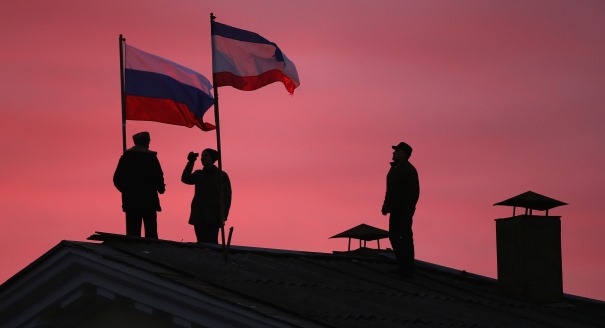
The first anniversary of Crimea’s annexation is an occasion to refocus on Ukraine’s central challenge: the need to implement domestic reforms and limit Russian leverage.
In March 2014, Russia’s annexation of Crimea temporarily topped Western news. It epitomized the end of what many in the West had believed was the agreed international legal framework of the post–Cold War era.
One year later, the issue is all but forgotten. The invasion marked only one step in the dramatic escalation of the crisis in Ukraine that began with the Euromaidan antigovernment protests and led to Crimea’s annexation, war in the eastern Donbas region, and a standoff between the West and Russia. In a bizarre twist of events, the war, which to date has claimed over 6,000 casualties and internally displaced over 1 million people, quickly overshadowed the de facto redrawing of Ukraine’s borders.
On the other hand, not talking about Crimea means that a tacit agreement is taking hold that Russia took back what culturally and historically belonged to it, that Crimeans had been discriminated against and mobilized for becoming part of the Russian Federation, and that Crimea’s status as an autonomous republic within the Ukrainian state was destabilizing.
Such views imply an inevitability about the events of March 2014. Even if realpolitik has sidelined the Crimea issue, observers should at least care enough to remember what actually happened. Crimea had certainly been of symbolic and strategic significance to Russia, and the quick and largely peaceful takeover had clearly been planned meticulously in advance. But an overt Russian intervention required a strong Russia and a political opportunity. The Euromaidan movement and its aftermath provided the trigger to put a rehearsed plan into action.
The regional referendum on the peninsula’s status orchestrated by Russia was a far cry from a free and fair vote. However, it is possible that even under democratic conditions, a narrow majority might have supported integration with the Russian Federation. We will never know.
#Crimea is conspicuous by its near absence in Western public discourse.Tweet This
The best possible scenario for Ukraine and the West in the future is an internationally overseen referendum on Crimea’s status. The biggest push for such a referendum and a potential reversal or modification of the current de facto situation has to come from within Crimea. Higher living standards in the rest of Ukraine, an open Ukrainian society, and the possibility of hassle-free travel to Western countries would be the key incentives for such a move.
In Russia, by contrast, the annexation’s anniversary in March 2015 was celebrated with pomp and circumstance. Festivities included a film on national television featuring President Vladimir Putin boasting about the careful planning of the actions in Crimea.
The target audience for this message was primarily domestic. The official rhetoric around Crimea is closely linked to increased public support for Putin. The Kremlin’s narrative also compensates for the news about war casualties, the effects of Western sanctions on Russia, and the impact of the low oil price on the Russian economy.
One year after the annexation, Crimea is inscribed into the domestic politics of both Russia and Ukraine. In Russia, Crimea serves as a rallying point. A March 2015 poll by Levada, a Russian NGO, showed that the vast majority of Russians see the annexation of Crimea as something positive. Over 50 percent of those surveyed said the move was motivated by the need to protect the Russian population in Crimea, followed by those who saw it as a correction of a historical injustice and an attempt to stabilize the chaotic political situation in Ukraine.
The quest for easier access to Crimea is at least one of several factors fueling the continuation of the war in eastern Ukraine. Russia has asserted its control over Crimea itself through a mixture of militarization, the nationalization of the main companies across different sectors, and repression.
The integration of Crimea into the Russian state continues to be costly for Russia: over the last year, it has cost an estimated $2 billion in subsidies and transfer payments to keep Crimea afloat.
According to the Levada poll, the majority of Russians see the economic consequences of integrating Crimea as positive. Only when asked if they were personally prepared to shoulder the related costs did respondents give somewhat divergent views: a third of those surveyed said that they were not prepared to contribute, compared with about 50 percent willing to contribute somewhat or significantly.
Most Russians see the economic effects of integrating #Crimea as positive.Tweet This
Moscow quickly broke with its early promise to accommodate the indigenous Crimean Tatar population and has established a system of control instead. The most prominent Crimean Tatar leaders have been banned from Crimea, and the main political organization of the Crimean Tatars, the Mejlis, has been declared illegal. People have vanished or have been arrested, and demonstrations and the use of national symbols have been suppressed.
In Ukraine, the Crimean legacy lives on through an estimated 10,000 Crimean Tatars who have left the peninsula and are now primarily living in western Ukraine and Kyiv. Crimea also remains dependent on water and energy supplies that are directed through Ukraine.
The first anniversary of the annexation of Crimea marks an occasion to stamp out flawed interpretations of the events of 2014. Most importantly, it provides a lens onto the central challenge in Ukraine: the need to implement domestic reforms and limit Russian leverage by making the country economically and politically more attractive than its eastern neighbors. In due course, this is also the only way to reverse or modify the current status of Crimea.

Nonresident Senior Fellow, Carnegie Europe
Gwendolyn Sasse is a nonresident senior fellow at Carnegie Europe. Her research focuses on Eastern Europe, with a particular focus on Ukrainian politics and society, EU enlargement, and comparative democratization.
Recent Work
Gwendolyn Sasse
Gwendolyn Sasse

The European Commissioner for Trade is headed to China. But after President Xi’s bridge-building visit to Washington, can a more isolated EU overcome Beijing’s stranglehold on critical raw materials? Who will blink first?

Rym Momtaz, ed.

The domestic impacts of how long it is taking to end the war in Ukraine have pushed the French electorate to the political extremes and compromised the country’s diplomatic capacity.
Rym Momtaz

Before the next wave of EU enlargement takes place, the union needs to grapple with thorny questions of how power is distributed among its members.


Emil Sondaj Hansen, Ditte Brasso Sørensen

A summer of escalation in the Black Sea has hurt Ukraine economically and is exacerbating world food security. A truce is needed—as is a broader reframing of Europe’s Ukraine strategy.

Thomas de Waal

Are Germany’s economic, industrial, and political struggles becoming a liability for the EU’s ability to rise to the geopolitical moment?
Rym Momtaz, ed.