

Commentary
Judy Dempsey
{
  "authors": [
    "Judy Dempsey"
  ],
  "type": "commentary",
  "blog": "Strategic Europe",
  "centerAffiliationAll": "",
  "centers": [
    "Carnegie Endowment for International Peace",
    "Carnegie Europe"
  ],
  "collections": [
    "Europe’s Eastern Neighborhood"
  ],
  "englishNewsletterAll": "",
  "nonEnglishNewsletterAll": "",
  "primaryCenter": "Carnegie Europe",
  "programAffiliation": "",
  "programs": [],
  "projects": [],
  "regions": [
    "Europe",
    "Eastern Europe"
  ],
  "topics": [
    "Security"
  ]
}
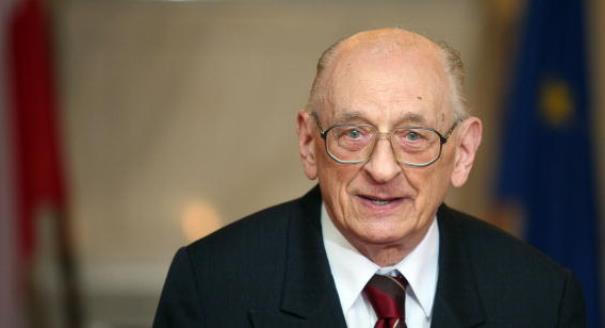
Source: Getty
Wladyslaw Bartoszewski, an indefatigable Polish historian, diplomat, and Auschwitz survivor, died on April 24 after spending his life seeking reconciliation with Germany and Israel.
He was busy up to the day of his death on April 24. As state secretary for international dialogue in Polish Prime Minister Ewa Kopacz’s chancellery and in the previous chancellery, Władysław Bartoszewski was preparing for German-Polish government consultations.
These consultations are probably the crowning achievement of the German-Polish relationship. Led by German Chancellor Angela Merkel, who travels with a team of cabinet ministers to Warsaw on April 27, they are designed to further strengthen a relationship that even Bartoszewski himself would once not have thought possible.
Merkel went along with the appointment of former Polish prime minister Donald Tusk as president of the European Council, which brings together the EU’s 28 heads of state and government. And after forging a very close friendship with Tusk, Merkel has wasted no time in reaching out to Kopacz, his successor.
But the close bonds between Berlin and Warsaw long predate Merkel. They go back to 1965, in the form of a letter written by the then primate of Poland, Cardinal Stefan Wyszyński, and Archbishop Bolesław Kominek: the “Polish Bishops’ Appeal to Their German Colleagues.”
It’s a very special letter, not only because it defied Poland’s ruling Communists, who were fiercely anti-German. It is also significant because the bishops, in Christian tradition, forgave and asked for forgiveness. They appealed for reconciliation, offering forgiveness for the German occupation and asking for forgiveness for forcing millions of Germans out of Poland after 1945.
While the response by the German bishops was cautious, over the years German politicians, notably the former Social Democratic chancellor Willy Brandt, worked hard to improve relations, notwithstanding Communist opposition.
Bartoszewski himself wasn’t free to pursue his real goal of fostering reconciliation between Poland and Germany, and between Poland and Israel, until the Communist regime imploded in 1989. Not that Communism stopped him from calling for dialogue. His past was his guide to the future.
He was brought up in the city of Łódź in a multicultural milieu. His mother, a devout Catholic, encouraged him to defend his Jewish neighbors in the face of anti-Semitism. As a teenager, he joined the Polish resistance against the Nazis and helped persecuted Jews. In late 1940, following a German police raid against Polish intellectuals, he was sent to the Auschwitz concentration camp, from where he was released in 1941.
The postwar years brought little respite. The Communists imprisoned Bartoszewski for seven years until 1955, when he was rehabilitated. He later taught at the Catholic University of Lublin and, at the first opportunity, joined the Solidarity trade union movement, which was founded in 1980. During the imposition of martial law in December 1981, Bartoszewski was imprisoned.
Once Poland emerged from Communism, Bartoszewski, a fluent German speaker, went into overdrive. He was appointed ambassador to Austria and in 1995 and between 2000 and 2001, served as Poland’s foreign minister. Not that diplomatic niceties were his guide.
In 1995, he had been invited to give a speech to the German Bundestag to mark the fiftieth anniversary of the outbreak of World War Two. Bartoszewski spoke with passion and sorrow about the Holocaust and the crimes committed by the Germans against the Poles but also about the forced resettlement and expulsion of the Germans from Poland. The speech won him praise in Germany but also some criticism back home.
Yet Bartoszewski was staunchly opposed to the Center Against Expulsions, a planned German documentation center in Berlin for expulsions and ethnic cleansing. He also had little time for Erika Steinbach, president of the Federation of Expellees, the German nonprofit organization that initiated the project. Steinbach had long fought, in vain, to set up the center.
Looking back over the growing German-Polish rapprochement, Bartoszewski remarked: “If someone had told me in 1941, while I was standing on the parade ground in Auschwitz, that I would have German friends one day, I would have called him mad.”
Coincidentally, as Germany celebrates sixty years of diplomatic relations with Israel, during that time Bartoszewski was instrumental in paving the way for reconciliation between Poland and Israel.
During World War Two, while serving in the Polish Home Army, Bartoszewski co-founded Żegota, the Council to Aid Jews. “Someone should do it? Someone should react? Someone should oppose? Someone should protest? I asked myself these questions and I found the answer. If someone, then why not me?” he said in an interview.
As a member of Żegota, he rescued Jews living in the Warsaw ghetto from being sent to the death camps and, over the years, worked for the welfare of a dwindling community.
On April 19, just a few days before his death, Bartoszewski attended a ceremony to mark the seventy-second anniversary of the beginning of the Warsaw Ghetto Uprising. “I remember those terrible days of uncertainty. Those attempts to give these people a hand. My help could mainly consist in facilitating escape from the ghetto while there were young people who wanted to fight, not escape,” he said in an interview.
When his death was announced on April 24, the tributes began to flow in. But it was perhaps one of Bartoszewski’s most memorable quotations that was repeated throughout that evening: “It’s worth being honest, although it doesn’t always pay off. It pays off to be dishonest, but it isn’t worth it.”

Nonresident Senior Fellow, Carnegie Europe
Judy Dempsey is a nonresident senior fellow at Carnegie Europe
Recent Work
Judy Dempsey
Judy Dempsey
Carnegie does not take institutional positions on public policy issues; the views represented herein are those of the author(s) and do not necessarily reflect the views of Carnegie, its staff, or its trustees.

The EU can impose sanctions but struggles to enforce them without the United States. With Washington increasingly disinterested in backing European interests, the bloc must now fend for itself.


Nicu Popescu, Tiago Antunes

Russia is testing the waters of NATO’s mutual defense clause. What do strikes in Romanian territorial waters mean for the alliance’s posture toward Moscow?

Dimitar Bechev

With its public finances in shambles, the far right polling at 35 percent ahead of the 2027 presidential election, and a growing protest movement, is France’s crisis a threat to the EU’s geopolitical awakening?

Rym Momtaz, ed.

Ahead of a tough winter for Ukraine, Donald Trump’s swing back toward Russia bodes ill. But instead of panicking, Kyiv’s European allies are focusing on action.
Rym Momtaz

While the EU and European governments are embracing the much-lauded middle-power moment, this entails three difficult conundrums.

Richard Youngs