

Commentary
Judy Dempsey
{
  "authors": [
    "Judy Dempsey"
  ],
  "type": "commentary",
  "blog": "Strategic Europe",
  "centerAffiliationAll": "",
  "centers": [
    "Carnegie Endowment for International Peace",
    "Carnegie Europe"
  ],
  "collections": [],
  "englishNewsletterAll": "",
  "nonEnglishNewsletterAll": "",
  "primaryCenter": "Carnegie Europe",
  "programAffiliation": "",
  "programs": [],
  "projects": [],
  "regions": [
    "Europe",
    "Eastern Europe"
  ],
  "topics": [
    "Democracy",
    "EU",
    "Security"
  ]
}
Source: Getty
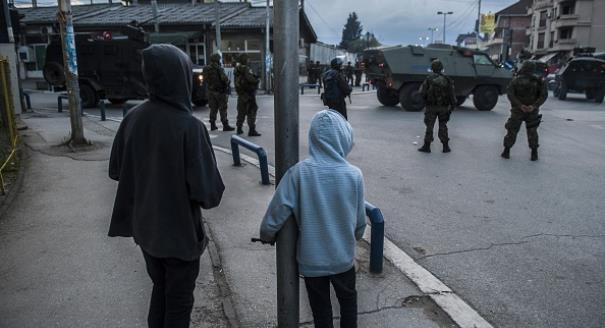
Gun battles in northern Macedonia have exposed the fragility of this Western Balkan country and the urgency for the EU and NATO to give it a membership perspective.
The killing of eight policemen and fourteen gunmen on May 9 and 10 in Kumanovo, northern Macedonia, has jolted the Western Balkans, which is trying to overcome the legacy of the civil wars that engulfed the region during the 1990s.
Ethnic Albanians from Kosovo allegedly carried out the shootings during gun battles in the ethnically mixed town, rekindling fears that ethnic tensions could exacerbate Macedonia’s already strained politics.
A spokesperson for the Macedonian police said the country’s authorities had neutralized “one of the most dangerous terrorist groups in the Balkans, whose founders are former NLA members.”
Nikola Gruevski, Macedonia’s prime minister, said the armed gunmen were intent on destabilizing the country. Some, he added, “are participants in several conflicts, some in the Middle East, which points out to their big experience in guerrilla fighting.”
Whatever the background to the killings and those who carried them out, the incident has not only exposed the fragility of Macedonia. It has also confirmed—as if confirmation were needed—that the European Union and NATO still have much unfinished business in the Western Balkans.
Jens Stoltenberg, NATO’s secretary general, and Johannes Hahn, the EU’s commissioner for enlargement negotiations, condemned the violence and called for a transparent investigation to establish what had happened.
Stoltenberg knew what was at stake: the spread of instability. “I urge everyone to exercise restraint and avoid any further escalation, in the interest of the country and the whole region,” he said. In 2001, NATO played a key role in preventing Macedonia from sliding into civil war by sending in 3,500 troops to shore up the country’s stability and security.
Macedonia is waiting to join NATO and is an EU candidate country. But its path to becoming a member of both organizations has been consistently blocked by Greece.
At issue for Athens is Macedonia’s name, which is officially the former Yugoslav Republic of Macedonia, or FYROM. The government in Skopje wants to call its country simply Macedonia. But Greece has argued that use of the name Macedonia implies territorial ambitions over a northern Greek province that bears the same name.
Gjorge Ivanov, Macedonia’s president, called on the EU and NATO to find a solution to unblock the country’s Euro-Atlantic path because “this situation is risky for the country and the region.”
Macedonia’s uncertain future has inevitably led to immense frustration among the country’s younger generation as well as among the political elites. This lack of perspective has also slowed economic and political reforms. In short, Macedonia is not in good shape.
The shootings coincide with growing opposition to Gruevski’s style of governing. For months, he has been embroiled in a wire-tapping scandal.
The opposition, led by the Social Democrats, has accused the government of the illegal surveillance of over 20,000 people, including prosecutors, judges, journalists, mayors, and ministers. Opposition leaders also claim that the government has run roughshod over human rights and press freedom.
The opposition has become so critical of Gruevski and his determination to remain in power that Zoran Zaev, the leader of the Social Democrats, questioned whether Gruevski orchestrated the ethnic unrest to distract the public from Macedonia’s growing economic and political crisis. If there was any grain of truth in that, then it would surely be a highly dangerous strategy and one that could easily backfire.
Students, too, are challenging the government. They have demonstrated against changes to how university examinations are conducted. On May 5, several student activists were detained.
While leaders from Albania and Kosovo condemned the recent violence, the Russian foreign ministry rushed to the defense of the Macedonian government. It also accused “Western-inspired” nongovernmental organizations of attempting to destabilize the country, according to Balkan Insight, a news publication.
“The eruption of anti-government activities in Macedonia over the last days is worrying,” the Russian foreign ministry stated. “The choice of many opposition movements and NGOs, inspired by the West, that favor the logic of the street and the known scenario of a ‘colored revolution,’ is full of dangerous consequences,” the ministry said, clearly referring to events in Ukraine after that country’s 2004–2005 Orange Revolution.
Russia’s accusations verge on paranoia. In fact, had the EU adopted a more hands-on policy vis-à-vis Macedonia, the country’s political climate might not have deteriorated as rapidly as it has done over the past few years.

Nonresident Senior Fellow, Carnegie Europe
Judy Dempsey is a nonresident senior fellow at Carnegie Europe
Recent Work
Judy Dempsey
Judy Dempsey
Carnegie does not take institutional positions on public policy issues; the views represented herein are those of the author(s) and do not necessarily reflect the views of Carnegie, its staff, or its trustees.

A summer of escalation in the Black Sea has hurt Ukraine economically and is exacerbating world food security. A truce is needed—as is a broader reframing of Europe’s Ukraine strategy.

Thomas de Waal

Are Germany’s economic, industrial, and political struggles becoming a liability for the EU’s ability to rise to the geopolitical moment?

Rym Momtaz, ed.

European Commission President Ursula von der Leyen is about to give her annual address on the state of the EU. Here’s what she won’t—but should—say.
Rym Momtaz

The aftermath of the Ceuta crisis shows Europe has drawn the wrong lessons. Rather than doubling down on failed migration policies, the EU needs to address the underlying roots of such episodes.

Richard Youngs

An overwhelming victory by a far-right-wing party in a small state in eastern Germany will have major repercussions for Chancellor Friedrich Merz’s coalition.
Judy Dempsey