

Commentary
Nathalie Tocci, Jan Techau
{
  "authors": [
    "Jan Techau"
  ],
  "type": "commentary",
  "blog": "Strategic Europe",
  "centerAffiliationAll": "",
  "centers": [
    "Carnegie Endowment for International Peace",
    "Carnegie Europe"
  ],
  "collections": [
    "EU Integration and Enlargement"
  ],
  "englishNewsletterAll": "",
  "nonEnglishNewsletterAll": "",
  "primaryCenter": "Carnegie Europe",
  "programAffiliation": "",
  "programs": [],
  "projects": [],
  "regions": [
    "Europe",
    "Western Europe",
    "Southern, Eastern, and Western Africa"
  ],
  "topics": [
    "EU",
    "Migration"
  ]
}
Source: Getty
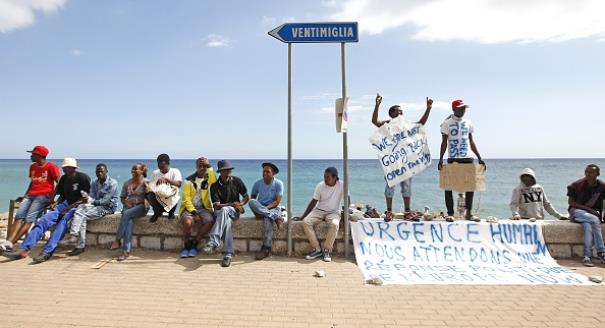
The Mediterranean refugee crisis is just a part of a comprehensive public policy failure by the EU and its member states in the field of migration.
Despite the many potentially existential crises in and around Europe—the war in Ukraine, Brexit, Grexit, and the eurozone crisis—there is relative calm on the political front in the European Union these days. Or so one would think. Because there is actually one issue that has led to the equivalent of a nervous breakdown in EU politics. It is a crisis that should, by all reasonable standards, be relatively easy to resolve. It is the refugee crisis in the Mediterranean.
Compared with the migratory flows generated by the Yugoslav Wars in the 1990s, the number of refugees crossing the Mediterranean today is relatively small. The money needed to provide shelter and basic living standards for them is peanuts in comparison with overall spending on social causes, humanitarian assistance, and development aid in Europe.
The European Union is attracting migrants, both legal and illegal, in large numbers. But in dealing with them, EU nations have dramatically underperformed for at least a generation, if not longer. The result is a policy field left to happenstance, dominated by improvisation, and prone to hijackings by political populists.
To understand the scope of this failure, look at how many policy fields are affected by the crisis, and how complete the political negligence is in most of them.
Let’s start with demographics. The migration crisis is the failure to attract the kind of immigrants that Europe’s aging societies want and need. But it is also the failure to secure the union’s borders against organized crime and human trafficking. It is the failure to grant humanitarian generosity to those fleeing persecution and war. And it is the failure to be strict with those who do not qualify for asylum in Europe. Furthermore, it is the failure to organize fair burden sharing among EU member states in terms of who should take care of incoming migrants. And it is, of course, the failure of a foreign and development policy that was designed to combat migratory pressure at its roots in Africa, the Middle East, and Asia.
On the domestic side, the crisis is the failure to prepare host societies for the impact that large-scale migration will have on identity and social cohesion. Perhaps most importantly, it is the failure to integrate those who stay into Europe’s majority societies. It is, in short, the failure to conceive and implement a comprehensive immigration policy for Europe.
In dealing with #migrants, EU nations have dramatically underperformed.Tweet This
It is the compounding of all of these aspects that makes the Mediterranean refugee crisis so much bigger than it would nominally have to be—and so much more complex to resolve. This is also the reason why the crisis goes to the core of the European project: it has proved that at the crossroads of foreign and identity politics, European commonalities end very quickly. It is much easier to do nothing, or to halfheartedly fight the symptoms, than to act together as Europeans.
As a consequence, events have taken over, with dramatic images of dying boat people in the Mediterranean creating an emotionally and morally charged political atmosphere. That makes a sober, facts-based, long-term response to the issue almost impossible.
The effect on domestic debates around Europe is profound. Majority societies in Europe—politically vulnerable after years of economic crisis, unaddressed identity issues, fear of globalization, and weak political leaderships—have become susceptible to the temptations of populist, xenophobic, even racist politics.
Politicians with simple solutions to complex immigration problems have thrived in traditionally welcoming and open-minded societies such as France, Sweden, Finland, Belgium, the Netherlands, Spain, and the United Kingdom. Populism has also infected Germany, albeit less intensely (so far) than elsewhere, and parts of Central Europe, such as Hungary. Fringe parties have gained political ground, and in many places, they drive the political agenda in a way that forces traditional center-left and center-right parties to pander to their messages.
The Mediterranean refugees have become the symbol of a failed EU immigration policy. And immigration policy could soon become the symbol of failed European integration where it is most direly needed. So the traumatized and exhausted faces of those who make it to the shores of Italy or Spain or Greece are a constant reminder to politicians of their decades-old failure to deliver in a crucial policy field that really matters to Europeans and that affects many thousands of non-Europeans.
It is time for Europeans to approach immigration in a cool-headed, determined way.Tweet This
Alongside the big structural economic reforms the continent needs, and a foreign policy revolution that would enable Europe to better play its role as a relevant power in the age of globalization, immigration could well be the most daunting reform task that lies ahead for European elites. Few policy fields are as complicated to manage, but few promise to yield as rich a reward for all of the EU.
It is about time for Europeans to calm down from their nervous breakdown and to approach the issue in a cool-headed, determined way. The future of the EU is at stake. And so are the lives of many thousands of people following the lure of that paradise called Europe.

Director, Europe Team, Eurasia Group
Techau is director with Eurasia Group's Europe team, covering Germany and European security from Berlin. Previously, he was director of Carnegie Europe.
Recent Work

Nathalie Tocci, Jan Techau
Jan Techau
Carnegie does not take institutional positions on public policy issues; the views represented herein are those of the author(s) and do not necessarily reflect the views of Carnegie, its staff, or its trustees.
The far right failed to win big in France’s municipal elections. But that’s not good news for the country’s left wing, which remained disunited while the broader right consolidated its momentum ahead of the 2027 presidential race.

Catherine Fieschi
Donald Trump has demanded that European allies send ships to the Strait of Hormuz while his war of choice in Iran rages on. He has constantly berated NATO while the alliance’s secretary-general has emphatically supported him.

Rym Momtaz, ed.
The EU is structurally incapable of reacting to today’s foreign policy crises. The union must fold the EEAS into the European Commission and create a security council better prepared to take action on the global stage.

Stefan Lehne
The war in Ukraine is costing Russia its leverage overseas. Across the South Caucasus and Middle East, this presents an opportunity for Europe to pick up the pieces and claim its own sphere of influence.


William Dixon, Maksym Beznosiuk
The war in Iran proves the United States is now a destabilizing actor for Europe and the Arab Gulf. From protect their economies and energy supplies to safeguarding their territorial integrity, both regions have much to gain from forming a new kind of partnership together.
Rym Momtaz